Whistleblower alleges rushed software testing at Wisk Aero
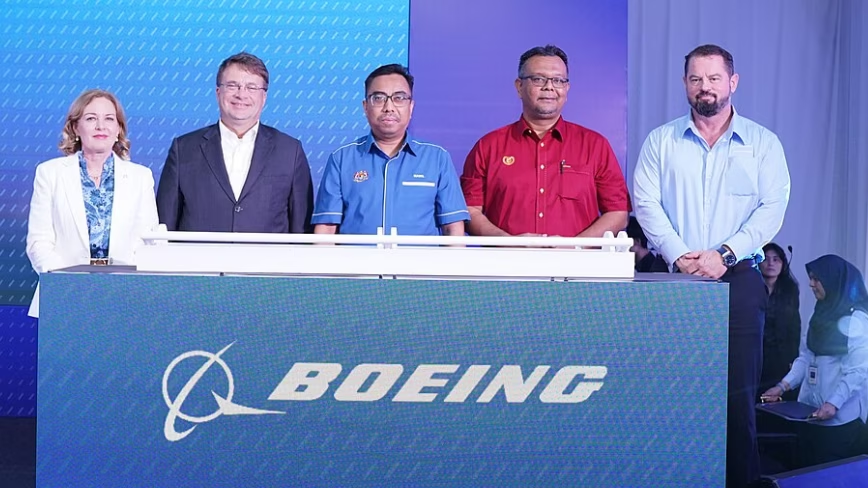
💡A high-stakes look at safety culture and software testing risks in autonomous aviation development.
⚡ 30-Second TL;DR
What Changed
Former Wisk Aero manager Briahna O’Neill filed a lawsuit for wrongful termination and discrimination.
Why It Matters
This lawsuit could lead to increased regulatory scrutiny of autonomous flight software development processes. It serves as a warning for AI safety teams regarding the risks of prioritizing speed over rigorous validation.
What To Do Next
Review your team's software testing protocols to ensure that safety-critical autonomous systems have documented, non-negotiable validation gates.
Key Points
- •Former Wisk Aero manager Briahna O’Neill filed a lawsuit for wrongful termination and discrimination.
- •The complaint alleges that internal safety concerns regarding reduced software testing were ignored.
- •Wisk Aero is Boeing’s primary subsidiary focused on autonomous air taxi technology.
🧠 Deep Insight
AI-generated analysis for this event — not the original article.
🔑 Enhanced Key Takeaways
- •The lawsuit, filed in California Superior Court, specifically alleges that Wisk Aero prioritized aggressive certification timelines over the rigorous validation of flight control software.
- •Briahna O'Neill claims she was subjected to a hostile work environment and retaliatory actions after documenting 'critical' software bugs that could potentially impact flight safety.
- •Wisk Aero's autonomous air taxi, the Generation 6 (Gen 6), is the primary focus of the testing concerns, as the company aims for FAA type certification.
- •The complaint alleges that Boeing's influence over Wisk Aero's internal processes contributed to a shift in corporate culture that marginalized safety engineers in favor of meeting development milestones.
- •Wisk Aero has publicly denied the allegations, stating that their safety protocols meet or exceed industry standards and that the termination was based on performance issues unrelated to the whistleblower claims.
📊 Competitor Analysis▸ Show
| Feature | Wisk Aero (Gen 6) | Joby Aviation (S4) | Archer Aviation (Midnight) |
|---|---|---|---|
| Autonomy Level | Fully Autonomous | Piloted (Transitioning to Auto) | Piloted (Transitioning to Auto) |
| Certification Status | In Progress (FAA) | In Progress (FAA) | In Progress (FAA) |
| Primary Backer | Boeing | Toyota / Delta Air Lines | Stellantis / United Airlines |
| Safety Approach | Multi-layered redundancy | Piloted redundancy | Piloted redundancy |
🛠️ Technical Deep Dive
- The Wisk Gen 6 utilizes a proprietary autonomous flight stack designed for 'detect and avoid' capabilities in urban environments.
- Flight control software architecture relies on a triple-redundant fly-by-wire system to mitigate single-point failures.
- The vehicle employs a distributed electric propulsion system with 12 independent lift fans and one pusher propeller for cruise flight.
- Software testing protocols typically involve Hardware-in-the-Loop (HITL) simulation to validate flight control laws before physical flight testing.
🔮 Future ImplicationsAI analysis grounded in cited sources
⏳ Timeline
Weekly AI Recap
Read this week's curated digest of top AI events →
👉Related Updates

AI-curated news aggregator. All content rights belong to original publishers.
Original source: The Next Web (TNW) ↗
This is a summary, not the original. Read the source, or get the weekly briefing.
Weekly AI briefing
One email a week. Unsubscribe anytime.