WeChat Tests AI-Written Moments
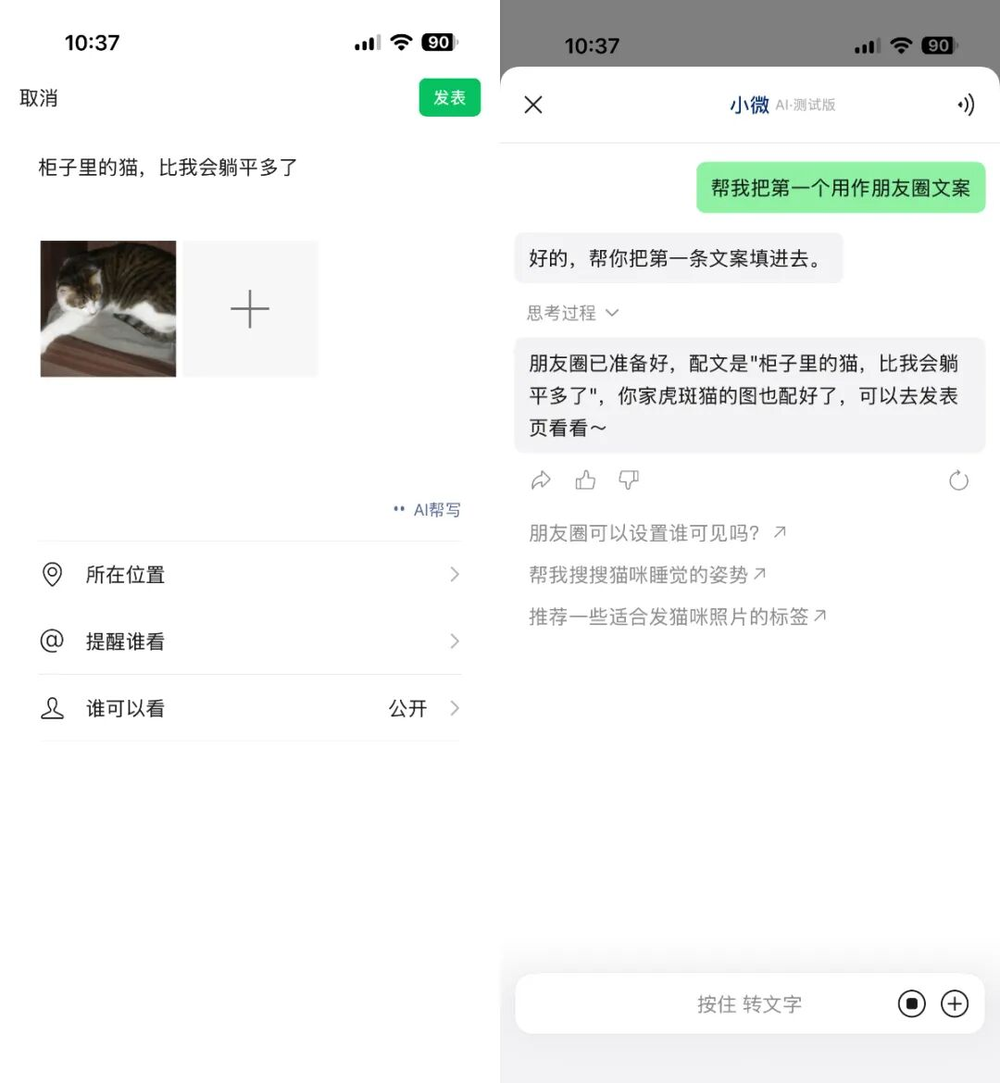
WeChat’s AI writing test and LinkedIn’s rollback reveal how quickly generative content can damage platform authenticity.
30-Second TL;DR
What Changed
WeChat is testing AI assistance for Moments, a feature intended to reduce the barrier to posting text-only updates.
Why It Matters
The feature highlights a platform tension: AI can improve expression, but widespread automation may erode authenticity and reduce trust in social content. AI product teams should treat provenance, user intent, and quality ranking as core design problems rather than afterthoughts.
What To Do Next
When building AI social-writing features, add an edit-first workflow, generation provenance labels, and a user-controlled opt-out before testing engagement-based ranking.
Key Points
- •WeChat is testing AI assistance for Moments, a feature intended to reduce the barrier to posting text-only updates.
- •LinkedIn removed its 'Rewrite with AI' feature and is testing a 'Seems like AI slop' reporting button.
- •A Pangram study of about one million posts found that 41% of LinkedIn long-form posts and 30% of short posts were fully AI-generated.
- •The article argues that AI makes formerly useful quality signals—length, structure, and professional wording—less reliable.
Deep Insight
AI-generated analysis for this event — not the original article.
Enhanced Key Takeaways
- •WeChat's AI integration is part of a broader 'Tencent Hunyuan' large language model deployment strategy, which aims to embed generative AI across its entire social and enterprise ecosystem.
- •The feature utilizes a 'style-transfer' mechanism that analyzes a user's historical posting patterns to ensure the AI-generated text mimics their personal tone rather than sounding generic.
- •Tencent has implemented strict safety guardrails for this feature, including mandatory watermarking of AI-assisted content to comply with China's 'Interim Measures for the Management of Generative AI Services'.
- •Unlike LinkedIn's open-feed model, WeChat's Moments are restricted to mutual contacts, which Tencent believes will mitigate the 'AI slop' phenomenon by maintaining social accountability.
- •Internal data from Tencent suggests that the primary goal of this feature is to increase the 'active posting rate' among users who experience social anxiety or 'writer's block' when sharing updates.
Competitor Analysis
- WeChat (Moments AI)
- Social engagement/Ease of use
- LinkedIn (AI Rewrite)
- Professional branding
- Meta (AI Studio)
- Creator monetization/Engagement
- WeChat (Moments AI)
- Personal/Casual
- LinkedIn (AI Rewrite)
- Professional/B2B
- Meta (AI Studio)
- Public/Creator-focused
- WeChat (Moments AI)
- Gray-testing
- LinkedIn (AI Rewrite)
- Withdrawn/Re-evaluating
- Meta (AI Studio)
- Active/Deployed
- WeChat (Moments AI)
- Mandatory watermarking
- LinkedIn (AI Rewrite)
- Reporting/Flagging
- Meta (AI Studio)
- Content labeling
| Feature | WeChat (Moments AI) | LinkedIn (AI Rewrite) | Meta (AI Studio) |
|---|---|---|---|
| Primary Goal | Social engagement/Ease of use | Professional branding | Creator monetization/Engagement |
| Content Type | Personal/Casual | Professional/B2B | Public/Creator-focused |
| Status | Gray-testing | Withdrawn/Re-evaluating | Active/Deployed |
| Safety Mechanism | Mandatory watermarking | Reporting/Flagging | Content labeling |
Future ImplicationsAI analysis grounded in cited sources
Timeline
- 2023-09Tencent officially releases the Hunyuan large language model for public testing.
- 2024-05WeChat begins integrating Hunyuan-powered AI features into its enterprise suite, WeChat Work.
- 2025-11Tencent updates its AI service guidelines to align with stricter national regulations on generative AI watermarking.
- 2026-07WeChat initiates gray-scale testing of AI-assisted writing for the Moments feed.
Weekly AI Recap
Read this week's curated digest of top AI events →
AI-curated news aggregator. All content rights belong to original publishers.
Original source: 虎嗅 ↗
This is a summary, not the original. Read the source, or get the weekly briefing.
The weekly digest
One email a week. Unsubscribe anytime.