WeChat Begins Testing 'Xiaowei' Native AI Assistant
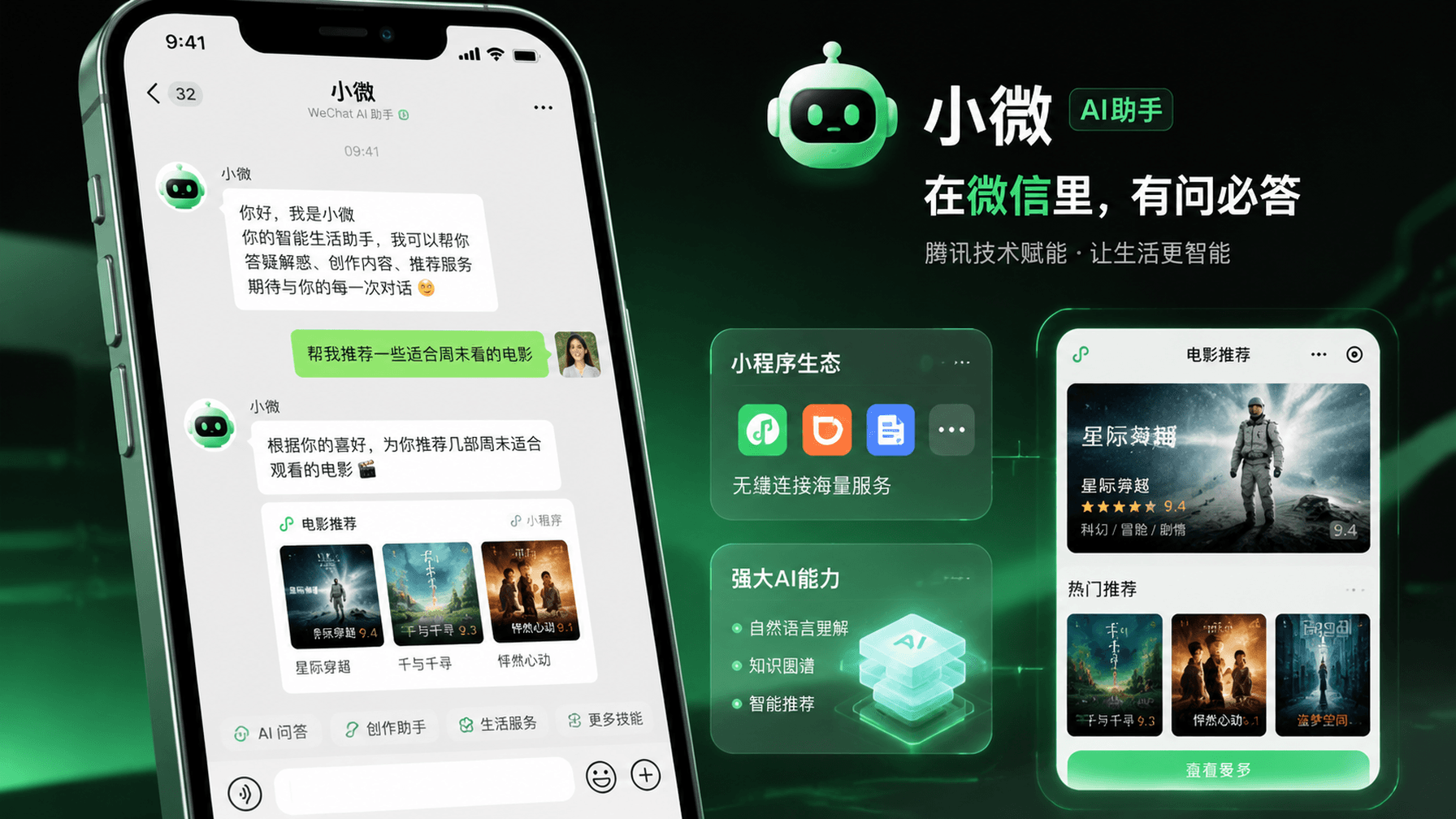
Tencent is integrating native AI into the world's largest super-app; watch how this shifts mobile UX paradigms.
30-Second TL;DR
What Changed
Xiaowei is being deployed as a native AI assistant within the WeChat ecosystem.
Why It Matters
This integration could fundamentally change how 1.4 billion users interact with mobile apps, potentially setting a new standard for AI-first super-apps. It forces competitors to accelerate their own native AI assistant integrations.
What To Do Next
Monitor the WeChat Open Platform documentation for new API endpoints related to Xiaowei to see how third-party services can integrate with this new AI layer.
Key Points
- •Xiaowei is being deployed as a native AI assistant within the WeChat ecosystem.
- •The rollout targets a massive user base of 1.4 billion active users.
- •The integration signifies Tencent's push to embed generative AI directly into daily social and utility workflows.
Deep Insight
AI-generated analysis for this event — not the original article.
Enhanced Key Takeaways
- •Xiaowei leverages Tencent's proprietary 'Hunyuan' large language model, which has been undergoing iterative training on Chinese-language datasets to optimize for local cultural nuances and regulatory compliance.
- •The assistant is designed to interface with WeChat's 'Mini Programs' ecosystem, allowing users to trigger third-party services—such as booking rides or ordering food—via natural language commands.
- •Tencent is utilizing a multimodal architecture for Xiaowei, enabling the assistant to process and generate not just text, but also images and voice responses within the chat interface.
- •The deployment includes a new 'AI-first' privacy framework that allows users to toggle local-only processing for sensitive data, addressing concerns regarding data sovereignty and cloud-based AI training.
- •Xiaowei is being positioned as a direct competitor to standalone AI apps by focusing on 'context-aware' assistance, where the AI can reference previous chat history to provide personalized recommendations.
Competitor Analysis
- WeChat Xiaowei
- WeChat (Super App)
- ByteDance Doubao
- Standalone App
- Baidu Ernie Bot
- Standalone/Search
- WeChat Xiaowei
- Deep (Mini Programs)
- ByteDance Doubao
- Moderate
- Baidu Ernie Bot
- High (Search/Cloud)
- WeChat Xiaowei
- Hunyuan
- ByteDance Doubao
- Doubao LLM
- Baidu Ernie Bot
- Ernie 4.0
- WeChat Xiaowei
- Freemium
- ByteDance Doubao
- Freemium
- Baidu Ernie Bot
- Freemium
| Feature | WeChat Xiaowei | ByteDance Doubao | Baidu Ernie Bot |
|---|---|---|---|
| Primary Platform | WeChat (Super App) | Standalone App | Standalone/Search |
| Ecosystem Integration | Deep (Mini Programs) | Moderate | High (Search/Cloud) |
| Core Model | Hunyuan | Doubao LLM | Ernie 4.0 |
| Pricing | Freemium | Freemium | Freemium |
Technical Deep Dive
- Architecture: Built on the Hunyuan foundation model utilizing a Mixture-of-Experts (MoE) approach to balance inference speed and task complexity.
- Integration Layer: Uses a proprietary API bridge to connect the LLM with WeChat's internal Mini Program framework, enabling function calling for external services.
- Multimodal Capabilities: Employs a unified encoder-decoder structure capable of handling cross-modal inputs including voice-to-text, image recognition, and text-to-image generation.
- Latency Optimization: Implements speculative decoding techniques to reduce token generation latency for real-time chat interactions.
Future ImplicationsAI analysis grounded in cited sources
Timeline
- 2023-09Tencent officially unveils the Hunyuan large language model at the Global Digital Ecosystem Summit.
- 2024-05Tencent begins integrating Hunyuan capabilities into select enterprise-facing WeChat Work features.
- 2025-02Tencent announces a major upgrade to Hunyuan, focusing on multimodal processing and improved reasoning.
- 2026-04Internal beta testing for the 'Xiaowei' branding begins among select WeChat power users.
Weekly AI Recap
Read this week's curated digest of top AI events →
Related Updates



AI-curated news aggregator. All content rights belong to original publishers.
Original source: Pandaily ↗
This is a summary, not the original. Read the source, or get the weekly briefing.
The weekly digest
One email a week. Unsubscribe anytime.