Webb telescope discovers black hole predating its host galaxy
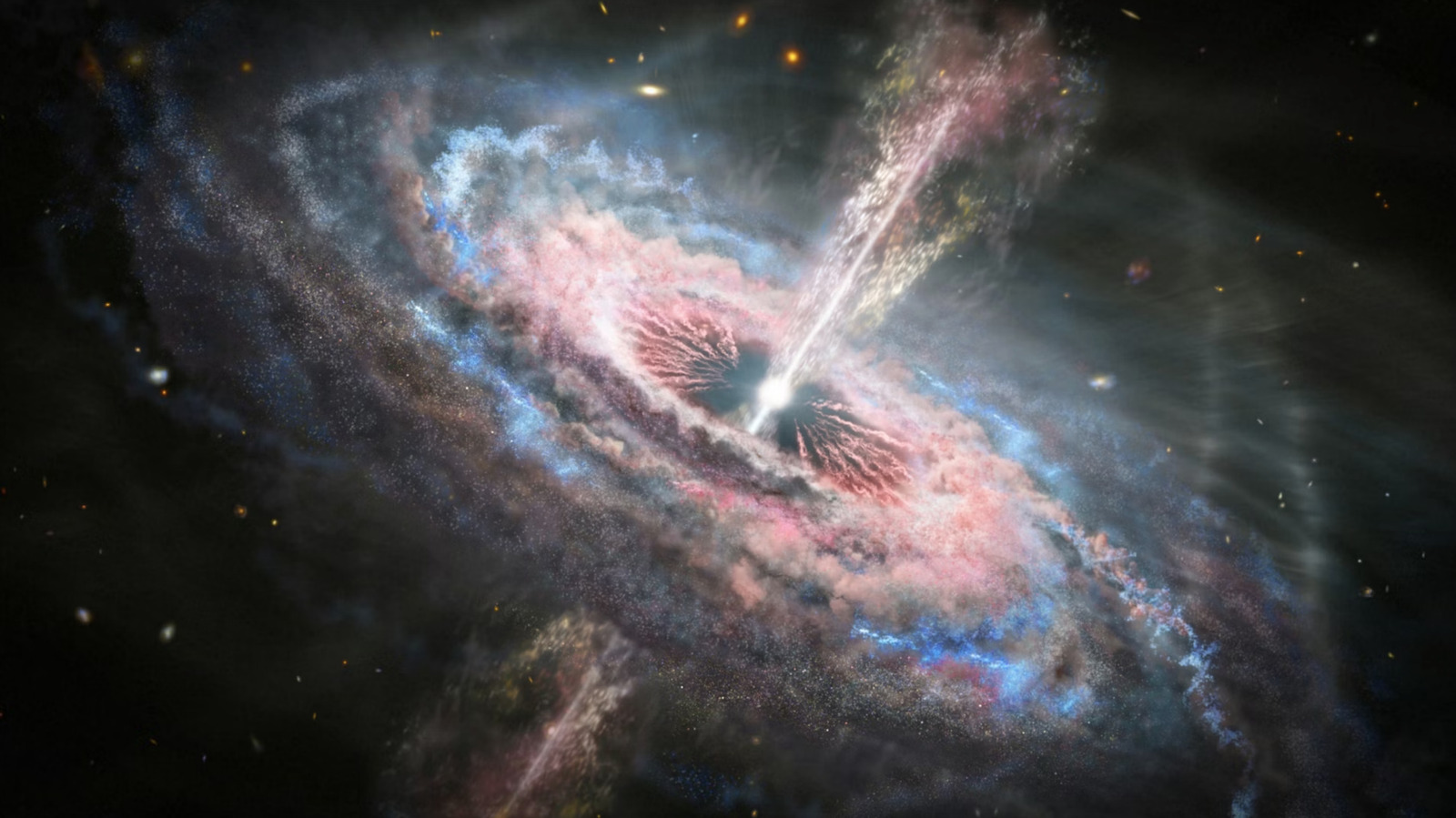
💡New cosmological data that could redefine how we model complex system growth in early universe simulations.
⚡ 30-Second TL;DR
What Changed
Black hole formation predates galaxy development
Why It Matters
This finding may force a revision of astrophysical simulation algorithms used to model early universe formation.
What To Do Next
Review the latest JWST data releases to update your astrophysical simulation parameters.
Key Points
- •Black hole formation predates galaxy development
- •Challenges current cosmological evolution theories
- •Data captured by James Webb Space Telescope
🧠 Deep Insight
Background and context from public sources — not the original article. 15 sources cited.
🔑 Enhanced Key Takeaways
- •The specific black hole, Abell2744-QSO1 (QSO1), has a directly measured mass of approximately 50 million solar masses, constituting at least two-thirds of its host galaxy's total mass, a ratio significantly higher than in the local universe.
- •This discovery supports the hypothesis that some early supermassive black holes might have formed via direct collapse, rather than through the gradual accumulation of stellar-mass black holes, and grew rapidly in the early universe.
- •The observations were made possible by gravitational lensing from galaxy cluster Abell 2744, which magnified and triply imaged QSO1, allowing for detailed study despite its distance of over 13 billion light-years.
- •The findings challenge the established 'co-evolution' paradigm, where black holes and their host galaxies were believed to grow in a synchronized manner.
🛠️ Technical Deep Dive
- The James Webb Space Telescope (JWST) utilized its Near-Infrared Spectrograph (NIRSpec) and Near-Infrared Camera (NIRCam) for these observations.
- NIRSpec's integral field unit (IFU) was specifically used to map the motions of hydrogen gas swirling around the black hole, enabling a direct measurement of its mass based on Keplerian motion.
- JWST is designed for infrared astronomy, allowing it to detect objects up to 100 times fainter than the Hubble Space Telescope and observe back to a redshift of approximately z≈20, corresponding to about 180 million years after the Big Bang.
- The telescope's exceptional capability to observe faint light from distant galaxies and detect key spectral features was crucial for identifying the accreting black hole.
- The phenomenon of gravitational lensing by the galaxy cluster Abell 2744 (also known as Pandora's Cluster) played a significant role by magnifying and triply imaging the distant object, Abell2744-QSO1, making its detailed study possible.
🔮 Future ImplicationsAI analysis grounded in cited sources
⏳ Timeline
📎 Sources (15)
Factual claims are grounded in the sources below. Forward-looking analysis is AI-generated interpretation.
Weekly AI Recap
Read this week's curated digest of top AI events →
👉Related Updates

AI-curated news aggregator. All content rights belong to original publishers.
Original source: Engadget ↗
This is a summary, not the original. Read the source, or get the weekly briefing.
The weekly digest
One email a week. Unsubscribe anytime.