🗾ITmedia AI+ (日本)•Freshcollected in 37m
Waymo揭示自動駕駛AI策略
💡了解Waymo為何質疑單一模型E2E路線,掌握自動駕駛AI架構選型的重要考量。
⚡ 30-Second TL;DR
What Changed
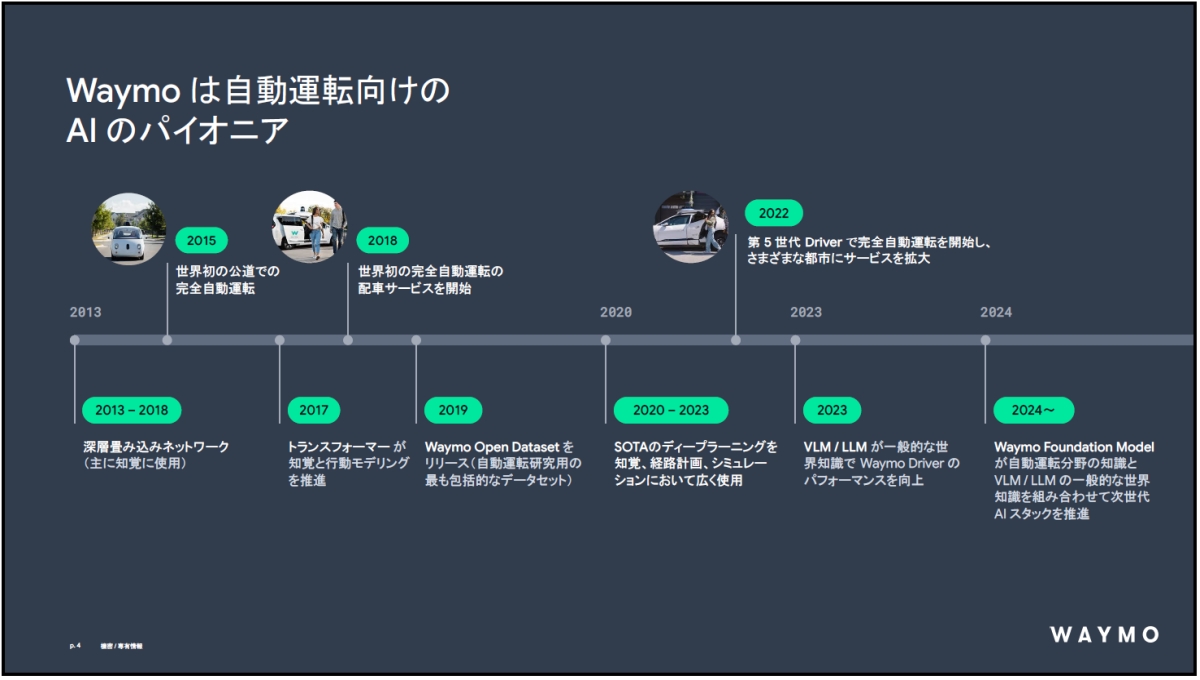
Waymo以自2009年Google Self-Driving Car Project開始的長期研發經驗為技術基礎
Why It Matters
Waymo的觀點可為自動駕駛開發者評估端到端架構與傳統分層式系統提供參考。其商業化服務經驗也使這場架構討論更貼近實際部署與營運需求。
What To Do Next
將Waymo對單一模型E2E方案的兩項疑慮納入你的自動駕駛系統架構評估表,並與分層式設計比較可驗證性與部署風險。
Who should care:Researchers & Academics
Key Points
- •Waymo以自2009年Google Self-Driving Car Project開始的長期研發經驗為技術基礎
- •公司針對單一AI模型主導的端到端(E2E)自動駕駛方案提出兩項問題
- •Waymo目前將這套自動駕駛技術應用於美國的無人駕駛移動服務
🧠 Deep Insight
AI-generated analysis for this event.
🔑 Enhanced Key Takeaways
- •Waymo identifies the 'black box' nature of end-to-end (E2E) models as a primary concern, noting that it complicates safety validation and debugging compared to their modular architecture.
- •The company emphasizes that E2E models struggle with 'long-tail' edge cases, where rare scenarios require explicit reasoning rather than just pattern matching from training data.
- •Waymo's current stack utilizes a 'Foundation Model' approach that integrates sensor data (LiDAR, radar, cameras) into a unified perception system while maintaining modular control logic for safety.
- •The transition from Google's early 'Chauffeur' project to the current Waymo Driver involves a shift toward deep learning-based behavior prediction that models the intent of other road users.
- •Waymo's strategy prioritizes 'interpretable AI,' ensuring that the system's decision-making process can be audited and verified by safety engineers, a requirement they argue E2E models currently fail to meet.
📊 Competitor Analysis▸ Show
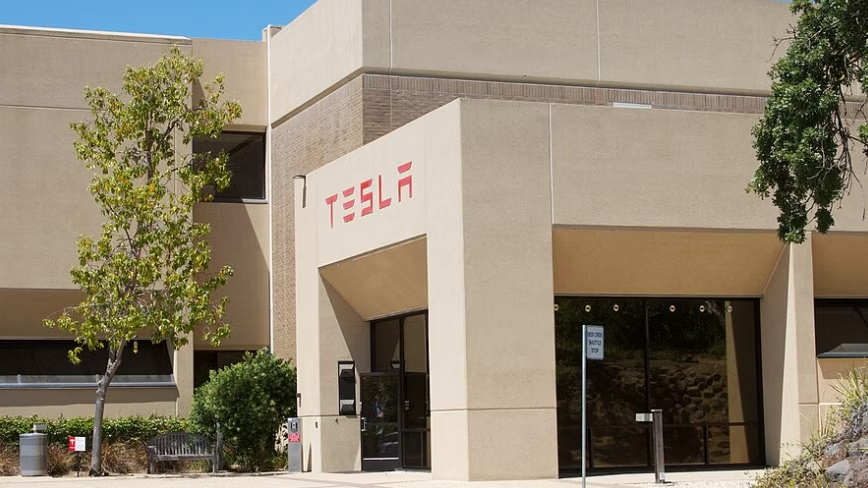
| Feature | Waymo | Tesla (FSD) | Zoox |
|---|---|---|---|
| Approach | Modular / Hybrid AI | End-to-End Neural Net | Modular / Purpose-built |
| Sensor Suite | LiDAR + Radar + Camera | Camera-only | LiDAR + Radar + Camera |
| Deployment | Robotaxi (Public) | Consumer ADAS | Robotaxi (Limited) |
| Safety Validation | High (Simulation/Real) | Moderate (Shadow Mode) | High (Simulation) |
🛠️ Technical Deep Dive
- Waymo utilizes a multi-modal sensor fusion architecture that processes LiDAR point clouds, high-resolution radar, and cameras through separate feature extractors before fusing them into a shared latent space.
- The system employs a 'Behavior Prediction' module that uses graph neural networks to model interactions between multiple agents (vehicles, pedestrians, cyclists) in complex urban environments.
- Waymo's motion planning uses a hierarchical approach, separating high-level trajectory generation from low-level control, allowing for deterministic safety constraints to be applied.
- The company leverages a massive simulation platform, 'Carcraft,' to perform millions of miles of virtual testing daily, specifically targeting the long-tail scenarios identified as problematic for E2E models.
🔮 Future ImplicationsAI analysis grounded in cited sources
Waymo will maintain a modular architecture over the next 24 months.
The company's explicit public stance against the current limitations of E2E models suggests they will prioritize safety-critical modularity over adopting a pure end-to-end approach.
Regulatory scrutiny on AI transparency will favor Waymo's approach.
As regulators demand more explainability in autonomous systems, Waymo's modular, interpretable design provides a clearer audit trail than opaque end-to-end neural networks.
⏳ Timeline
2009-01
Google Self-Driving Car Project officially begins.
2016-12
Waymo spins out from Google's X division to become an independent Alphabet company.
2018-12
Waymo launches Waymo One, the first commercial driverless robotaxi service in Phoenix.
2020-10
Waymo begins fully driverless operations (no human safety driver) for the public in Phoenix.
2023-08
Waymo expands fully driverless commercial service to San Francisco.
2025-06
Waymo reaches significant milestone in scaling driverless operations across multiple major US metropolitan areas.
📰
Weekly AI Recap
Read this week's curated digest of top AI events →
👉Related Updates

AI-curated news aggregator. All content rights belong to original publishers.
Original source: ITmedia AI+ (日本) ↗