Nevada Limits Tesla’s Robotaxi Fleet to 10
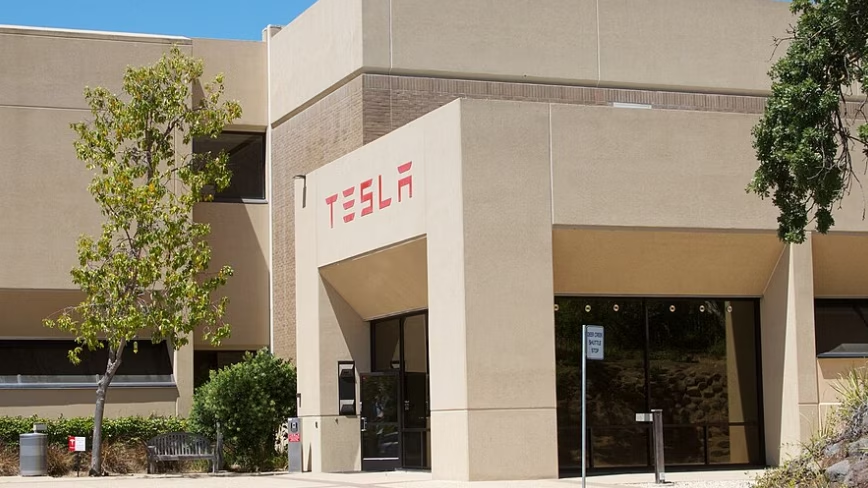
💡Tesla wanted 5,000 robotaxis; regulators approved 10, revealing the real deployment bottleneck.
⚡ 30-Second TL;DR
What Changed
Tesla sought approval for as many as 5,000 robotaxis across Las Vegas.
Why It Matters
The decision sharply limits Tesla’s near-term ability to gather operational data and scale autonomous ride services in Las Vegas. It also highlights how regulatory approval, rather than model capability alone, can determine the pace of robotaxi deployment.
What To Do Next
If you are building an autonomous mobility service, model your Las Vegas pilot around Nevada’s 10-vehicle cap and verify the current interim order before budgeting fleet expansion.
Key Points
- •Tesla sought approval for as many as 5,000 robotaxis across Las Vegas.
- •The Nevada Transportation Authority granted permission for only 10 vehicles.
- •The interim cap creates a major gap between Tesla’s requested scale and its approved deployment.
🧠 Deep Insight
AI-generated analysis for this event.
🔑 Enhanced Key Takeaways
- •The Nevada Transportation Authority (NTA) cited concerns regarding Tesla's 'Full Self-Driving' (FSD) safety record and the lack of a human safety driver in the proposed robotaxi configuration as primary reasons for the restrictive cap.
- •Tesla's application was part of a broader push to launch its 'Cybercab' platform, which relies exclusively on camera-based vision systems rather than LiDAR, a decision that has faced scrutiny from state regulators.
- •The interim order mandates that Tesla must provide comprehensive telematics data and incident reports to the NTA every 30 days to be considered for a potential fleet expansion.
- •Local Las Vegas labor unions and taxi operator associations formally intervened in the regulatory process, arguing that an immediate 5,000-vehicle deployment would disrupt local traffic infrastructure and labor markets.
- •This decision marks the first time a U.S. state regulator has explicitly limited a Tesla autonomous fleet size based on a 'probationary' performance period rather than a blanket denial.
📊 Competitor Analysis▸ Show
| Feature | Tesla (Cybercab) | Waymo (Driver) | Zoox |
|---|---|---|---|
| Sensor Suite | Vision-Only | LiDAR/Radar/Camera | LiDAR/Radar/Camera |
| Operational Status | Limited (10 units) | Fully Operational | Limited/Testing |
| Human Safety Driver | None (Proposed) | None | None |
| Market Presence | Las Vegas (Restricted) | Multi-City (Scale) | Multi-City (Testing) |
🛠️ Technical Deep Dive
- The Cybercab architecture utilizes Tesla's end-to-end neural network, which processes raw video input directly into steering, braking, and acceleration commands.
- The vehicle lacks traditional steering wheels and pedals, relying on the Hardware 4 (HW4) computer suite for redundant processing.
- Communication with the fleet management system is handled via Tesla's proprietary Starlink-integrated cellular link to ensure low-latency remote assistance capabilities.
- The vehicle employs inductive charging technology, eliminating the need for manual plug-in charging at depots.
🔮 Future ImplicationsAI analysis grounded in cited sources
⏳ Timeline
Weekly AI Recap
Read this week's curated digest of top AI events →
👉Related Updates


AI-curated news aggregator. All content rights belong to original publishers.
Original source: The Next Web (TNW) ↗