VR-Trained Humanoids to Fix Recycling Labor Crisis
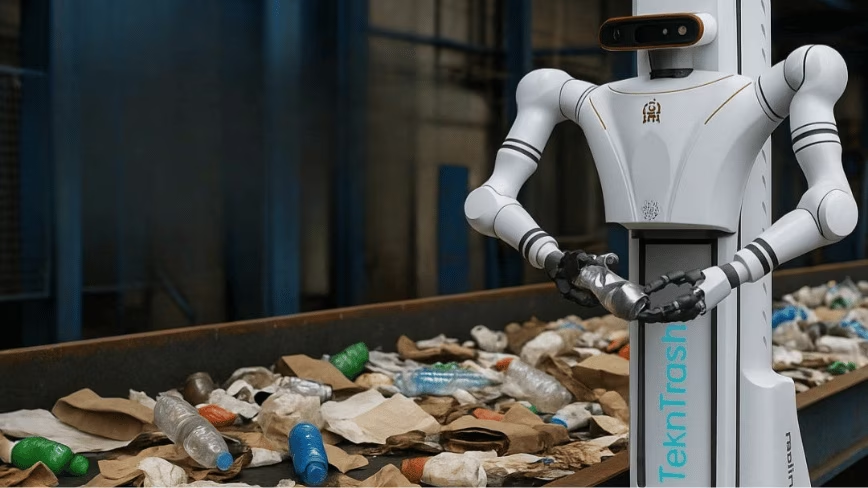
💡VR training for humanoids solves real labor crises—essential blueprint for embodied AI apps
⚡ 30-Second TL;DR
What Changed
40% annual staff turnover at waste sorting facilities
Why It Matters
This could accelerate adoption of embodied AI in industrial settings, reducing reliance on human labor in high-risk jobs and setting precedents for VR training scalability.
What To Do Next
Prototype VR training pipelines for your humanoid robot projects using Unity or similar simulators.
Key Points
- •40% annual staff turnover at waste sorting facilities
- •Fatality rate 8x national average across industries
- •Work injuries 45% higher than other sectors
- •Humanoid robots trained using VR headsets for replacement
🧠 Deep Insight
AI-generated analysis for this event — not the original article.
🔑 Enhanced Key Takeaways
- •The integration of VR-teleoperation allows for 'human-in-the-loop' learning, where robots capture human dexterity and decision-making patterns to build autonomous behavioral models for complex, non-uniform waste sorting.
- •Current deployments are focusing on 'brownfield' facilities, utilizing modular humanoid platforms that do not require expensive structural overhauls of existing conveyor belt systems.
- •Regulatory bodies are currently evaluating new safety standards specifically for human-robot collaborative spaces in waste management, as existing ISO standards for industrial robots do not fully account for the unpredictable nature of waste streams.
📊 Competitor Analysis▸ Show
| Company | Platform | Primary Focus | Pricing Model | Benchmarks |
|---|---|---|---|---|
| Covariant | Brain AI | General Purpose Sorting | RaaS (Robots-as-a-Service) | 99%+ pick accuracy in controlled tests |
| AMP Robotics | Neural Network Vision | High-speed recycling sorting | Subscription/Lease | 80+ picks per minute |
| Figure AI | Figure 02 | General Purpose Humanoid | Enterprise Licensing | Human-level dexterity in manipulation |
🛠️ Technical Deep Dive
- Architecture: Utilizes transformer-based foundation models for policy learning, allowing robots to generalize across different waste types (e.g., varying plastic grades, crushed cans).
- Teleoperation Interface: Employs low-latency VR headsets (e.g., Meta Quest Pro or custom industrial HMDs) paired with haptic feedback gloves to map human joint kinematics to humanoid actuators.
- Perception: Multi-modal sensor fusion combining RGB-D cameras for depth perception and tactile sensors in fingertips to detect material density and surface friction.
- Actuation: High-torque electric actuators with force-torque sensing at each joint to prevent damage when handling heavy or jammed debris.
🔮 Future ImplicationsAI analysis grounded in cited sources
⏳ Timeline
Weekly AI Recap
Read this week's curated digest of top AI events →
👉Related Updates


AI-curated news aggregator. All content rights belong to original publishers.
Original source: The Next Web (TNW) ↗
This is a summary, not the original. Read the source, or get the weekly briefing.
Weekly AI briefing
One email a week. Unsubscribe anytime.