Visa Buys BioCatch to Fight AI Scams
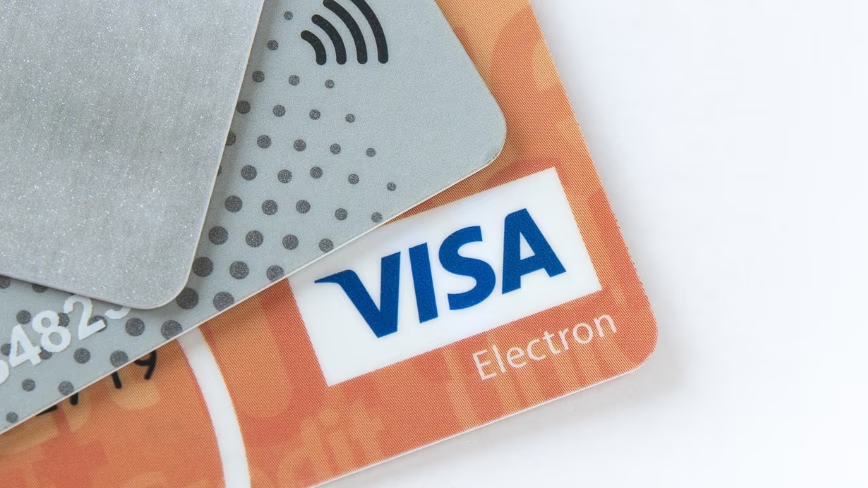
See how behavioral biometrics are becoming a frontline defense against AI-assisted fraud.
30-Second TL;DR
What Changed
Visa will acquire BioCatch for $2.4 billion in cash.
Why It Matters
The deal signals that behavioral biometrics are becoming a strategic defense layer against AI-assisted fraud. Banks and digital services may face stronger expectations to detect account takeover and automated abuse without relying only on passwords or static identity checks.
What To Do Next
Evaluate whether your authentication flow can ingest behavioral signals such as typing cadence and device handling to detect account takeover.
Key Points
- •Visa will acquire BioCatch for $2.4 billion in cash.
- •BioCatch analyzes keystroke timing, touchscreen pressure, swipe patterns, and device handling.
- •The platform protects approximately 760 million users across roughly 350 banks.
- •The acquisition targets increasingly sophisticated scams involving AI and automated bots.
Deep Insight
AI-generated analysis for this event — not the original article.
Enhanced Key Takeaways
- •BioCatch's behavioral biometric technology utilizes a proprietary 'Behavioral Intelligence' engine that processes over 2,000 behavioral parameters to create a unique user profile.
- •The acquisition follows a long-standing strategic partnership where Visa had previously integrated BioCatch's technology into its Visa Advanced Authorization (VAA) suite.
- •BioCatch has historically maintained a strong presence in the EMEA and LATAM markets, which will significantly bolster Visa's fraud prevention footprint in these regions.
- •The deal includes a significant retention package for BioCatch's engineering team to ensure the continuity of their 'Mule Account' detection capabilities, which are critical for identifying money laundering networks.
- •BioCatch's platform is designed to be 'passive,' meaning it operates in the background without requiring active user authentication steps like passwords or MFA, reducing friction in the user experience.
Competitor Analysis
- BioCatch
- Behavioral Biometrics
- LexisNexis ThreatMetrix
- Device Intelligence
- Nuance Gatekeeper
- Voice Biometrics
- BioCatch
- Passive/Invisible
- LexisNexis ThreatMetrix
- Device/Network Analysis
- Nuance Gatekeeper
- Active/Passive Voice
- BioCatch
- Leader in Behavioral
- LexisNexis ThreatMetrix
- Leader in Identity/Risk
- Nuance Gatekeeper
- Leader in Contact Center
- BioCatch
- Enterprise/Volume
- LexisNexis ThreatMetrix
- Enterprise/Risk-based
- Nuance Gatekeeper
- Enterprise/License
| Feature | BioCatch | LexisNexis ThreatMetrix | Nuance Gatekeeper |
|---|---|---|---|
| Primary Focus | Behavioral Biometrics | Device Intelligence | Voice Biometrics |
| Deployment | Passive/Invisible | Device/Network Analysis | Active/Passive Voice |
| Market Position | Leader in Behavioral | Leader in Identity/Risk | Leader in Contact Center |
| Pricing Model | Enterprise/Volume | Enterprise/Risk-based | Enterprise/License |
Technical Deep Dive
- Behavioral Biometric Engine: Uses machine learning to analyze human-computer interaction (HCI) patterns including mouse movements, tilt, and scroll speed.
- Mule Account Detection: Employs graph database analysis to identify clusters of accounts exhibiting coordinated, non-human behavior patterns.
- Continuous Authentication: Unlike static login checks, the system monitors the entire session to detect mid-session account takeovers (ATO).
- Device Fingerprinting: Combines behavioral data with hardware-level telemetry to detect emulators, remote access tools (RATs), and botnets.
- Privacy-Preserving Architecture: Processes behavioral data as mathematical vectors rather than storing raw biometric images or keystroke logs.
Future ImplicationsAI analysis grounded in cited sources
Timeline
- 2011-01BioCatch is founded in Tel Aviv, Israel, focusing on behavioral biometrics.
- 2018-05BioCatch raises $30 million in Series C funding to expand its global fraud detection platform.
- 2022-03Visa announces a strategic investment in BioCatch to enhance its fraud prevention capabilities.
- 2024-09BioCatch reaches a milestone of protecting over 700 million users globally.
- 2026-08Visa completes the $2.4 billion acquisition of BioCatch.
Weekly AI Recap
Read this week's curated digest of top AI events →
Related Updates


AI-curated news aggregator. All content rights belong to original publishers.
Original source: The Next Web (TNW) ↗
This is a summary, not the original. Read the source, or get the weekly briefing.
The weekly digest
One email a week. Unsubscribe anytime.