Vipshop Q1 2026: Profit Growth Amidst Revenue Stagnation
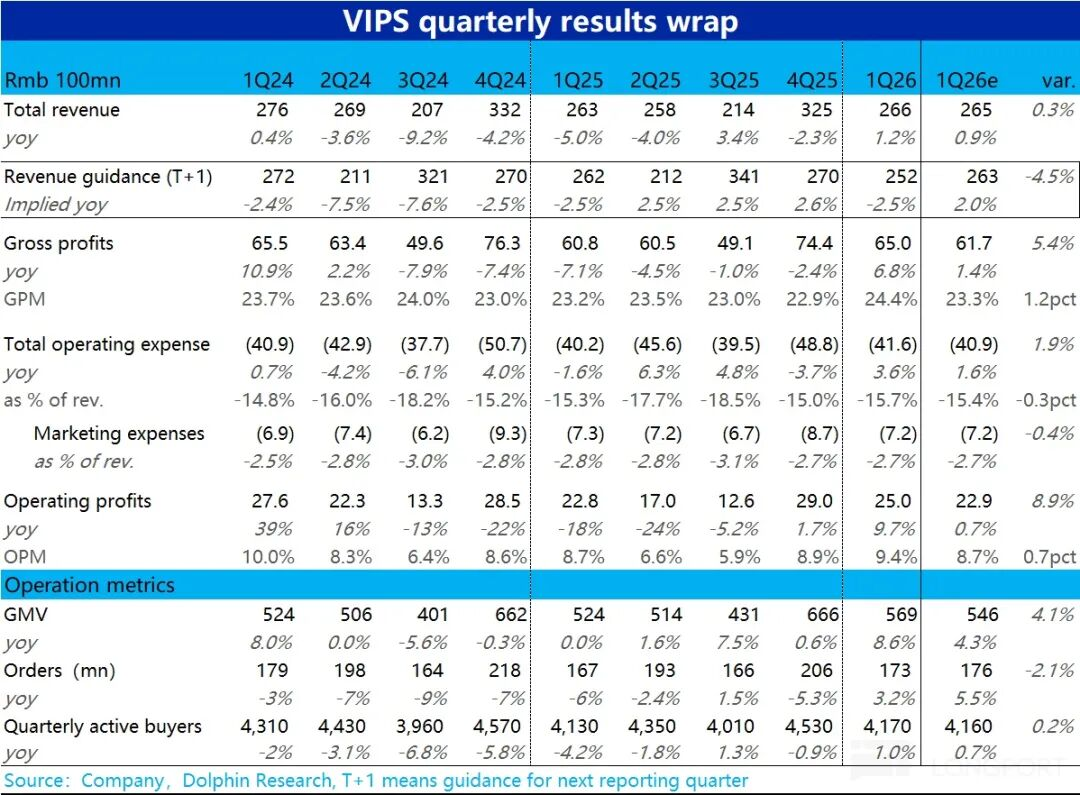
A case study on how e-commerce platforms can prioritize profit margins over user growth in a saturated market.
30-Second TL;DR
What Changed
GMV grew by 9% YoY, significantly outperforming revenue growth.
Why It Matters
Vipshop's model demonstrates the viability of a 'small but beautiful' strategy in the e-commerce sector, focusing on profit over scale in a cooling market.
What To Do Next
Analyze the impact of 3P business expansion on e-commerce platform margins as a defensive strategy against slowing user acquisition.
Key Points
- •GMV grew by 9% YoY, significantly outperforming revenue growth.
- •毛利率提升至 24.4%,主要得益於客單價提升與高毛利 3P 業務佔比增加。
- •Operating profit increased by 10% YoY, despite stagnant active user growth (+0.9%).
- •Q2 2026 revenue guidance indicates a potential return to negative growth (-5% to 0%).
Deep Insight
AI-generated analysis for this event — not the original article.
Enhanced Key Takeaways
- •The timing of the Chinese New Year significantly impacted Vipshop's Q1 2026 results, pulling demand forward into the holiday period and contributing to softer sales trends in March and the second quarter. [5]
- •Vipshop's 'Super VIP' (SVIP) membership program is a crucial driver of profitability and customer loyalty, with SVIP members growing by 9% year-over-year in Q1 2026 and contributing 50%-55% of total online spending. [14]
- •The company's business model is primarily centered on offering off-price branded products through flash sales, leveraging strong relationships with over 29,000 brand partners to secure discounted inventory and minimize inventory risk. [1, 10, 22]
- •Vipshop has been actively expanding its 'Made for Vipshop' initiative, collaborating with over 200 brands to offer customized products based on consumer insights, and introducing new promotional channels like 'Time-limit Offers' and 'Daily Low Prices' to optimize operations. [10]
- •Vipshop is reportedly considering a secondary listing in Hong Kong as early as 2026, potentially to diversify its investor base and hedge against potential US delisting risks under the Holding Foreign Companies Accountable Act (HFCAA). [25]
Competitor Analysis
- Vipshop
- Online discount retail, flash sales
- Alibaba (Tmall/Taobao)
- Marketplace (B2C & C2C), broad categories
- JD.com
- Direct sales (B2C), strong logistics
- Pinduoduo
- Social commerce, group buying, value focus
- Vipshop
- Branded apparel, accessories, beauty, home
- Alibaba (Tmall/Taobao)
- Extensive range across all categories
- JD.com
- Electronics, home appliances, general merchandise
- Pinduoduo
- Agricultural products, general merchandise, low-price items
- Vipshop
- Deep discounts (30-70% off) on branded goods
- Alibaba (Tmall/Taobao)
- Varied, from premium to budget
- JD.com
- Competitive pricing, quality assurance
- Pinduoduo
- Ultra-low prices, bulk discounts
- Vipshop
- In-house logistics network, own warehouses [2, 12]
- Alibaba (Tmall/Taobao)
- Cainiao Network (partnered logistics)
- JD.com
- Extensive in-house logistics, fast delivery
- Pinduoduo
- Partnered logistics, focus on efficiency
| Feature/Aspect | Vipshop | Alibaba (Tmall/Taobao) | JD.com | Pinduoduo |
|---|---|---|---|---|
| Core Business Model | Online discount retail, flash sales | Marketplace (B2C & C2C), broad categories | Direct sales (B2C), strong logistics | Social commerce, group buying, value focus |
| Product Focus | Branded apparel, accessories, beauty, home | Extensive range across all categories | Electronics, home appliances, general merchandise | Agricultural products, general merchandise, low-price items |
| Pricing Strategy | Deep discounts (30-70% off) on branded goods | Varied, from premium to budget | Competitive pricing, quality assurance | Ultra-low prices, bulk discounts |
| Target Market | Value-conscious, middle-income consumers, female-skewed, Tier 2-4 cities [8] | Broad consumer base across all tiers | Quality-conscious consumers, urban areas | Price-sensitive consumers, lower-tier cities [21] |
| Logistics | In-house logistics network, own warehouses [2, 12] | Cainiao Network (partnered logistics) | Extensive in-house logistics, fast delivery | Partnered logistics, focus on efficiency |
| Competitive Edge | Flash sales, brand relationships, curated discounts, SVIP program [6, 22] | Market dominance, ecosystem, vast selection, data insights | Authenticity, fast delivery, customer service [6] | Price advantage, social engagement, gamification [6] |
Technical Deep Dive
- Vipshop utilizes AI-powered product recommendations and has explored virtual reality shopping initiatives. [11]
- The company employs AI-enhanced algorithms to provide personalized shopping experiences for its users. [4]
- Data science is applied for demand forecasting, which is crucial for optimizing inventory management within its flash sales model. [20]
- Vipshop's in-house IT systems support various critical functions, including the user-interface website, customer service, enterprise resource planning (ERP), warehouse and logistics management, product information management, and business intelligence. [17]
- Investments in technology and supply-chain optimization are central to the company's ability to scale operations and maintain service quality. [12]
- Recent upgrades to warehouses and returns centers aim to reduce reverse logistics costs and improve apparel handling, while enhanced fit data and richer product pages are designed to lower return rates. [20]
Future ImplicationsAI analysis grounded in cited sources
Timeline
- 2008-08Vipshop Holdings Limited founded in Guangzhou, China, pioneering the online flash sales model. [1, 3]
- 2012-03Listed on the New York Stock Exchange (NYSE) under the ticker VIPS. [2, 3]
- 2013-11Transferred its primary domain to VIP.com, enhancing its branding as a premium discount platform. [2]
- 2015Began operating its own logistics and distribution system to enhance operational efficiency. [2, 4]
- 2017Received a significant strategic investment of approximately US$863 million from Tencent and JD.com. [3]
- 2023Launched initiatives to promote eco-friendly supply chains, including expanded use of recycled packaging and green logistics practices. [1]
Weekly AI Recap
Read this week's curated digest of top AI events →
AI-curated news aggregator. All content rights belong to original publishers.
Original source: 虎嗅 ↗
This is a summary, not the original. Read the source, or get the weekly briefing.
The weekly digest
One email a week. Unsubscribe anytime.