🐯虎嗅•Freshcollected in 17m
Vertex Lab's V2Fun brings 3D generation to HarmonyOS
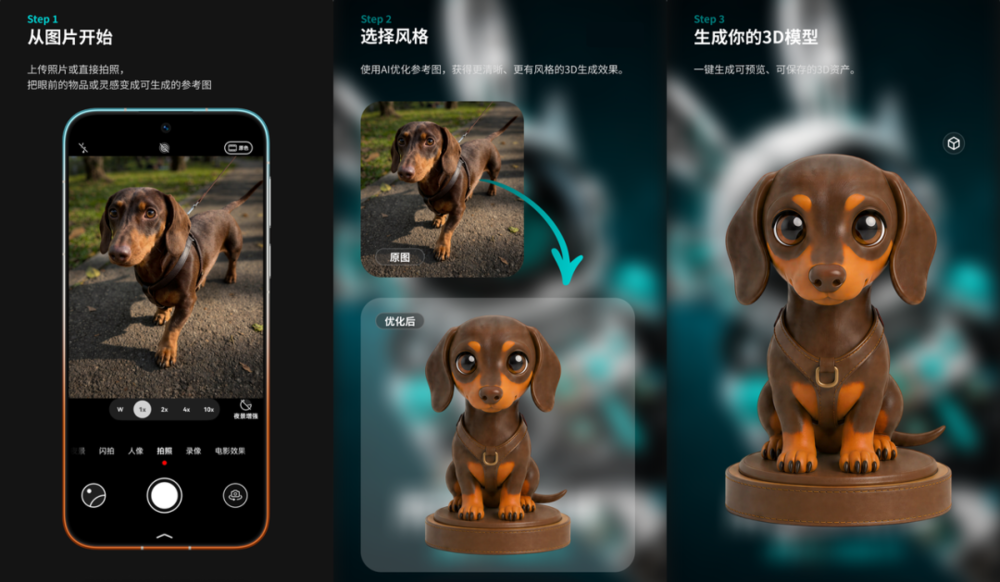
💡A deep dive into how 3D generative AI is evolving from static assets to interactive world models on HarmonyOS.
⚡ 30-Second TL;DR
What Changed
V2Fun uses VAE+DiT (Diffusion Transformer) architecture for high-fidelity 3D generation.
Why It Matters
Lowering the barrier to 3D content creation will accelerate the adoption of AR/VR and digital twin applications in the HarmonyOS ecosystem.
What To Do Next
Experiment with DiT-based 3D generation models to understand how they handle structural constraints compared to standard diffusion models.
Who should care:Developers & AI Engineers
Key Points
- •V2Fun uses VAE+DiT (Diffusion Transformer) architecture for high-fidelity 3D generation.
- •The platform enables users to generate 3D models with precise geometry, textures, and skeletons.
- •Vertex Lab is targeting a transition from '3D native assets' to '3D world models'.
- •The app is optimized for HarmonyOS to leverage its ecosystem and spatial computing capabilities.
🧠 Deep Insight
AI-generated analysis for this event.
🔑 Enhanced Key Takeaways
- •Vertex Lab has integrated V2Fun with Huawei's Pangu model ecosystem to enhance semantic understanding and generation speed on HarmonyOS devices.
- •The V2Fun platform utilizes a proprietary 'Any-to-3D' pipeline that supports text-to-3D, image-to-3D, and video-to-3D conversion modalities.
- •Vertex Lab has secured strategic partnerships with several HarmonyOS-native game developers to integrate V2Fun's API directly into mobile game asset pipelines.
- •The application features a real-time 'Spatial Preview' mode that utilizes HarmonyOS's distributed hardware capabilities to render 3D assets across multiple connected devices simultaneously.
- •Vertex Lab's research team has published benchmarks indicating that their DiT-based architecture achieves a 40% reduction in inference latency compared to traditional U-Net based diffusion models for 3D generation.
📊 Competitor Analysis▸ Show
| Feature | V2Fun (Vertex Lab) | Luma AI (Genie) | Meshy.ai |
|---|---|---|---|
| Primary Platform | HarmonyOS Native | Web/Cloud | Web/Cloud |
| Architecture | VAE + DiT | Transformer-based | Multi-view Diffusion |
| Spatial Integration | Deep HarmonyOS/Spatial | Limited | None |
| Pricing Model | Freemium/Enterprise API | Subscription/Credits | Subscription/Credits |
🛠️ Technical Deep Dive
- Architecture: Employs a latent diffusion transformer (DiT) framework that operates on compressed 3D latent spaces rather than raw voxel grids.
- Geometry Processing: Utilizes an implicit surface representation (SDF) which is converted to high-quality meshes via a differentiable marching cubes layer.
- Texture Synthesis: Implements a multi-stage refinement process where a secondary diffusion model generates high-resolution UV maps based on the initial geometry.
- HarmonyOS Optimization: Leverages the ArkTS framework and MindSpore Lite for on-device acceleration, minimizing cloud-roundtrip latency for asset generation.
🔮 Future ImplicationsAI analysis grounded in cited sources
V2Fun will become the standard asset generation tool for the HarmonyOS gaming ecosystem.
Deep integration with HarmonyOS APIs provides a performance advantage that third-party cloud-based competitors cannot match on Huawei hardware.
Vertex Lab will transition from a consumer app provider to a B2B infrastructure provider for spatial computing.
The focus on '3D world models' suggests a pivot toward providing backend generative services for enterprise-scale metaverse and digital twin applications.
⏳ Timeline
2024-05
Vertex Lab founded with a focus on generative 3D AI research.
2025-02
Initial release of V2Fun beta for desktop platforms.
2025-11
Vertex Lab announces strategic partnership with Huawei for HarmonyOS development.
2026-06
V2Fun officially launches on the HarmonyOS AppGallery with spatial computing support.
📰
Weekly AI Recap
Read this week's curated digest of top AI events →
👉Related Updates

AI-curated news aggregator. All content rights belong to original publishers.
Original source: 虎嗅 ↗