Vercel AI Gateway introduces firewall-style routing rules
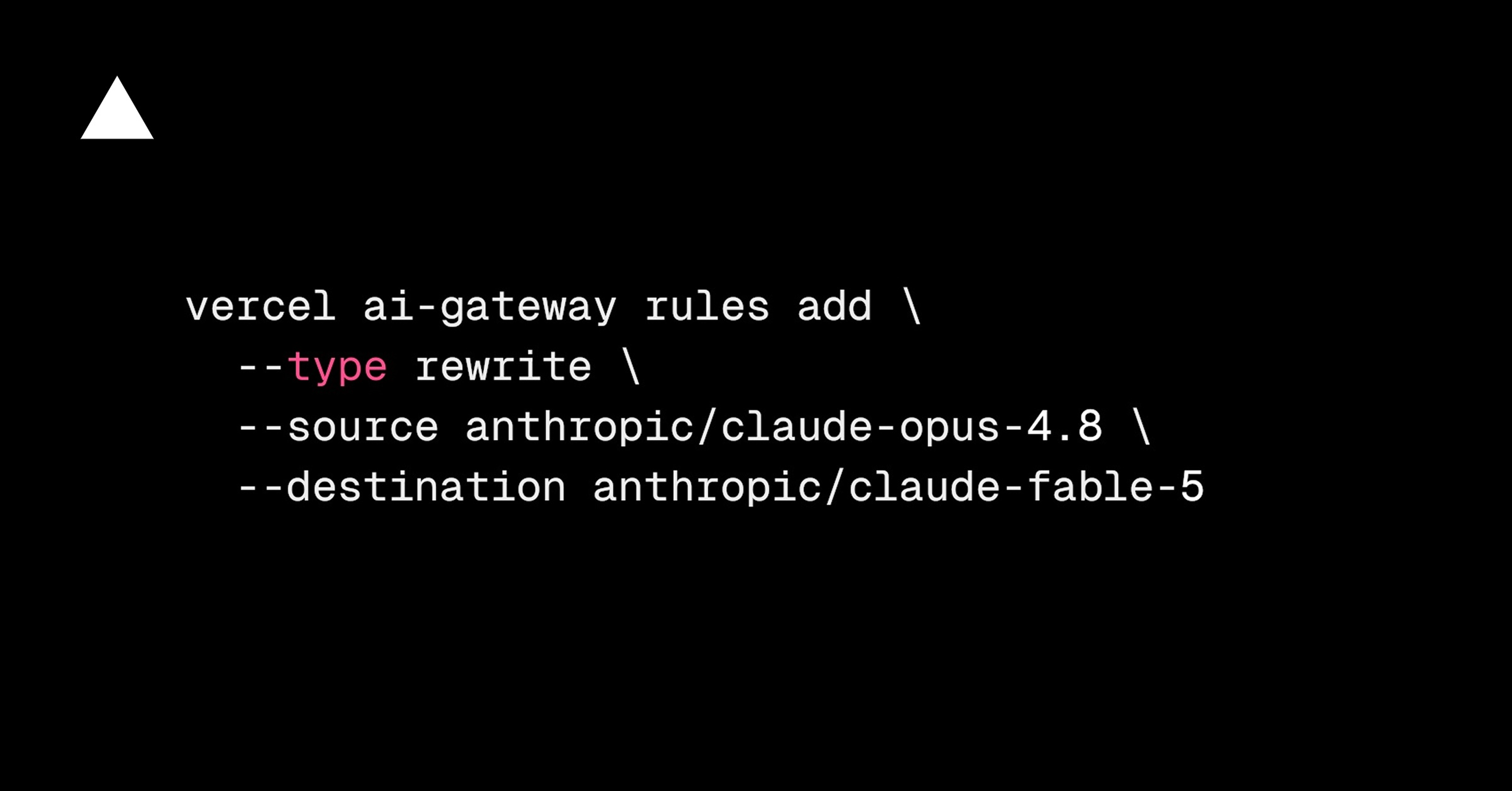
💡Instantly reroute AI traffic and block models without shipping new code—a must-have for production AI reliability.
⚡ 30-Second TL;DR
What Changed
Implement rewrite rules to transparently swap models for failover or cost optimization.
Why It Matters
This significantly reduces operational overhead for AI-powered applications by decoupling model management from the codebase. It allows teams to respond instantly to model outages or deprecations.
What To Do Next
Use the Vercel CLI to configure a rewrite rule for your production model to ensure seamless failover if your primary provider experiences downtime.
Key Points
- •Implement rewrite rules to transparently swap models for failover or cost optimization.
- •Use deny rules to block unauthorized models with a 403 response.
- •Manage rules via Vercel CLI without requiring application-level code changes.
- •Rules apply globally to all requests using team AI Gateway credentials.
🧠 Deep Insight
AI-generated analysis for this event — not the original article.
🔑 Enhanced Key Takeaways
- •The routing rules leverage Vercel's edge network infrastructure, ensuring that traffic interception and modification occur with sub-millisecond latency before reaching the upstream AI provider.
- •These rules support regex-based pattern matching for request paths and headers, allowing for granular control over specific API endpoints or user segments.
- •The implementation integrates with Vercel's existing observability suite, providing real-time logs that distinguish between original and rewritten model requests for auditing purposes.
- •The firewall-style rules are designed to mitigate 'prompt injection' and 'jailbreak' attempts by allowing developers to intercept and sanitize payloads at the gateway level.
- •Vercel has introduced a 'dry-run' mode for these routing rules, enabling teams to test traffic redirection logic in production environments without actually affecting live requests.
📊 Competitor Analysis▸ Show
| Feature | Vercel AI Gateway | Cloudflare AI Gateway | Helicone | LangSmith (Gateway) |
|---|---|---|---|---|
| Routing Rules | Native Firewall-style | Advanced Load Balancing | Request Transformation | Policy-based Control |
| Pricing | Usage-based (Vercel) | Tiered (Free/Pro) | Tiered/Enterprise | Usage-based |
| Primary Focus | Frontend/Edge Integration | Global Network Security | Observability/Caching | LLM Ops/Evaluation |
🛠️ Technical Deep Dive
- The gateway operates as a reverse proxy layer that intercepts outgoing requests to providers like OpenAI, Anthropic, and Google Gemini.
- Routing logic is executed within the Vercel Edge Runtime, utilizing V8 isolates for high-performance execution.
- Rewrite rules utilize a JSON-based configuration schema that is synchronized across global edge nodes via Vercel's internal control plane.
- Deny rules return a standardized 403 Forbidden response with a custom X-Vercel-AI-Gateway-Reason header for debugging.
- The system supports header injection, allowing developers to dynamically append authentication tokens or custom metadata to proxied requests.
🔮 Future ImplicationsAI analysis grounded in cited sources
⏳ Timeline
Weekly AI Recap
Read this week's curated digest of top AI events →
👉Related Updates
AI-curated news aggregator. All content rights belong to original publishers.
Original source: Vercel News ↗
This is a summary, not the original. Read the source, or get the weekly briefing.
Weekly AI briefing
One email a week. Unsubscribe anytime.