Venus Aerospace raises $91M for detonation rocket engine
💡High-stakes aerospace funding often precedes breakthroughs in AI-optimized propulsion and structural design.
⚡ 30-Second TL;DR
What Changed
Secured $91 million in Series B funding led by Mercury Fund.
Why It Matters
This funding signals a shift toward high-efficiency propulsion systems that could redefine aerospace logistics and defense capabilities.
What To Do Next
Monitor the integration of AI-driven fluid dynamics simulations in high-stakes aerospace engineering projects.
Key Points
- •Secured $91 million in Series B funding led by Mercury Fund.
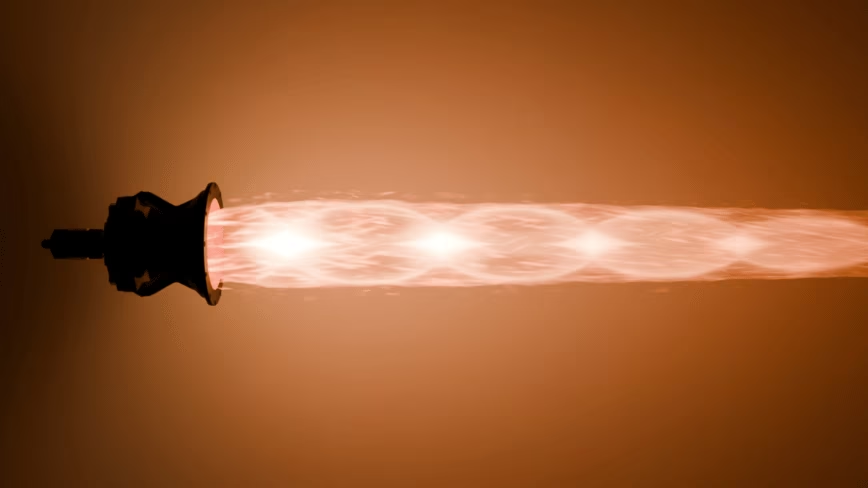
- •Focusing on the development of Rotating Detonation Rocket Engine (RDRE) technology.
- •Backed by major defense industry players including Lockheed Martin Ventures.
🧠 Deep Insight
AI-generated analysis for this event — not the original article.
🔑 Enhanced Key Takeaways
- •The RDRE technology aims to achieve a 15% increase in fuel efficiency compared to traditional constant-pressure rocket engines by utilizing supersonic combustion.
- •Venus Aerospace is developing a hypersonic aircraft platform, the 'Stargazer,' which is designed to utilize this engine technology for Mach 9 flight speeds.
- •The company has successfully conducted flight tests of a drone prototype equipped with RDRE technology to validate the engine's performance in real-world conditions.
- •Beyond defense applications, the company is exploring commercial high-speed point-to-point travel, potentially reducing transcontinental flight times to under an hour.
- •The Series B funding will specifically support the transition from laboratory-scale testing to full-scale engine integration and flight-ready hardware production.
📊 Competitor Analysis▸ Show
| Competitor | Technology Focus | Key Advantage | Status |
|---|---|---|---|
| Hermeus | Hypersonic Engines (Turbine-based) | Integrated air-breathing propulsion | Flight testing |
| Destinus | Hydrogen-powered Hypersonics | Liquid hydrogen focus | Prototype testing |
| GE Aerospace | Rotating Detonation Combustion | Industrial/Aviation scale | R&D phase |
🛠️ Technical Deep Dive
- RDRE operates by trapping a detonation wave within an annular channel, creating a self-sustaining combustion process.
- The engine utilizes high-frequency pressure waves that travel circumferentially around the engine chamber.
- Unlike traditional deflagration-based rockets, RDRE achieves pressure gain combustion, which significantly improves thermodynamic efficiency.
- The design reduces the number of moving parts compared to traditional turbomachinery, potentially lowering weight and manufacturing complexity.
🔮 Future ImplicationsAI analysis grounded in cited sources
⏳ Timeline
Weekly AI Recap
Read this week's curated digest of top AI events →
👉Related Updates


AI-curated news aggregator. All content rights belong to original publishers.
Original source: The Next Web (TNW) ↗
This is a summary, not the original. Read the source, or get the weekly briefing.
The weekly digest
One email a week. Unsubscribe anytime.