Vellum launches Plugin Hub for personal AI assistants
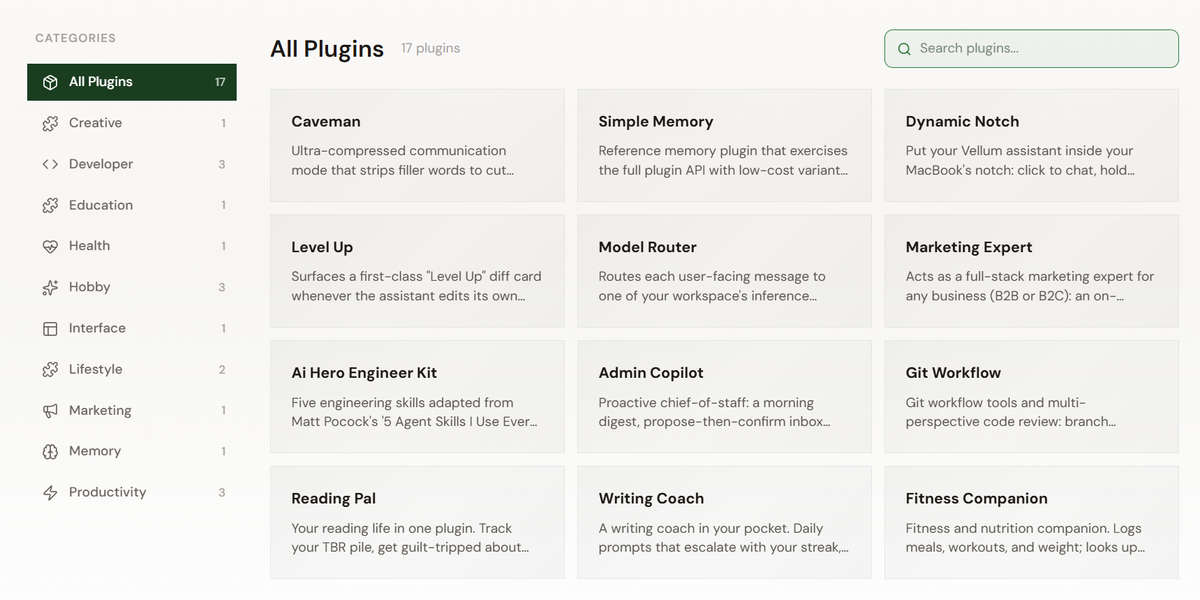
💡Discover how to extend local-first AI assistants with modular, persistent plugins via Vellum's new hub.
⚡ 30-Second TL;DR
What Changed
Vellum launches an open catalog for installable AI plugins.
Why It Matters
This launch signals a shift toward modular, extensible local AI ecosystems, allowing developers to build specialized tools that persist across sessions. It lowers the barrier for integrating custom workflows into private, local-first AI environments.
What To Do Next
Explore the Vellum Plugin Hub documentation to see how you can package your own custom tools as plugins for local-first AI agents.
Key Points
- •Vellum launches an open catalog for installable AI plugins.
- •Focuses on enhancing local-first AI assistants with persistent capabilities.
- •Enables modular expansion of AI agent functionality.
🧠 Deep Insight
AI-generated analysis for this event — not the original article.
🔑 Enhanced Key Takeaways
- •Vellum's Plugin Hub utilizes a sandboxed execution environment to ensure that local-first AI agents maintain data privacy while executing third-party code.
- •The architecture supports cross-platform synchronization, allowing users to sync installed plugins across desktop and mobile instances of Vellum assistants via encrypted local storage.
- •Developers can publish plugins to the Hub using a standardized manifest format that defines tool-use capabilities, authentication requirements, and resource constraints.
- •The Hub includes a community-driven vetting system where plugin security and performance metrics are transparently displayed to end-users before installation.
- •Vellum has implemented a 'Local-Only' mode for the Plugin Hub, enabling users to host and run plugins entirely offline without requiring a connection to Vellum's central servers.
📊 Competitor Analysis▸ Show
| Feature | Vellum Plugin Hub | Ollama Library | LangChain Hub |
|---|---|---|---|
| Primary Focus | Personal AI Assistants | Local Model Distribution | Prompt/Chain Sharing |
| Execution | Sandboxed Local | Local/Server | Cloud/Local |
| Pricing | Free/Open Source | Free/Open Source | Free/Freemium |
🛠️ Technical Deep Dive
- Plugin Architecture: Uses a WebAssembly (Wasm) runtime to execute plugin logic, providing near-native performance with strict memory and CPU isolation.
- Integration Layer: Plugins interact with the core AI agent via a JSON-RPC interface, allowing for asynchronous tool calling and state management.
- Data Persistence: Utilizes an encrypted SQLite database for local plugin state, ensuring that persistent data remains inaccessible to the host system or other plugins.
- Manifest Specification: Plugins are defined via a YAML manifest that specifies required permissions (e.g., file system access, network requests) and model compatibility requirements.
🔮 Future ImplicationsAI analysis grounded in cited sources
⏳ Timeline
Weekly AI Recap
Read this week's curated digest of top AI events →
👉Related Updates
AI-curated news aggregator. All content rights belong to original publishers.
Original source: TestingCatalog ↗
This is a summary, not the original. Read the source, or get the weekly briefing.
The weekly digest
One email a week. Unsubscribe anytime.