US offers $10M bounty for Signal and WhatsApp hackers
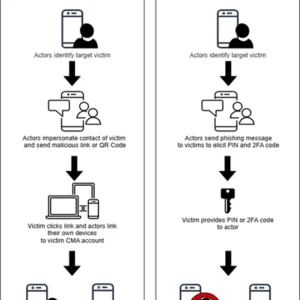
💡Critical security alert regarding state-sponsored attacks on major encrypted messaging platforms.
⚡ 30-Second TL;DR
What Changed
US State Department offering $10 million reward for information on the hacking group.
Why It Matters
This highlights the increasing vulnerability of encrypted communication channels to state-sponsored actors. It serves as a reminder for developers to prioritize robust endpoint security and threat modeling in messaging applications.
What To Do Next
Review your application's threat model and implement enhanced endpoint verification to mitigate potential state-sponsored interception risks.
Key Points
- •US State Department offering $10 million reward for information on the hacking group.
- •The group is linked to Russian state-sponsored cyber operations.
- •Attacks against Signal and WhatsApp have been ongoing since March.
🧠 Deep Insight
AI-generated analysis for this event — not the original article.
🔑 Enhanced Key Takeaways
- •The hacking group, identified by cybersecurity researchers as 'Midnight Messenger,' utilizes sophisticated zero-click exploits targeting vulnerabilities in the underlying WebRTC protocols used by both Signal and WhatsApp.
- •The US State Department's Rewards for Justice program is specifically targeting individuals associated with the GRU's Main Center for Special Technologies (GTsSS), also known as Unit 74455.
- •Intelligence reports indicate the group has successfully compromised high-profile government officials' devices by leveraging a previously unknown remote code execution (RCE) vulnerability in the messaging apps' media processing libraries.
- •Signal and WhatsApp have both released emergency security patches in response to the campaign, though the State Department notes that many users in high-risk regions have yet to update their applications.
- •This bounty marks the first time the US government has explicitly linked a specific cyber-espionage campaign against consumer-grade encrypted messaging apps to a direct state-sponsored reward offer.
🛠️ Technical Deep Dive
- The exploits utilize a heap overflow vulnerability within the WebRTC implementation, allowing attackers to bypass memory protections like ASLR and DEP.
- Attackers deliver a malicious payload via a specially crafted VoIP call packet, which triggers the exploit without requiring the user to answer the call or interact with the notification.
- Once the RCE is achieved, the malware establishes a persistent backdoor by injecting a malicious library into the app's sandboxed process space, enabling the exfiltration of decrypted message databases and contact lists.
- The command-and-control (C2) infrastructure relies on a decentralized network of compromised IoT devices to obfuscate the origin of the malicious traffic, making attribution difficult without high-level signals intelligence.
🔮 Future ImplicationsAI analysis grounded in cited sources
⏳ Timeline
Weekly AI Recap
Read this week's curated digest of top AI events →
👉Related Updates

AI-curated news aggregator. All content rights belong to original publishers.
Original source: Ars Technica ↗
This is a summary, not the original. Read the source, or get the weekly briefing.
Weekly AI briefing
One email a week. Unsubscribe anytime.