US Government Releases Declassified UFO Files
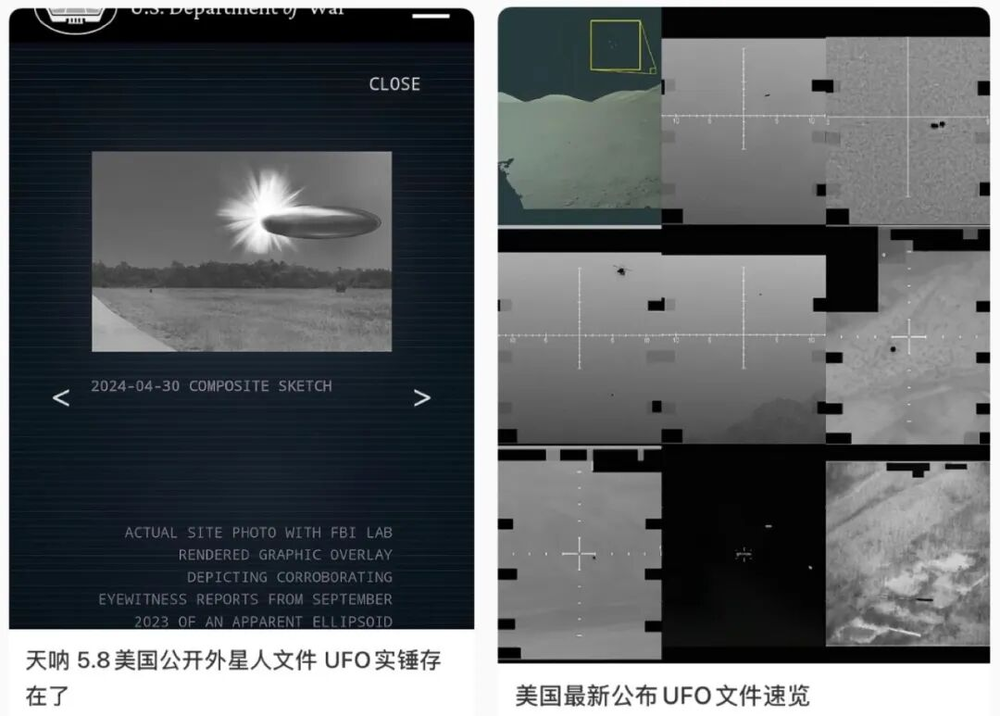
A look at how human pattern recognition and AI sensor data intersect in the recent US UFO file release.
30-Second TL;DR
What Changed
Pentagon released over 400 declassified files on unidentified aerial phenomena.
Why It Matters
Highlights the intersection of data interpretation, human cognitive bias, and the challenge of analyzing ambiguous sensor data in the AI era.
What To Do Next
When building computer vision models, be aware of how sensor artifacts can lead to false positives and the importance of robust data validation.
Key Points
- •Pentagon released over 400 declassified files on unidentified aerial phenomena.
- •Public interest focused on 'octagonal' infrared imagery, potentially linked to sensor artifacts.
- •Cultural and psychological analysis suggests human tendency to project 'sacred geometry' onto ambiguous data.
- •Jungian 'collective unconscious' theory is used to explain cross-cultural similarities in geometric symbols.
Deep Insight
Background and context from public sources — not the original article. 23 sources cited.
Enhanced Key Takeaways
- •The recent release of declassified UAP files on May 8, 2026, was initiated by the Trump administration through a new interagency platform called the Presidential Unsealing and Reporting System for UAP Encounters (PURSUE), hosted on WAR.GOV/UFO.
- •This initial tranche, comprising over 160 files including reports, photos, and videos, is explicitly described by the Pentagon as containing "unresolved cases" for which definitive determinations could not be made, and it did not confirm the existence of extraterrestrial life.
- •The UAP research community has expressed that much of the newly released data is underwhelming, often consisting of previously public or ambiguous material, and that raw files without proper context may lead to more confusion than clarity.
- •The All-domain Anomaly Resolution Office (AARO), established in 2022, plays a key role in coordinating the declassification of Department of War files and preparing them for public posting, while continuing its statutory mission of detecting, identifying, analyzing, and resolving UAP.
- •The release is part of an announced "rolling disclosure process," with additional files expected to be released every few weeks, indicating an ongoing commitment to transparency.
Technical Deep Dive
- The 'octagonal' infrared imagery, which garnered public interest, is often attributed to sensor artifacts such as the 'bokeh' effect, where the shape of a camera's aperture (e.g., a 6-blade iris) can cause out-of-focus light sources to appear as geometric shapes like hexagons or octagons.
- Modern digital cameras, particularly those with rolling shutters, face challenges in accurately capturing fast-moving UAPs due to potential distortions, skewed effects, autofocus limitations, and increased image noise in low-light conditions.
- Effective UAP detection is hampered by environmental interference, limitations in sensor resolution, and the absence of integrated multi-domain tracking systems, as most current sensors are designed for single environments (e.g., air traffic radar not for underwater objects).
- The All-domain Anomaly Resolution Office (AARO) advocates for the development of multi-domain detection frameworks to overcome the limitations of single-environment sensors.
- Experts suggest a multimodal approach for UAP analysis, combining active and passive radar, microwave and electromagnetic spectrum detection, X-ray/gamma ray spectroscopy, magnetometry, optical imaging (including FLIR and UV), gravitational lensing analysis, radiation detection, audio detection, and sonar to provide more comprehensive and credible data.
- Analysis of UAP data is currently hindered by poor sensor calibration, a lack of multiple measurements, insufficient sensor metadata, and the absence of baseline data, according to NASA's UAP study team.
Future ImplicationsAI analysis grounded in cited sources
Timeline
- 1947-1969US Air Force conducts Project Blue Book (and predecessors Project Sign and Grudge) to investigate UFO sightings.
- 1969-12Project Blue Book officially terminates, concluding no evidence of national security threat, advanced technology, or extraterrestrial vehicles.
- 2021-06Office of the Director of National Intelligence (ODNI) releases 'Preliminary Assessment: Unidentified Aerial Phenomena' report to Congress.
- 2022The All-domain Anomaly Resolution Office (AARO) is established by the US Department of Defense to investigate UAPs.
- 2024-11ODNI and DoD publish the Fiscal Year 2024 Consolidated Annual Report on Unidentified Anomalous Phenomena (UAP).
- 2026-02President Donald Trump directs federal agencies to identify and declassify government files related to UAPs and extraterrestrial life.
- 2026-05The Trump administration releases the first tranche of declassified UAP files via the Presidential Unsealing and Reporting System for UAP Encounters (PURSUE) on WAR.GOV/UFO.
Sources (23)
Factual claims are grounded in the sources below. Forward-looking analysis is AI-generated interpretation.
Weekly AI Recap
Read this week's curated digest of top AI events →
AI-curated news aggregator. All content rights belong to original publishers.
Original source: 虎嗅 ↗
This is a summary, not the original. Read the source, or get the weekly briefing.
The weekly digest
One email a week. Unsubscribe anytime.