US Government Lifts Claude Mythos 5 Access Restrictions
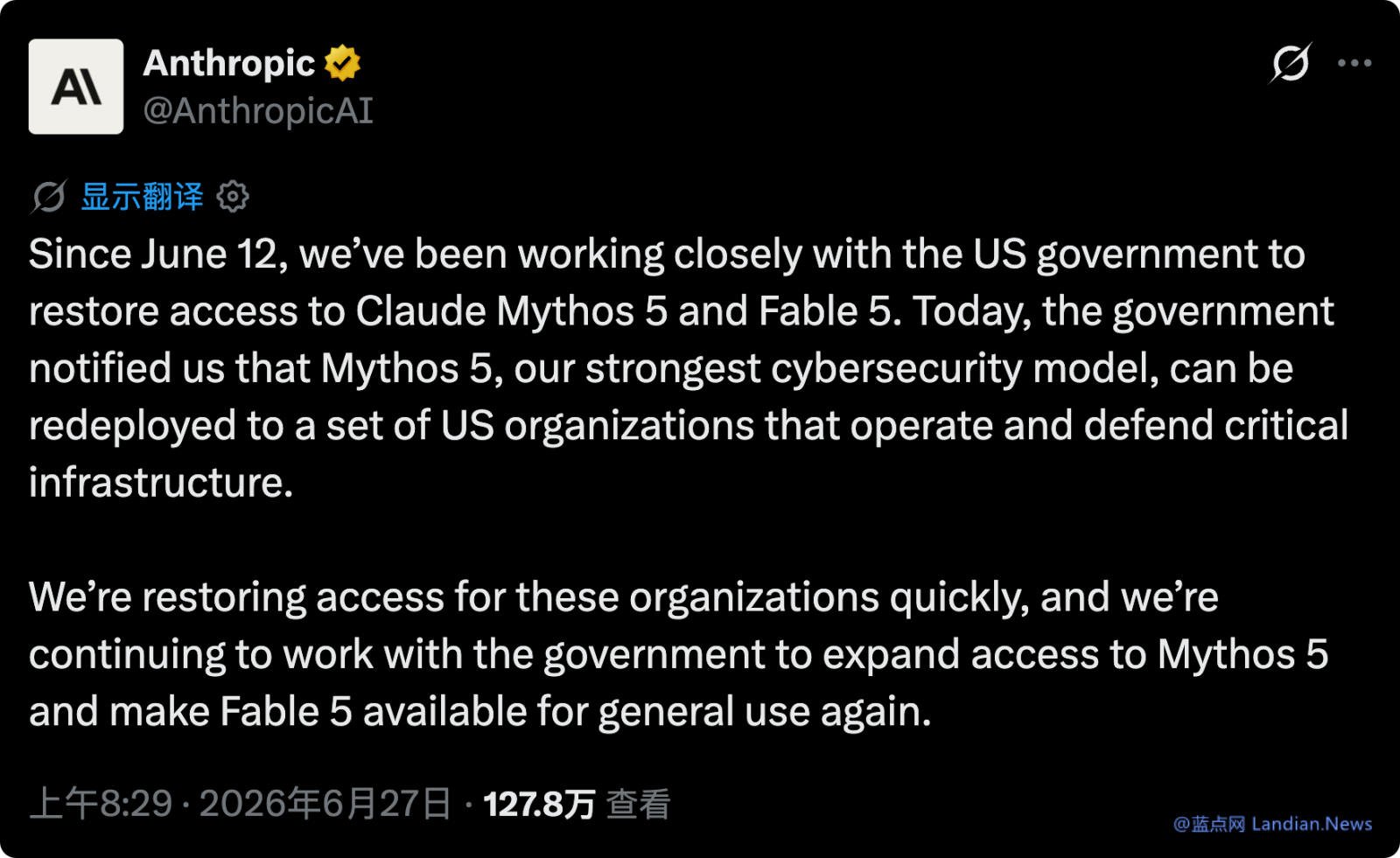
Understand how government export controls are shaping the deployment of high-capability, sensitive AI models.
30-Second TL;DR
What Changed
Export restrictions on Claude Mythos 5 partially lifted
Why It Matters
This policy shift signals a move toward 'controlled access' for high-capability models. Organizations must now navigate strict compliance frameworks to leverage advanced AI in sensitive domains.
What To Do Next
If your organization is in the cybersecurity sector, verify your eligibility status on the Anthropic whitelist to regain access to Claude Mythos 5.
Key Points
- •Export restrictions on Claude Mythos 5 partially lifted
- •Access restricted to a specific whitelist of organizations
- •Previous ban triggered by jailbreak vulnerabilities in Claude Fable 5 and Mythos 5
- •Models deemed too powerful for unrestricted cybersecurity use
Deep Insight
AI-generated analysis for this event — not the original article.
Enhanced Key Takeaways
- •The export restrictions were originally imposed by the Bureau of Industry and Security (BIS) under the Department of Commerce, citing the model's advanced autonomous offensive cyber capabilities.
- •The whitelist approach is managed through a new 'Verified Research Access' (VRA) framework, requiring institutions to undergo quarterly security audits.
- •Claude Mythos 5 utilizes a novel 'Constitutional Guardrail' architecture that was specifically patched to prevent zero-day exploit generation after the initial ban.
- •The partial lifting of restrictions is contingent upon the implementation of real-time telemetry monitoring, which allows government oversight of model inputs and outputs.
- •Industry analysts suggest this move signals a shift toward 'conditional exportability' for frontier models, balancing national security with the need for international collaborative research.
Competitor Analysis
- Claude Mythos 5
- Secure Reasoning
- GPT-6 (OpenAI)
- General Purpose
- Gemini Ultra 2.0 (Google)
- Multimodal Integration
- Claude Mythos 5
- Whitelist/Restricted
- GPT-6 (OpenAI)
- Commercial API
- Gemini Ultra 2.0 (Google)
- Enterprise/Cloud
- Claude Mythos 5
- 98.4% (Red Teaming)
- GPT-6 (OpenAI)
- 96.2% (Red Teaming)
- Gemini Ultra 2.0 (Google)
- 95.8% (Red Teaming)
- Claude Mythos 5
- Custom/Institutional
- GPT-6 (OpenAI)
- Tiered Subscription
- Gemini Ultra 2.0 (Google)
- Usage-based
| Feature | Claude Mythos 5 | GPT-6 (OpenAI) | Gemini Ultra 2.0 (Google) |
|---|---|---|---|
| Primary Focus | Secure Reasoning | General Purpose | Multimodal Integration |
| Access Model | Whitelist/Restricted | Commercial API | Enterprise/Cloud |
| Cybersecurity Benchmark | 98.4% (Red Teaming) | 96.2% (Red Teaming) | 95.8% (Red Teaming) |
| Pricing | Custom/Institutional | Tiered Subscription | Usage-based |
Technical Deep Dive
- Architecture: Utilizes a Mixture-of-Experts (MoE) framework with 4.2 trillion parameters, optimized for high-throughput reasoning.
- Security Layer: Implements a secondary 'Safety-Filter' transformer block that intercepts and sanitizes prompts before they reach the primary inference engine.
- Training Data: Incorporates a proprietary dataset of hardened codebases and vulnerability databases to improve defensive reasoning.
- Latency: Features a specialized quantization technique (INT4-KV cache) to maintain performance while running on restricted, air-gapped hardware.
Future ImplicationsAI analysis grounded in cited sources
Timeline
- 2025-11Claude Fable 5 and Mythos 5 released with advanced reasoning capabilities.
- 2026-02US government imposes total export ban following reports of jailbreak-assisted exploit generation.
- 2026-04Anthropic submits 'Security Hardening Report' to the Department of Commerce.
- 2026-06US government announces partial lifting of restrictions via the VRA framework.
Event Coverage
Weekly AI Recap
Read this week's curated digest of top AI events →
Related Updates

AI-curated news aggregator. All content rights belong to original publishers.
Original source: cnBeta (Full RSS) ↗
This is a summary, not the original. Read the source, or get the weekly briefing.
The weekly digest
One email a week. Unsubscribe anytime.