US Government Regulates Software Usage Rights
💡Understand how new federal software export controls might impact your product's global distribution strategy.
⚡ 30-Second TL;DR
What Changed
Commerce Department issued new software usage restrictions
Why It Matters
This policy change could force software companies to implement stricter identity verification and export control compliance measures. It may complicate global deployment strategies for AI and enterprise software.
What To Do Next
Review your software's export compliance documentation and ensure your user verification systems can handle geographic access restrictions.
Key Points
- •Commerce Department issued new software usage restrictions
- •Shift in federal oversight of software distribution
- •Potential impact on cross-border software accessibility
🧠 Deep Insight
Background and context from public sources — not the original article. 15 sources cited.
🔑 Enhanced Key Takeaways
- •The new directives extend the scope of regulation to include software license keys and their renewals, meaning that ongoing access to software can be revoked or require new authorization based on changes in geopolitical circumstances or the end-user's status.
- •The Commerce Department is actively working to close a recognized 'cloud loophole' through proposed legislation, the Remote Access Security Act, which aims to regulate remote access to controlled technologies via cloud services, potentially significantly impacting Software-as-a-Service (SaaS) and Infrastructure-as-a-Service (IaaS) business models.
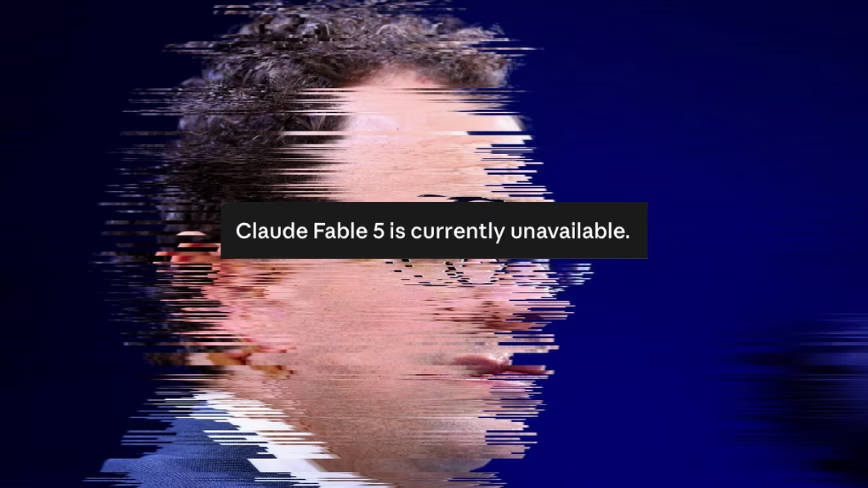
- •Recent government actions specifically target advanced computing items and AI models, exemplified by the US government's directive to suspend access to Anthropic's Fable 5 and Mythos 5 AI models for foreign nationals due to national security concerns.
- •The regulations encompass 'deemed exports,' which means that the release of source code or technical data to a foreign national, even if they are located within the United States, is considered an export and is subject to federal oversight.
- •There is a legislative push, such as the proposed Connected Vehicle Security Act of 2026, to expand existing Connected Vehicle Regulations to cover a broader range of activities (including manufacture and resale) and additional countries (Iran and North Korea) for vehicles and their associated software and hardware.
🛠️ Technical Deep Dive
- The regulations are primarily governed by the Export Administration Regulations (EAR), enforced by the Bureau of Industry and Security (BIS) within the Commerce Department.
- Items subject to control are classified using Export Control Classification Numbers (ECCNs) found on the Commerce Control List (CCL), with a broad 'catch-all' category known as EAR99 for items not specifically listed.
- The definition of 'release' of software is expansive, covering not only physical shipments and electronic transmissions but also visual inspection by foreign nationals, exchanges of information, or the application of personal knowledge or technical experience acquired in the United States.
- Recent clarifications specify that a 'release' of software includes both source code and object code, and the transfer of 'access information' (such as a key) that unlocks object code software is also subject to licensing requirements.
- For cloud-based services, the customer, rather than the cloud service provider, is typically considered the 'exporter' and bears the responsibility for ensuring compliance with EAR.
- Controlled items include advanced computing integrated circuits, graphics processing units (GPUs), high-performance servers, supercomputing systems, and certain AI model training technologies.
- Compliance programs require companies to review the CCL and Country Chart, obtain necessary licenses, and perform classification reviews for their items.
🔮 Future ImplicationsAI analysis grounded in cited sources
⏳ Timeline
📎 Sources (15)
Factual claims are grounded in the sources below. Forward-looking analysis is AI-generated interpretation.
Weekly AI Recap
Read this week's curated digest of top AI events →
👉Related Updates



AI-curated news aggregator. All content rights belong to original publishers.
Original source: The Next Web (TNW) ↗
This is a summary, not the original. Read the source, or get the weekly briefing.
Weekly AI briefing
One email a week. Unsubscribe anytime.