US and ASML clash over chip tool location in China
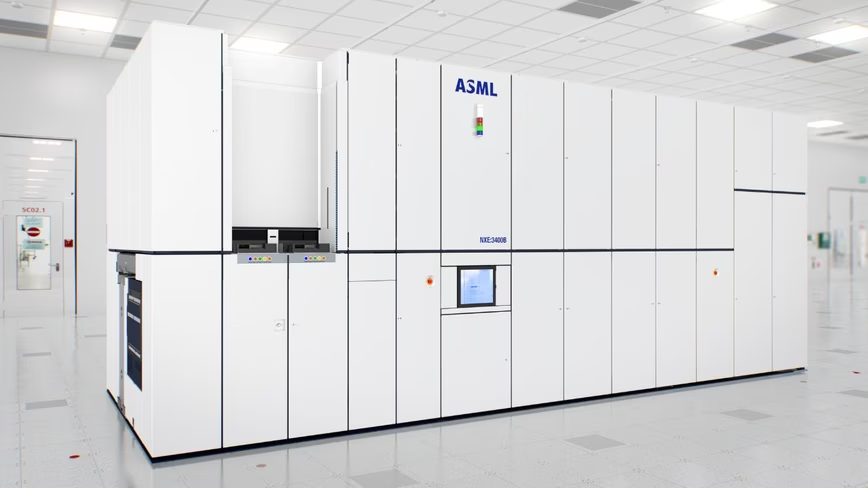
💡Geopolitical tensions over lithography tools directly threaten the global supply of AI-critical high-end chips.
⚡ 30-Second TL;DR
What Changed
US Commerce Secretary Howard Lutnick confronted ASML leadership regarding the alleged tool shipment.
Why It Matters
Heightened export controls could further restrict access to advanced lithography tools, impacting AI hardware development timelines.
What To Do Next
Monitor your hardware supply chain dependencies for potential disruptions caused by tightening semiconductor export regulations.
Key Points
- •US Commerce Secretary Howard Lutnick confronted ASML leadership regarding the alleged tool shipment.
- •ASML officially denies that any of its restricted cutting-edge equipment has entered China.
- •The US government has not yet provided public evidence to support its claim.
🧠 Deep Insight
AI-generated analysis for this event — not the original article.
🔑 Enhanced Key Takeaways
- •The dispute centers on the potential unauthorized transfer of Extreme Ultraviolet (EUV) lithography systems, which are already subject to a total export ban to China under existing Dutch and US regulations.
- •Howard Lutnick's involvement as Commerce Secretary marks a shift toward more aggressive, high-level diplomatic pressure on European semiconductor equipment suppliers compared to previous administrations.
- •ASML's internal investigation protocols involve tracking the unique identifiers and software activation keys of every high-end machine, which the company claims would make an undetected shipment impossible.
- •Industry analysts suggest the US suspicion may stem from intelligence regarding 'smuggled' or 'refurbished' older Deep Ultraviolet (DUV) machines being modified to perform advanced processes, rather than a new EUV shipment.
- •The Dutch government, which holds the ultimate authority over ASML's export licenses, has reportedly expressed frustration with the US for publicly escalating the issue without sharing specific intelligence.
🛠️ Technical Deep Dive
- EUV (Extreme Ultraviolet) lithography uses 13.5nm wavelength light to print features on silicon wafers, enabling sub-7nm process nodes.
- DUV (Deep Ultraviolet) immersion lithography, specifically the NXT:2000i and later series, is the primary focus of current export restrictions due to its capability to support multi-patterning for advanced nodes.
- ASML's 'Guardian' software system requires periodic authentication and remote connectivity to the company's servers, which serves as a primary control mechanism for preventing unauthorized use of restricted hardware.
🔮 Future ImplicationsAI analysis grounded in cited sources
⏳ Timeline
📰 Event Coverage
Weekly AI Recap
Read this week's curated digest of top AI events →
👉Related Updates



AI-curated news aggregator. All content rights belong to original publishers.
Original source: The Next Web (TNW) ↗
This is a summary, not the original. Read the source, or get the weekly briefing.
Weekly AI briefing
One email a week. Unsubscribe anytime.