US Air Force CCA Drone Fires Live Missile
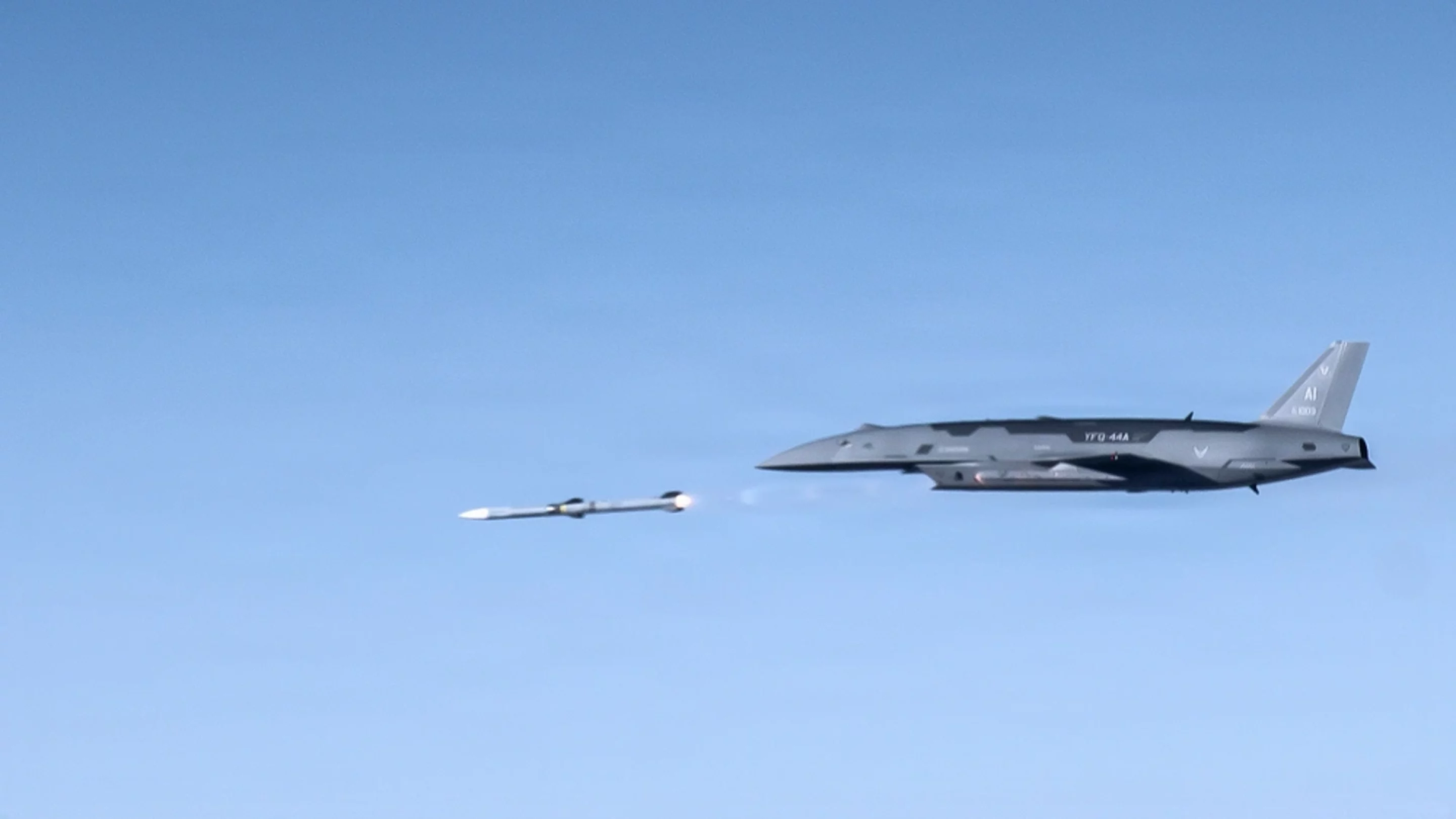
💡First successful live-fire test for autonomous wingman drones, setting a new standard for AI in defense robotics.
⚡ 30-Second TL;DR
What Changed
YFQ-44A drone successfully engaged a simulated target with an AIM-120 missile.
Why It Matters
This development signals a shift toward autonomous aerial warfare, requiring AI practitioners to focus on robust edge-computing and real-time target acquisition algorithms for defense.
What To Do Next
Review the latest defense-related autonomous flight control documentation from Anduril to understand edge AI integration requirements.
Key Points
- •YFQ-44A drone successfully engaged a simulated target with an AIM-120 missile.
- •The test validates the integration of autonomous systems with advanced weapon platforms.
- •This achievement accelerates the development of the Collaborative Combat Aircraft program.
🧠 Deep Insight
AI-generated analysis for this event.
🔑 Enhanced Key Takeaways
- •The YFQ-44A, developed by Anduril as part of the CCA Increment 1 program, utilizes the Lattice OS for autonomous mission execution and sensor fusion.
- •This live-fire test was conducted at Eglin Air Force Base's test ranges, specifically targeting a BQM-167 subscale aerial target.
- •The integration of the AIM-120 AMRAAM required specific modifications to the drone's internal weapons bay to ensure safe separation and data link connectivity during flight.
- •The CCA program aims to field a fleet of at least 1,000 autonomous aircraft to operate alongside manned platforms like the F-35 and the future NGAD fighter.
- •Anduril was selected as one of two prime contractors for the CCA program, competing against General Atomics to finalize production designs for the Air Force.
📊 Competitor Analysis▸ Show
| Feature | Anduril YFQ-44A | General Atomics Gambit | Boeing MQ-28 Ghost Bat |
|---|---|---|---|
| Primary Focus | Modular/Open Architecture | High-Speed/Multi-Mission | Long-Range/Sensor Integration |
| Status | Live-Fire Validated | Prototype Testing | Operational/Flight Testing |
| Key Advantage | Lattice OS Autonomy | Manufacturing Scalability | Proven Manned-Teaming |
🛠️ Technical Deep Dive
- Platform: YFQ-44A Loyal Wingman (CCA Increment 1).
- Software Architecture: Lattice OS, an AI-enabled mission autonomy platform designed for decentralized command and control.
- Weapon Integration: Internal weapons bay configured for AIM-120 AMRAAM; utilizes MIL-STD-1760 interface for weapon-to-platform communication.
- Propulsion: Single-engine turbofan optimized for subsonic to transonic cruise efficiency.
- Sensor Suite: Multi-spectral EO/IR and passive RF sensors for target acquisition without active radar emission.
🔮 Future ImplicationsAI analysis grounded in cited sources
⏳ Timeline
Weekly AI Recap
Read this week's curated digest of top AI events →
👉Related Updates



AI-curated news aggregator. All content rights belong to original publishers.
Original source: cnBeta (Full RSS) ↗