๐ŸŒFreshcollected in 82m

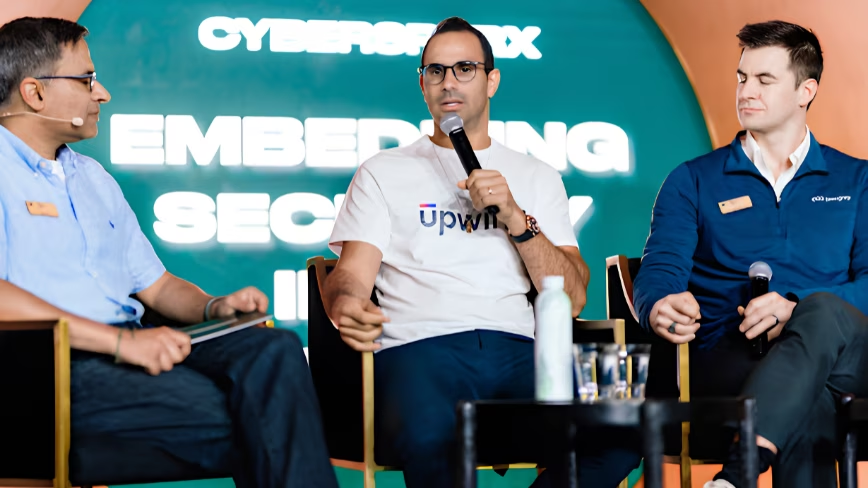
Upwind launches AI Sensor for Endpoints security
Upwind launches AI Sensor for Endpoints security
PostLinkedIn
๐ŸŒRead original on The Next Web (TNW)
#security#endpoint-protection#data-governanceupwind-ai-sensor-for-endpoints

๐Ÿ’กA new tool to secure the bridge between your developers and AI systems.

โšก 30-Second TL;DR

What Changed

New visibility tool for developer devices and AI systems

Why It Matters

Provides security teams with the necessary visibility to govern AI usage and prevent data leakage in enterprise environments.

What To Do Next

Evaluate your current endpoint security stack to see if it provides visibility into AI model API calls and data exfiltration.

Who should care:Enterprise & Security Teams

๐Ÿง  Deep Insight

AI-generated analysis for this event.

๐Ÿ”‘ Enhanced Key Takeaways

  • โ€ขThe AI Sensor for Endpoints leverages eBPF (extended Berkeley Packet Filter) technology to achieve deep observability into kernel-level processes without requiring intrusive agents.
  • โ€ขUpwind's solution specifically targets the prevention of 'Shadow AI' by identifying unauthorized LLM interactions originating from developer workstations.
  • โ€ขThe tool integrates with existing CI/CD pipelines to automatically correlate endpoint data movement with specific code commits and build processes.
  • โ€ขIt provides automated policy enforcement that can block data exfiltration attempts to non-sanctioned AI models in real-time.
  • โ€ขThe sensor is designed to reduce 'alert fatigue' by using behavioral baselining to distinguish between legitimate developer tool usage and anomalous data transfers.
๐Ÿ“Š Competitor Analysisโ–ธ Show
FeatureUpwind AI SensorWiz (Cloud Security)Palo Alto Networks (Prisma)
Endpoint FocusHigh (Developer-centric)Low (Cloud-centric)Medium (Broad Enterprise)
eBPF NativeYesYesYes
AI Data TrackingSpecializedGeneralGeneral
Pricing ModelUsage-basedAsset-basedSubscription-based

๐Ÿ› ๏ธ Technical Deep Dive

  • Utilizes eBPF programs to monitor system calls and network sockets on developer endpoints with minimal performance overhead.
  • Implements kernel-level hooks to intercept data streams before they are encrypted by browser or application-level TLS.
  • Employs a lightweight local inference engine to classify data sensitivity (PII, secrets, proprietary code) before transmission.
  • Architecture supports asynchronous data streaming to the Upwind backend to ensure developer productivity is not impacted by latency.
  • Integrates with identity providers (IdP) to map data movement to specific developer identities and roles.

๐Ÿ”ฎ Future ImplicationsAI analysis grounded in cited sources

Endpoint security will shift from signature-based detection to behavioral AI-data flow analysis.
As developers increasingly use local LLMs, traditional antivirus tools cannot effectively monitor the context of data being processed.
eBPF-based observability will become the industry standard for developer workstation security.
The need for deep visibility without kernel instability makes eBPF the most viable technical path for monitoring modern, complex developer environments.

โณ Timeline

2023-05
Upwind emerges from stealth with a focus on cloud-native security and runtime protection.
2024-02
Upwind announces Series A funding to expand its cloud security platform capabilities.
2025-09
Upwind expands platform to include AI security posture management (AI-SPM) features.
2026-06
Launch of AI Sensor for Endpoints to extend visibility to developer devices.
๐Ÿ“ฐ

Weekly AI Recap

Read this week's curated digest of top AI events โ†’

๐Ÿ‘‰Related Updates

AI-curated news aggregator. All content rights belong to original publishers.
Original source: The Next Web (TNW) โ†—