Unitree’s Three-Hour Embodied AI Response
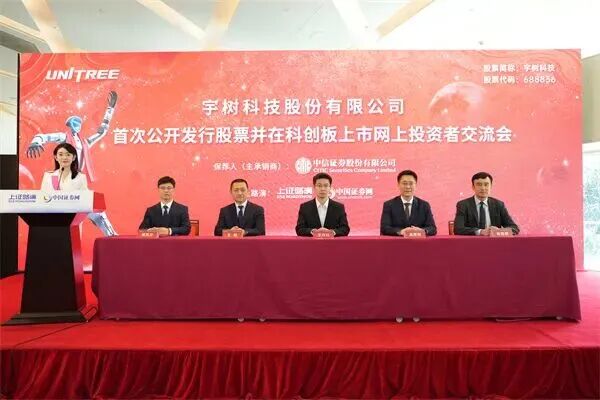
See why Unitree’s latest public response could shape the next embodied-AI IPO cycle.
30-Second TL;DR
What Changed
Wang Xingxing and Unitree Robotics responded publicly over a three-hour period.
Why It Matters
The article matters to robotics founders and builders because it signals increasing scrutiny of embodied-AI companies before public listings. It may also encourage teams to strengthen public communication, product evidence, and commercialization narratives.
What To Do Next
Review Unitree’s official SDK and robot documentation, then map its sensing, control, and deployment interfaces against your robotics prototype.
Key Points
- •Wang Xingxing and Unitree Robotics responded publicly over a three-hour period.
- •The discussion is connected to the growing focus on embodied AI companies.
- •The episode may influence perceptions of the embodied-AI IPO market.
Deep Insight
AI-generated analysis for this event — not the original article.
Enhanced Key Takeaways
- •The 'three-hour response' refers to a high-intensity, marathon-style live stream or public Q&A session where Wang Xingxing addressed market skepticism regarding Unitree's hardware-to-AI transition.
- •Unitree has been aggressively pivoting from a pure quadruped robot manufacturer to an embodied AI platform provider, specifically focusing on the integration of large multimodal models (LMMs) into their G1 and H1 humanoid series.
- •Market analysts view this specific public engagement as a strategic move to stabilize investor confidence following volatility in the Chinese robotics sector's valuation multiples.
- •The discussion highlighted Unitree's proprietary 'Unitree World Model' development, which aims to reduce reliance on third-party foundation models for real-time motor control and spatial reasoning.
- •The event served as a litmus test for the 'Embodied AI IPO' narrative, as Unitree is widely considered one of the most likely candidates to lead the next wave of robotics-focused public offerings in the Hong Kong or mainland Chinese markets.
Competitor Analysis
- Unitree (G1/H1)
- Cost-effective mass production
- Tesla (Optimus)
- End-to-end neural control
- Figure AI
- Commercial labor automation
- Boston Dynamics (Atlas)
- R&D and industrial agility
- Unitree (G1/H1)
- Aggressive entry-level ($16k+)
- Tesla (Optimus)
- Projected mass-market scale
- Figure AI
- High-end enterprise
- Boston Dynamics (Atlas)
- Premium/Custom
- Unitree (G1/H1)
- High torque-to-weight ratio
- Tesla (Optimus)
- FSD-derived vision stack
- Figure AI
- OpenAI-integrated reasoning
- Boston Dynamics (Atlas)
- Hydraulic/Electric hybrid power
| Feature | Unitree (G1/H1) | Tesla (Optimus) | Figure AI | Boston Dynamics (Atlas) |
|---|---|---|---|---|
| Primary Focus | Cost-effective mass production | End-to-end neural control | Commercial labor automation | R&D and industrial agility |
| Pricing Strategy | Aggressive entry-level ($16k+) | Projected mass-market scale | High-end enterprise | Premium/Custom |
| Key Benchmark | High torque-to-weight ratio | FSD-derived vision stack | OpenAI-integrated reasoning | Hydraulic/Electric hybrid power |
Technical Deep Dive
- Unitree utilizes a proprietary joint actuator design that achieves high torque density, critical for the dynamic stability required in embodied AI tasks.
- The embodied AI stack integrates reinforcement learning (RL) with transformer-based architectures to enable zero-shot generalization in unstructured environments.
- Implementation involves a hierarchical control system where high-level semantic tasks are processed via LMMs, while low-level motor control is handled by high-frequency (1kHz+) controllers.
- The G1 humanoid incorporates a specialized vision-language-action (VLA) model that maps visual inputs directly to joint position commands, bypassing traditional hard-coded kinematics.
Future ImplicationsAI analysis grounded in cited sources
Timeline
- 2017-08Unitree Robotics founded by Wang Xingxing.
- 2021-06Launch of the B1 industrial quadruped robot.
- 2023-08Release of the H1 general-purpose humanoid robot.
- 2024-05Launch of the G1 humanoid agent, signaling a shift toward embodied AI.
- 2026-08Wang Xingxing conducts the three-hour public response session regarding embodied AI strategy.
Weekly AI Recap
Read this week's curated digest of top AI events →
AI-curated news aggregator. All content rights belong to original publishers.
Original source: 钛媒体 ↗
This is a summary, not the original. Read the source, or get the weekly briefing.
The weekly digest
One email a week. Unsubscribe anytime.