Unitree's Struggle for Market Leadership
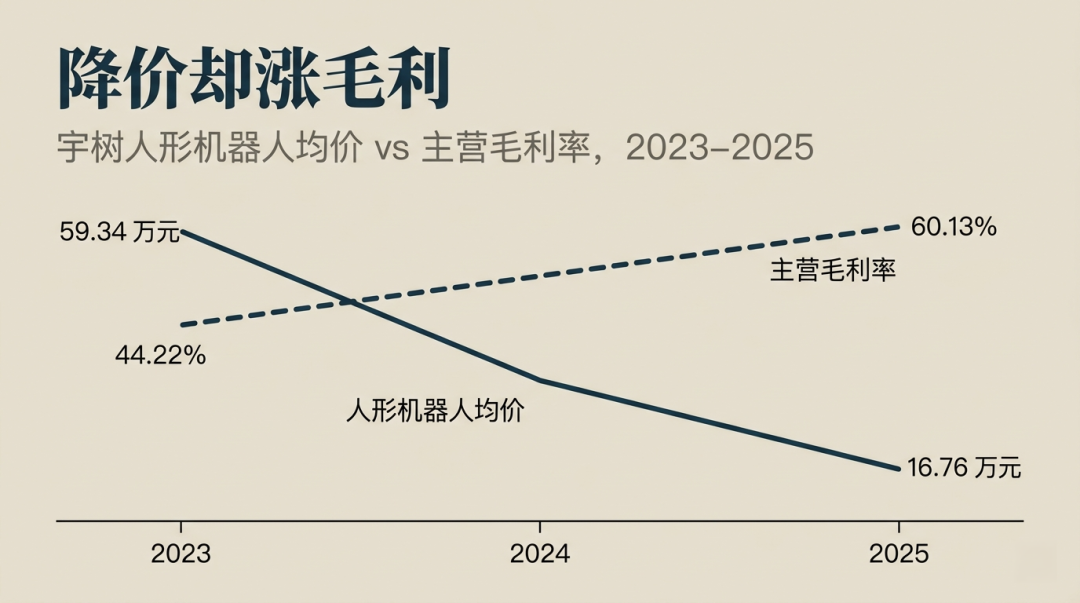
💡Understand the economic challenges facing top humanoid robot manufacturers in a shifting market.
⚡ 30-Second TL;DR
What Changed
Unitree's net profit after deduction fell by 52.55%.
Why It Matters
The robotics sector is moving from hardware-centric to value-added service models, forcing hardware leaders to pivot their business strategies.
What To Do Next
Monitor Unitree's software-as-a-service (SaaS) offerings to see how they plan to monetize their hardware base.
Key Points
- •Unitree's net profit after deduction fell by 52.55%.
- •The company holds a leading global shipment position.
- •Rapid industry value shifts threaten long-term profitability.
🧠 Deep Insight
AI-generated analysis for this event — not the original article.
🔑 Enhanced Key Takeaways
- •Unitree has aggressively pursued a 'price-disruptor' strategy, launching the G1 humanoid robot at a sub-$16,000 price point to capture early market share.
- •The company's R&D expenditure has surged significantly as it pivots from quadrupedal robots to general-purpose humanoid platforms, impacting short-term net margins.
- •Unitree is increasingly focusing on vertical integration of core components, including self-developed joint motors and actuators, to reduce reliance on third-party suppliers.
- •The firm has expanded its commercial footprint by establishing strategic partnerships with automotive manufacturers for factory-floor pilot testing of its humanoid robots.
- •Supply chain volatility and the rising cost of high-performance sensors and AI compute modules have been identified as primary drivers for the recent decline in net profitability.
📊 Competitor Analysis▸ Show
| Feature | Unitree (G1/H1) | Tesla (Optimus) | Figure AI (Figure 02) |
|---|---|---|---|
| Target Market | Research/Commercial | Mass Manufacturing | Industrial/Logistics |
| Pricing | ~$16,000 (Entry) | Est. $20k-$30k | Premium/Enterprise |
| Key Strength | Cost/Agility | AI/Scale | Humanoid Dexterity |
🛠️ Technical Deep Dive
- Actuator Technology: Utilizes high-torque density joint motors with integrated planetary gearboxes to achieve high dynamic response.
- Control Architecture: Employs reinforcement learning-based locomotion controllers combined with traditional model predictive control (MPC) for stability.
- Sensing: Integrates multi-modal sensor suites including 3D LiDAR, depth cameras, and IMUs for real-time SLAM and obstacle avoidance.
- Compute: Leverages edge AI processing units capable of handling real-time kinematic calculations and low-latency motor control loops.
🔮 Future ImplicationsAI analysis grounded in cited sources
⏳ Timeline
Weekly AI Recap
Read this week's curated digest of top AI events →
👉Related Updates



AI-curated news aggregator. All content rights belong to original publishers.
Original source: 钛媒体 ↗
This is a summary, not the original. Read the source, or get the weekly briefing.
The weekly digest
One email a week. Unsubscribe anytime.