Unitree Robotics Set to Debut on Shanghai’s STAR Market
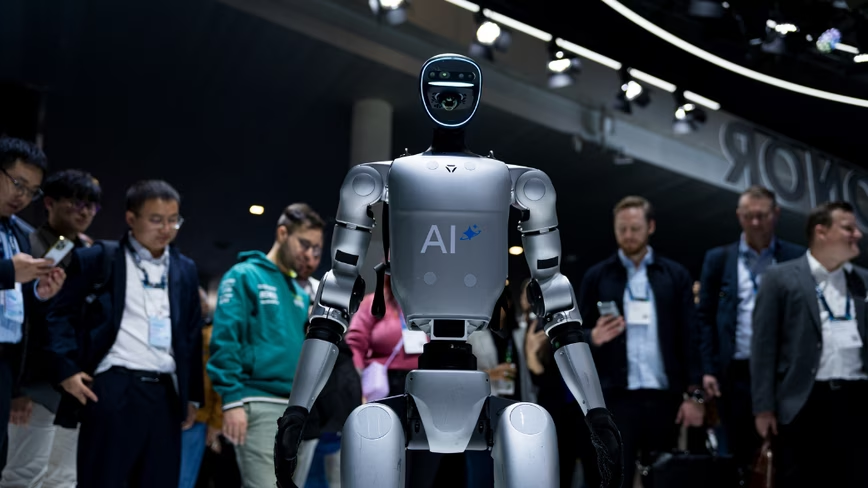
💡Unitree’s landmark listing signals rising capital and competition in China’s humanoid robotics market.
⚡ 30-Second TL;DR
What Changed
Trading is scheduled to start on Shanghai’s STAR Market on 19 August.
Why It Matters
Unitree’s listing could give embodied-AI startups greater visibility and improve access to capital for robotics development. It may also intensify competition among Chinese humanoid robot companies seeking commercial deployments.
What To Do Next
Review Unitree Robotics’ available SDK and robot deployment specifications to assess whether its platforms fit your embodied-AI prototype roadmap.
Key Points
- •Trading is scheduled to start on Shanghai’s STAR Market on 19 August.
- •Unitree would become the first general-purpose humanoid robot maker listed on mainland China’s stock market.
- •The listing follows record investor demand and highlights China’s growing humanoid robotics sector.
🧠 Deep Insight
AI-generated analysis for this event.
🔑 Enhanced Key Takeaways
- •Unitree's IPO is expected to raise approximately 3.5 billion RMB, significantly exceeding initial capital raising targets due to institutional oversubscription.
- •The company has secured strategic partnerships with major Chinese automotive manufacturers to integrate humanoid robots into assembly lines by Q4 2026.
- •Unitree's valuation at the time of listing is estimated at 28 billion RMB, reflecting a premium valuation compared to traditional industrial robotics firms.
- •The listing is supported by the Shanghai Municipal Government's 'AI+ Robotics' initiative, which provides tax incentives and R&D subsidies for companies on the STAR Market.
- •Unitree has reported a 140% year-over-year revenue growth for the first half of 2026, driven primarily by the commercial adoption of the G1 and H1 humanoid series.
📊 Competitor Analysis▸ Show
| Feature | Unitree (H1/G1) | Tesla (Optimus) | Figure AI | Boston Dynamics (Atlas) |
|---|---|---|---|---|
| Primary Market | Commercial/Industrial | Internal/Automotive | Industrial/Logistics | R&D/Industrial |
| Pricing | ~$16,000 - $90,000 | Projected <$20,000 | Undisclosed | High (Premium) |
| Key Benchmark | High torque-to-weight ratio | FSD-based neural net | OpenAI-integrated LLM | Hydraulic/Electric hybrid |
🛠️ Technical Deep Dive
- Actuator Technology: Utilizes proprietary high-torque joint motors with integrated planetary gearboxes to achieve high power density.
- Control Architecture: Employs a hierarchical control system combining Whole-Body Control (WBC) for stability and Reinforcement Learning (RL) for complex locomotion.
- Sensing Suite: Integrates 3D LiDAR, depth cameras, and IMU sensors for real-time SLAM and obstacle avoidance.
- Battery System: Features a high-energy-density lithium-ion pack designed for 2-3 hours of continuous operation in industrial environments.
- Software Stack: Runs on a customized Linux-based real-time operating system with support for ROS 2 and proprietary simulation environments for digital twin training.
🔮 Future ImplicationsAI analysis grounded in cited sources
⏳ Timeline
Weekly AI Recap
Read this week's curated digest of top AI events →
👉Related Updates


AI-curated news aggregator. All content rights belong to original publishers.
Original source: The Next Web (TNW) ↗