Unitree Robotics IPO Registration Becomes Effective
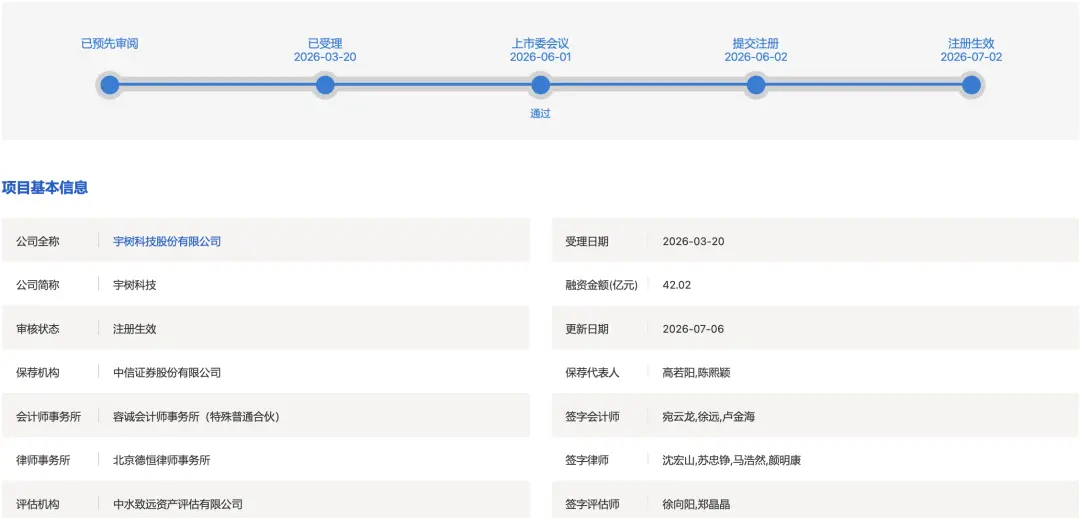
💡Leading robotics firm Unitree goes public; a major signal for the growth of the embodied AI and humanoid market.
⚡ 30-Second TL;DR
What Changed
Unitree Robotics IPO registration on the STAR Market is now effective.
Why It Matters
Unitree's public listing will likely accelerate R&D investment in humanoid robotics and embodied AI, intensifying competition in the global robotics market.
What To Do Next
Monitor Unitree's public financial disclosures to track their R&D spending on embodied AI and motor control algorithms.
Key Points
- •Unitree Robotics IPO registration on the STAR Market is now effective.
- •The company passed regulatory review regarding issuance and information disclosure requirements.
- •This marks a significant milestone for the Chinese embodied AI and robotics industry.
🧠 Deep Insight
AI-generated analysis for this event — not the original article.
🔑 Enhanced Key Takeaways
- •Unitree Robotics has positioned itself as a leader in cost-effective robotics by leveraging a vertically integrated supply chain, allowing them to produce humanoid robots at a significantly lower price point than Western counterparts.
- •The IPO proceeds are earmarked primarily for the expansion of their 'Embodied AI' research center and the construction of a new automated manufacturing facility in Hangzhou.
- •Unitree's G1 and H1 humanoid models have recently integrated advanced Large World Models (LWM) to improve real-time environmental interaction and autonomous decision-making capabilities.
- •The company has secured strategic partnerships with major Chinese automotive manufacturers to pilot their humanoid robots in assembly line tasks, moving beyond R&D into industrial deployment.
- •Unitree's valuation at the time of the STAR Market IPO filing reflects a significant premium driven by their rapid iteration cycles, which have seen new hardware generations released every 12-18 months.
📊 Competitor Analysis▸ Show
| Feature | Unitree Robotics | Tesla (Optimus) | Boston Dynamics | Figure AI |
|---|---|---|---|---|
| Primary Focus | Consumer/Industrial | Mass Production | R&D/Logistics | Industrial/General Purpose |
| Pricing Strategy | Low-cost/Accessible | Target <$20k | High-end/Premium | Enterprise/High-end |
| Key Advantage | Rapid Iteration | Scale/AI Integration | Mobility/Robustness | OpenAI Partnership |
🛠️ Technical Deep Dive
- Actuator Technology: Utilizes proprietary high-torque density joint motors with integrated planetary gearboxes to achieve high power-to-weight ratios.
- Control Architecture: Employs a hierarchical control system combining Whole-Body Control (WBC) for stability and Reinforcement Learning (RL) for complex locomotion tasks.
- Sensing Suite: Integrates 3D LiDAR, depth cameras, and force/torque sensors at the extremities to enable tactile feedback and SLAM (Simultaneous Localization and Mapping).
- Compute: Runs on a distributed computing architecture, offloading heavy perception tasks to onboard high-performance AI accelerators while maintaining low-latency loops for motor control.
🔮 Future ImplicationsAI analysis grounded in cited sources
⏳ Timeline
Weekly AI Recap
Read this week's curated digest of top AI events →
👉Related Updates



AI-curated news aggregator. All content rights belong to original publishers.
Original source: cnBeta (Full RSS) ↗
This is a summary, not the original. Read the source, or get the weekly briefing.
Weekly AI briefing
One email a week. Unsubscribe anytime.