Unitree G1 Robot Flies on Commercial Plane
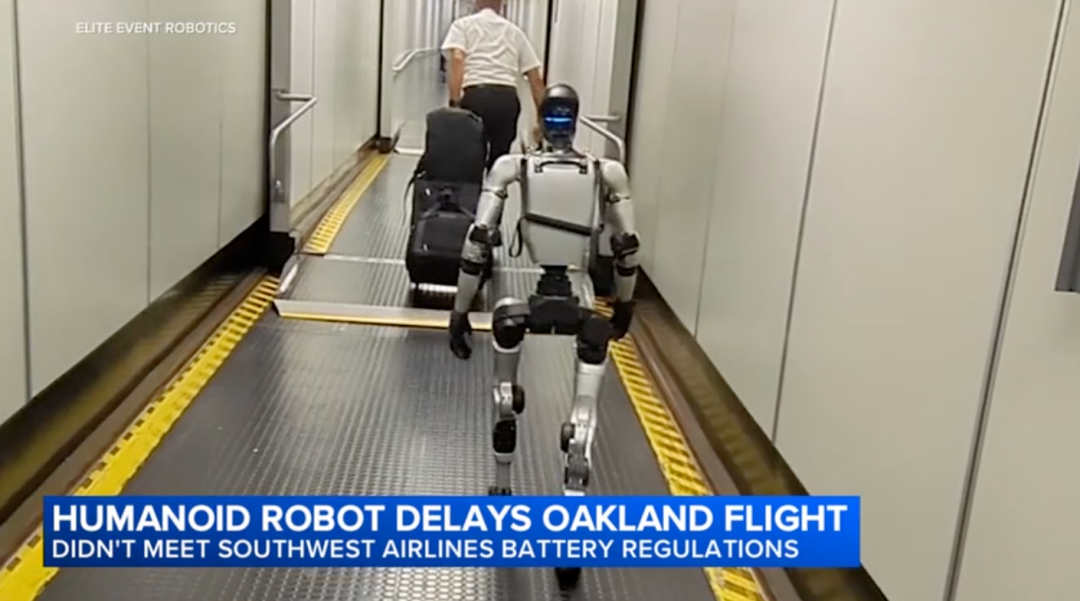
Humanoid robot boards plane but battery regs ground it—key logistics hurdle for embodied AI
30-Second TL;DR
What Changed
Unitree G1 robot Bebop purchased seat on Southwest flight 1568 from Oakland to San Diego
Why It Matters
This real-world deployment tests aviation rules for humanoid robots, potentially influencing future transport standards for embodied AI in commercial events. It underscores battery safety as a key bottleneck for mobile robotics.
What To Do Next
Assess FAA lithium battery limits for humanoid robot prototypes before field deployments.
Key Points
- •Unitree G1 robot Bebop purchased seat on Southwest flight 1568 from Oakland to San Diego
- •Battery over 160Wh confiscated per FAA lithium battery rules, rendering robot immobile
- •Robot navigated airport independently, posed for photos, and was secured with seatbelt
- •Event used for Elite Event Robotics rental at medical conference in Chicago
Deep Insight
AI-generated analysis for this event — not the original article.
Enhanced Key Takeaways
- •The incident has sparked a formal review by the FAA regarding the classification of humanoid robots in commercial aviation, specifically addressing whether they should be categorized as 'assistive devices' or 'cargo' when occupying a seat.
- •Unitree Robotics has publicly stated that the G1's battery pack is modular and designed for quick removal, a feature intended to facilitate compliance with international air travel regulations, though this specific flight highlighted a gap in airline-specific enforcement protocols.
- •Elite Event Robotics, the rental agency involved, has updated its standard operating procedures to require pre-flight battery capacity verification and the use of TSA-approved shipping cases for all future humanoid robot transport.
Competitor Analysis
- Unitree G1
- Consumer/Research
- Tesla Optimus Gen 2
- Industrial/Consumer
- Figure 02
- Industrial/Commercial
- Boston Dynamics Atlas (Electric)
- Industrial/Research
- Unitree G1
- ~$16,000
- Tesla Optimus Gen 2
- TBD (Target <$20k)
- Figure 02
- High (Enterprise)
- Boston Dynamics Atlas (Electric)
- High (Enterprise)
- Unitree G1
- Dynamic/Agile
- Tesla Optimus Gen 2
- Human-like gait
- Figure 02
- Advanced manipulation
- Boston Dynamics Atlas (Electric)
- Parkour-capable
- Unitree G1
- Modular/Removable
- Tesla Optimus Gen 2
- Integrated
- Figure 02
- Integrated
- Boston Dynamics Atlas (Electric)
- Integrated
| Feature | Unitree G1 | Tesla Optimus Gen 2 | Figure 02 | Boston Dynamics Atlas (Electric) |
|---|---|---|---|---|
| Target Market | Consumer/Research | Industrial/Consumer | Industrial/Commercial | Industrial/Research |
| Base Price | ~$16,000 | TBD (Target <$20k) | High (Enterprise) | High (Enterprise) |
| Mobility | Dynamic/Agile | Human-like gait | Advanced manipulation | Parkour-capable |
| Battery | Modular/Removable | Integrated | Integrated | Integrated |
Technical Deep Dive
- Model Architecture: The G1 utilizes a proprietary joint motor system with high torque density, allowing for a wide range of motion including complex squatting and twisting maneuvers.
- Control System: Features a reinforcement learning-based locomotion controller that enables autonomous navigation in unstructured environments like airport terminals.
- Power Specifications: The standard battery pack is typically rated at approximately 180-200Wh, which exceeds the FAA's 160Wh limit for lithium-ion batteries in carry-on or checked luggage without special operator approval.
- Sensors: Equipped with a 3D LiDAR and depth camera suite for real-time SLAM (Simultaneous Localization and Mapping) and obstacle avoidance.
Future ImplicationsAI analysis grounded in cited sources
Timeline
- 2024-05Unitree officially unveils the G1 humanoid robot, positioning it as an affordable, mass-producible platform.
- 2024-08Unitree begins mass production and initial shipments of the G1 to research institutions and early adopters.
- 2025-11Unitree announces software updates for the G1, significantly improving autonomous navigation and interaction capabilities.
- 2026-05The 'Bebop' G1 unit is involved in the Southwest Airlines transport incident, highlighting regulatory gaps.
Weekly AI Recap
Read this week's curated digest of top AI events →
AI-curated news aggregator. All content rights belong to original publishers.
Original source: 虎嗅 ↗
This is a summary, not the original. Read the source, or get the weekly briefing.
The weekly digest
One email a week. Unsubscribe anytime.