Understanding the Safety-Usefulness Tradeoff Model in AI
💡Learn how to strategically align AI safety goals with developer incentives and organizational constraints.
⚡ 30-Second TL;DR
What Changed
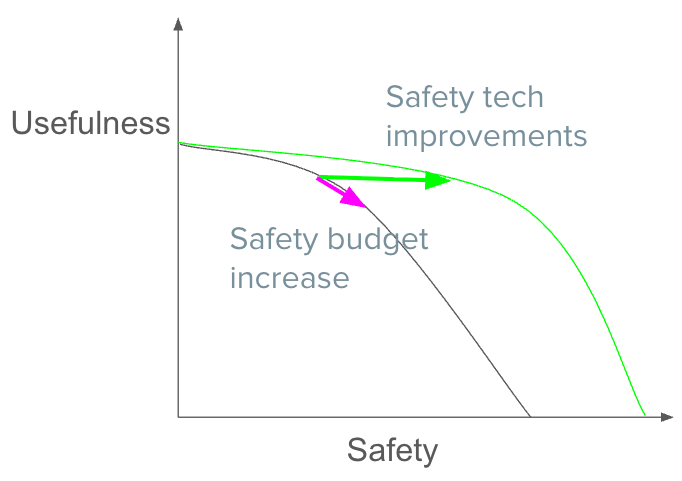
The safety-usefulness model assumes developers face a cost-efficiency constraint when implementing safety measures.
Why It Matters
Provides a conceptual framework for AI practitioners to evaluate how safety interventions are adopted within organizational constraints. It helps researchers identify which levers—technical or political—are most effective for risk mitigation.
What To Do Next
Map your current safety initiatives against the 'rushed developer' vs 'limited political will' framework to determine if you need better technical tools or better stakeholder advocacy.
Key Points
- •The safety-usefulness model assumes developers face a cost-efficiency constraint when implementing safety measures.
- •Safety improvements can be achieved by pushing the Pareto frontier or increasing the developer's safety budget.
- •Developer motivations vary between shared-value alignment and external stakeholder pressure.
- •Strategies for AI risk reduction must be adapted based on whether the developer is acting under constraints or conflicting priorities.
🧠 Deep Insight
Background and context from public sources — not the original article. 12 sources cited.
🔑 Enhanced Key Takeaways
- •The 'Capability-Safety Pareto Frontier' is a conceptual framework from multi-agent safety research that challenges the traditional zero-sum assumption, positing that both AI capability and safety can improve simultaneously through effective governance design in multi-agent systems.
- •Leading AI laboratories, including Anthropic, OpenAI, Google DeepMind, Meta, and Amazon, have publicly released detailed 'Frontier Safety Frameworks' that define thresholds, risk domains, evaluation methods, and governance procedures, indicating a structured, industry-wide effort to manage risks from advanced AI models.
- •Technical advancements like the Adaptive Safe Context Learning (ASCL) framework and Inverse Frequency Policy Optimization (IFPO) are being developed to specifically mitigate the safety-utility tradeoff in Large Language Models (LLMs) by enabling models to autonomously decide when to consult safety rules and how to generate reasoning, thereby decoupling rule retrieval from reasoning for improved performance.
- •The 'filter fallacy' suggests that AI models cannot be truly 'cleaned' of harmful capabilities, as the capacity to produce unsafe outputs is an inherent residue of the same statistical learning that generates helpful behaviors; training primarily makes harmful responses harder to reach by default, rather than eliminating them.
- •A significant challenge in AI risk reduction stems from misaligned incentives, where those most vulnerable to AI risks (e.g., the public) are often not those primarily responsible for addressing them (e.g., developers, governance actors), leading to competitive pressures that can disincentivize sufficient investment in safety measures by individual developers.
🛠️ Technical Deep Dive
- Safety alignment capabilities in AI models are achieved through techniques such as Reinforcement Learning from Human Feedback (RLHF) and preference optimization, enabling models to autonomously refuse unsafe or malicious outputs.
- Recent technical advances to mitigate vulnerabilities include low-rank updates, explicit reasoning pipelines, and inference-time interventions.
- Preference-based alignment methods, including DPO, Safe-NCA, and IPO, can significantly increase global safety scores (e.g., from ~58% to ~99.9%) and reduce output toxicity, but often result in reductions in general capability, illustrating a persistent safety-utility tradeoff.
- The Adaptive Safe Context Learning (ASCL) framework addresses the safety-utility tradeoff by formulating safety alignment as a multi-turn tool-use process, allowing the model to decide when to consult safety rules and how to generate reasoning.
- ASCL incorporates Inverse Frequency Policy Optimization (IFPO) to rebalance advantage estimates, aiming to decouple rule retrieval from subsequent reasoning and achieve higher overall performance.
- 'Utility Engineering' is an approach focused on actively steering an AI system's utility function to align its emergent value system with desired preferences, such as those of a citizen assembly, rather than allowing values to emerge arbitrarily from training data.
🔮 Future ImplicationsAI analysis grounded in cited sources
⏳ Timeline
📎 Sources (12)
Factual claims are grounded in the sources below. Forward-looking analysis is AI-generated interpretation.
Weekly AI Recap
Read this week's curated digest of top AI events →
👉Related Updates
AI-curated news aggregator. All content rights belong to original publishers.
Original source: AI Alignment Forum ↗
This is a summary, not the original. Read the source, or get the weekly briefing.
The weekly digest
One email a week. Unsubscribe anytime.