Understanding Inner and Outer Loops in AI Coding
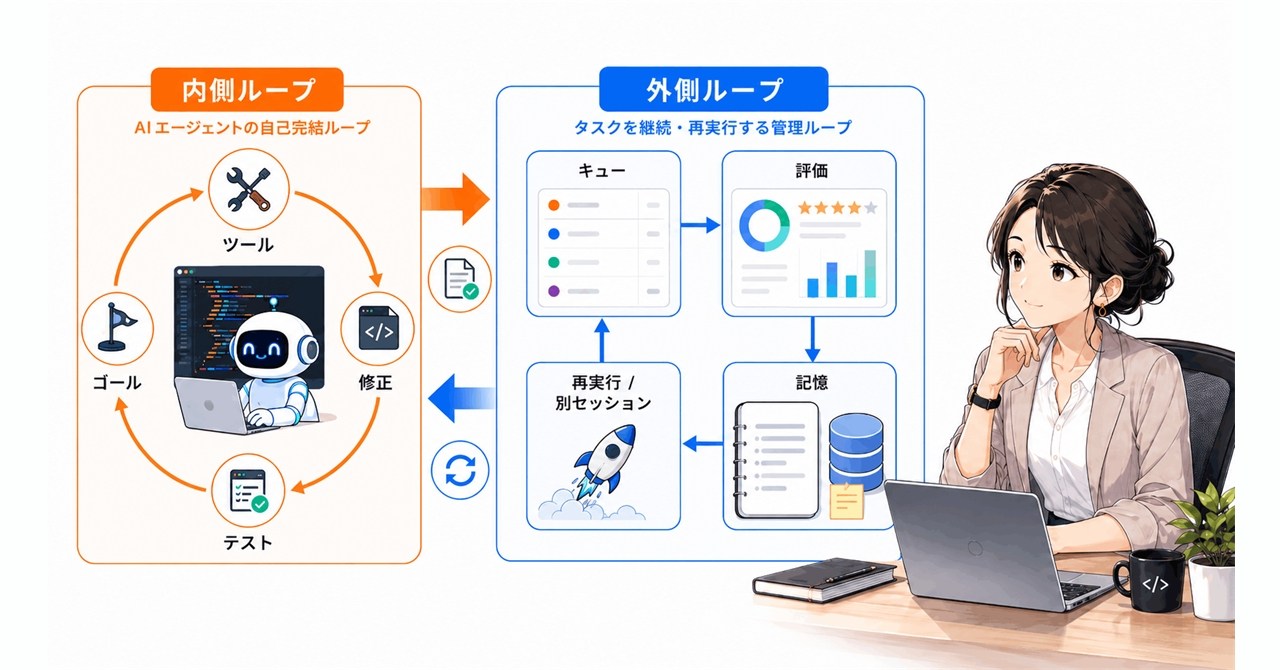
Master the architectural patterns required to build reliable, long-running AI coding agents.
30-Second TL;DR
What Changed
Distinction between agent-driven inner loops and harness-driven outer loops
Why It Matters
Understanding these loop structures is critical for developers building autonomous coding agents that require long-term context and reliability.
What To Do Next
Review your agent's architecture to ensure the outer loop (harness) effectively manages state persistence to prevent context loss during complex tasks.
Key Points
- •Distinction between agent-driven inner loops and harness-driven outer loops
- •Challenges of maintaining state and memory across long-running AI coding tasks
- •Practical architectural patterns for building robust AI software engineering agents
Deep Insight
AI-generated analysis for this event — not the original article.
Enhanced Key Takeaways
- •The 'inner loop' typically refers to the iterative cycle of code generation, compilation, and local testing performed by an agent, while the 'outer loop' encompasses CI/CD integration, security scanning, and deployment validation.
- •State management in long-running AI coding tasks is increasingly being solved through 'context window orchestration' techniques, such as RAG-based memory retrieval and hierarchical summarization of past interaction logs.
- •Modern AI software engineering frameworks are adopting 'checkpointing' mechanisms that allow agents to pause and resume complex coding tasks without losing the semantic state of the codebase.
- •The integration of 'formal verification' tools within the outer loop is emerging as a critical pattern to ensure that AI-generated code meets safety and compliance standards before human review.
- •Industry benchmarks for AI coding agents are shifting from simple pass@k metrics to 'task completion rates' that measure the agent's ability to navigate multi-file repositories and maintain architectural consistency over time.
Technical Deep Dive
- Inner Loop Architecture: Utilizes local LLM inference or API-based agents coupled with ephemeral sandboxed environments (e.g., Docker containers or WebAssembly runtimes) for immediate execution feedback.
- Outer Loop Orchestration: Employs workflow engines like Temporal or custom Kubernetes operators to manage long-lived state, handle retries, and coordinate multi-agent interactions.
- Memory Management: Implements vector databases (e.g., Pinecone, Milvus) for semantic code search and graph-based memory structures to track dependency relationships across large-scale repositories.
- Feedback Loops: Incorporates static analysis tools (e.g., SonarQube, ESLint) and dynamic testing frameworks (e.g., PyTest, Jest) as automated guardrails within the harness.
Future ImplicationsAI analysis grounded in cited sources
Timeline
- 2023-06Emergence of early autonomous coding agents like AutoGPT and BabyAGI highlighting the need for structured loop management.
- 2024-03Introduction of Devin by Cognition AI, popularizing the concept of end-to-end autonomous software engineering agents.
- 2025-01Shift in industry focus from simple code generation to complex repository-wide refactoring and maintenance tasks.
- 2025-11Widespread adoption of formal verification and automated security guardrails within AI coding agent workflows.
Weekly AI Recap
Read this week's curated digest of top AI events →
Related Updates
AI-curated news aggregator. All content rights belong to original publishers.
Original source: ITmedia AI+ (日本) ↗
This is a summary, not the original. Read the source, or get the weekly briefing.
The weekly digest
One email a week. Unsubscribe anytime.