Understanding Google DeepMind's SynthID for AI Image Detection
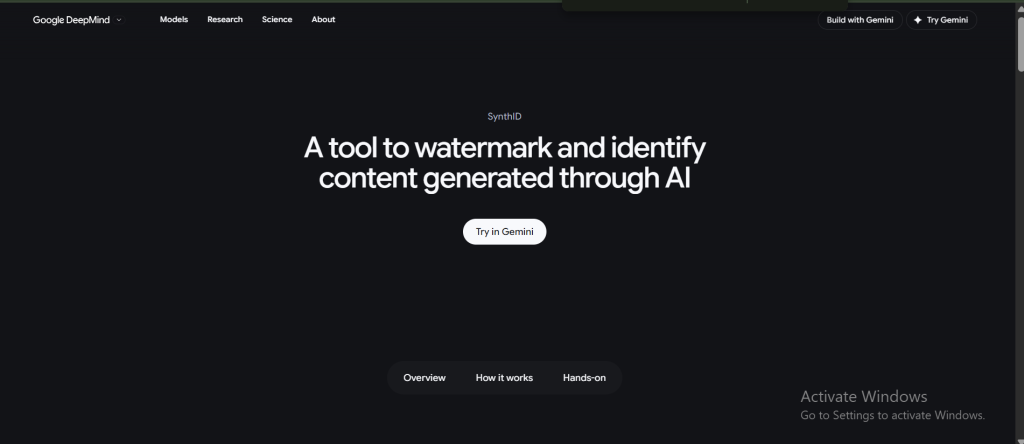
Learn how Google's invisible watermarking technology works to authenticate AI-generated media.
30-Second TL;DR
What Changed
SynthID embeds invisible digital watermarks into AI-generated images.
Why It Matters
SynthID provides a standardized way to track AI-generated content, which is essential for maintaining digital trust. It helps platforms and creators distinguish between human-made and machine-generated assets.
What To Do Next
If you are building an image generation pipeline, integrate SynthID to ensure your model's output is verifiable and compliant with emerging AI transparency standards.
Key Points
- •SynthID embeds invisible digital watermarks into AI-generated images.
- •The technology is designed to persist even if the image is edited, cropped, or resized.
- •It serves as a critical tool for identifying synthetic media and combating misinformation.
Deep Insight
AI-generated analysis for this event — not the original article.
Enhanced Key Takeaways
- •SynthID has been expanded beyond images to include audio, video, and text modalities, allowing for cross-media provenance verification [1].
- •The technology utilizes a dual-approach system: a generative model that embeds the watermark and a separate identification model that detects it with high statistical confidence [1, 2].
- •Google has integrated SynthID into the C2PA (Coalition for Content Provenance and Authenticity) technical standard to promote industry-wide interoperability [3].
- •SynthID is available to third-party developers via the Google Cloud Vertex AI platform, enabling enterprise-level adoption for synthetic media labeling [4].
- •The detection model provides three confidence levels—detected, not detected, and possibly detected—to account for varying degrees of image manipulation [2].
Competitor Analysis
- SynthID
- Image/Audio/Video/Text
- Meta Stable Signature
- Image
- Digimarc
- Image/Audio/Video
- Adobe Content Credentials
- Metadata/C2PA
- SynthID
- Statistical/Neural
- Meta Stable Signature
- Neural Network
- Digimarc
- Frequency Domain
- Adobe Content Credentials
- Cryptographic Metadata
- SynthID
- High (Resilient to edits)
- Meta Stable Signature
- Moderate
- Digimarc
- High (Forensic)
- Adobe Content Credentials
- Low (Stripped by screenshots)
| Feature | SynthID | Meta Stable Signature | Digimarc | Adobe Content Credentials |
|---|---|---|---|---|
| Primary Modality | Image/Audio/Video/Text | Image | Image/Audio/Video | Metadata/C2PA |
| Detection Method | Statistical/Neural | Neural Network | Frequency Domain | Cryptographic Metadata |
| Robustness | High (Resilient to edits) | Moderate | High (Forensic) | Low (Stripped by screenshots) |
Technical Deep Dive
- SynthID operates by modifying the pixel values of an image in a way that is imperceptible to the human eye but detectable by a specialized neural network.
- The watermark is embedded during the image generation process by adjusting the logits of the model's output layer, ensuring the watermark is baked into the generation process rather than applied as a post-processing layer.
- The detection model is trained to recognize the specific statistical patterns introduced by the embedding process, even when the image undergoes transformations like compression, color changes, or cropping.
- For text, SynthID uses a sampling technique that biases the model's token selection probabilities, creating a detectable statistical signature in the generated sequence.
- The system is designed to be computationally efficient, ensuring that the embedding process does not significantly increase latency during inference.
Future ImplicationsAI analysis grounded in cited sources
Timeline
- 2023-08Google DeepMind announces the initial launch of SynthID for Imagen-generated images.
- 2023-12SynthID capabilities are expanded to include audio generation via Lyria.
- 2024-05Google announces the expansion of SynthID to support video generation models.
- 2024-11Google releases SynthID Text, enabling watermarking for Gemini-generated text outputs.
Weekly AI Recap
Read this week's curated digest of top AI events →
AI-curated news aggregator. All content rights belong to original publishers.
Original source: TechCabal ↗
This is a summary, not the original. Read the source, or get the weekly briefing.
The weekly digest
One email a week. Unsubscribe anytime.