Understanding Amazon Quick ARNs for multi-tenant architectures
💡Master AWS resource identification to streamline cross-account migrations and secure multi-tenant deployments.
⚡ 30-Second TL;DR
What Changed
Clarifies the structure and syntax of Amazon Quick ARNs.
Why It Matters
Helps cloud architects and DevOps engineers diagnose permission issues more effectively and design more robust, scalable multi-tenant architectures on AWS.
What To Do Next
Review your current multi-tenant architecture against the provided ARN mental model to identify potential permission gaps.
Key Points
- •Clarifies the structure and syntax of Amazon Quick ARNs.
- •Provides strategies for cross-account migration using ARNs.
- •Offers guidance on managing namespace permissions for multi-tenant setups.
🧠 Deep Insight
Background and context from public sources — not the original article. 17 sources cited.
🔑 Enhanced Key Takeaways
- •Multi-tenant architectures on AWS can achieve scalable and fine-grained tenant isolation through dynamic IAM policies that leverage session tags and variables, reducing the need for an unmanageable number of static policies.
- •AWS offers various multi-tenancy isolation models—Silo, Bridge, and Pool—each presenting different trade-offs in terms of tenant isolation, cost, and operational complexity, particularly at the database and infrastructure tiers.
- •Attribute-Based Access Control (ABAC) is a highly scalable mechanism for multi-tenant access control, allowing policies to grant or restrict access based on tags applied to both principals and resources, thereby simplifying policy management as the number of tenants and resources grows.
- •Advanced data partitioning strategies for multi-tenant storage, such as using S3 Access Points or segregating data by prefixes within shared S3 buckets, provide scalable and secure alternatives to dedicated buckets per tenant, addressing challenges like management overhead and policy size limits.
🛠️ Technical Deep Dive
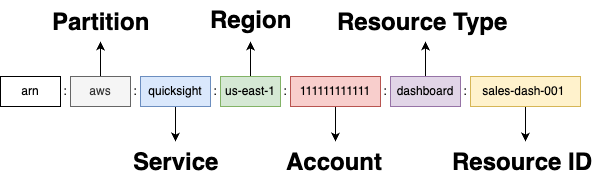
- ARN Structure: An Amazon Resource Name (ARN) follows the format
arn:partition:service:region:account-id:resource.- Partition: Identifies the AWS partition (e.g.,
awsfor standard regions,aws-cnfor China). - Service: Specifies the AWS service (e.g.,
s3,ec2,iam). - Region: Indicates the geographical area where the resource resides; optional for global resources.
- Account ID: The 12-digit AWS account ID of the resource owner.
- Resource: A path or identifier specific to the service and resource type.
- Partition: Identifies the AWS partition (e.g.,
- Wildcard Usage: ARNs support wildcards like
*(matches zero or more characters) and?(matches a single character) for flexible pattern matching in IAM policies. - Policy Evaluation: IAM policies use ARNs to define precise access controls. Both identity-based policies (attached to users/roles) and resource-based policies (attached to resources like S3 buckets) evaluate ARNs to determine permissions.
- Multi-Tenant Enforcement:
- Dynamic Policies with Session Tags: In multi-tenant environments,
sts:AssumeRolecan be used withsts:TagSessionto pass tenant-specific context as session tags. These tags can then be referenced in IAM policies using conditions to dynamically scope permissions to a specific tenant's resources. - Attribute-Based Access Control (ABAC): ABAC leverages tags on both the principal (user/role) and the resource. Policies are written to allow access if specific tags match, providing fine-grained control that scales without needing to modify policies for every new tenant or resource.
- Cross-Account Access: ARNs are fundamental for establishing trust relationships between different AWS accounts, enabling roles in one account to assume roles in another for delegated administration and multi-account strategies.
- Dynamic Policies with Session Tags: In multi-tenant environments,
🔮 Future ImplicationsAI analysis grounded in cited sources
⏳ Timeline
📎 Sources (17)
Factual claims are grounded in the sources below. Forward-looking analysis is AI-generated interpretation.
Weekly AI Recap
Read this week's curated digest of top AI events →
👉Related Updates
AI-curated news aggregator. All content rights belong to original publishers.
Original source: AWS Machine Learning Blog ↗
This is a summary, not the original. Read the source, or get the weekly briefing.
The weekly digest
One email a week. Unsubscribe anytime.