UK Royal Navy Completes First Neuan Drone Catapult Launch
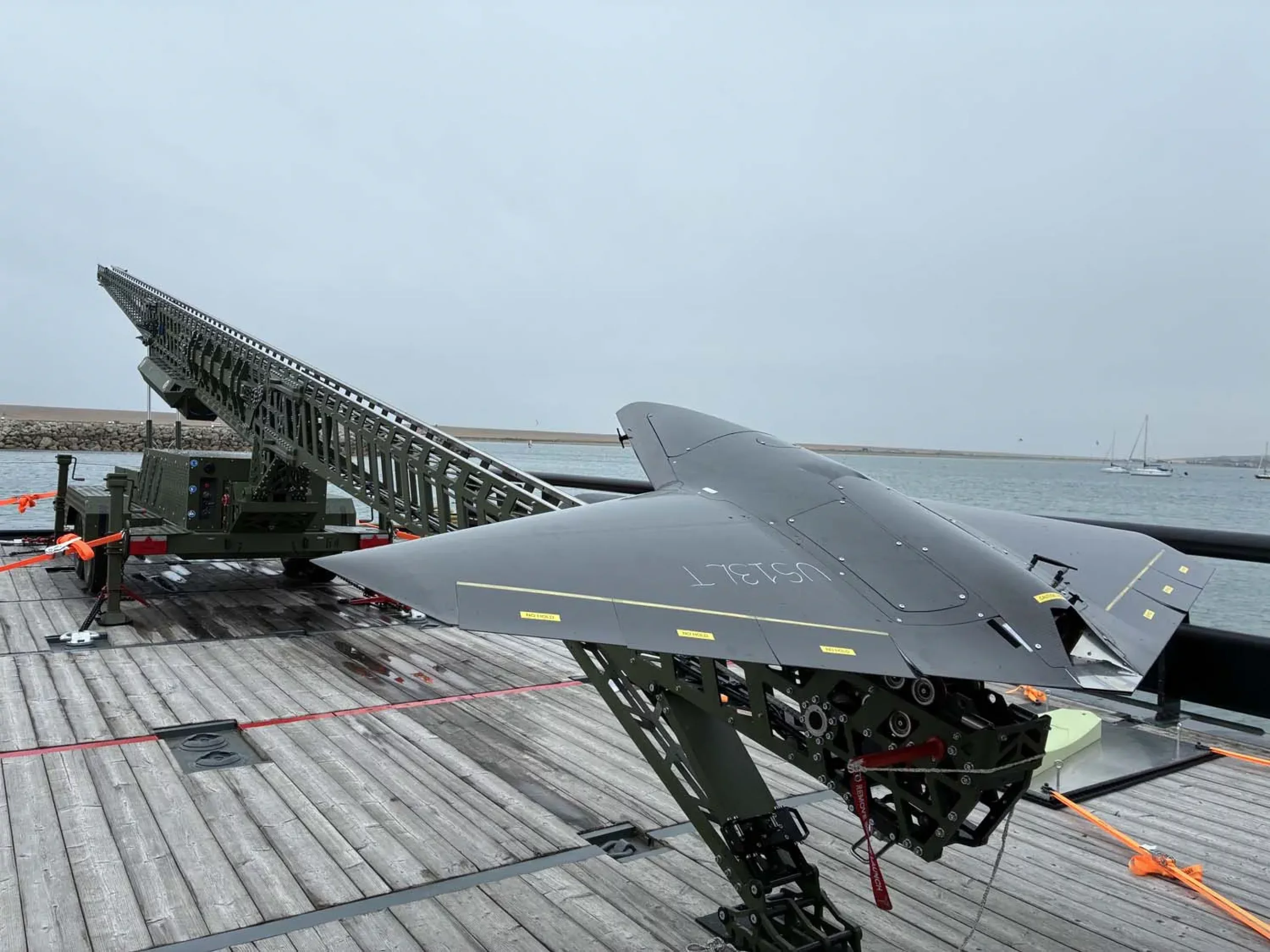
💡First successful ship-based catapult launch of a strike drone, signaling a shift in naval autonomous warfare.
⚡ 30-Second TL;DR
What Changed
Successfully launched the Neuan strike drone from a moving vessel using a catapult system.
Why It Matters
This marks a significant step in autonomous maritime strike capabilities, showing that compact, high-performance drones can be deployed from standard naval platforms.
What To Do Next
For defense-tech builders, focus on optimizing flight control software for high-G catapult launches and maritime environment stability.
Key Points
- •Successfully launched the Neuan strike drone from a moving vessel using a catapult system.
- •The test was part of the 'Neptune' exercise, focusing on modern maritime warfare capabilities.
- •Reflects the military's strategy to incorporate lessons from recent regional conflicts regarding drone warfare.
🧠 Deep Insight
AI-generated analysis for this event — not the original article.
🔑 Enhanced Key Takeaways
- •The Neuan drone system utilizes a modular pneumatic catapult launcher designed for rapid deployment from various Royal Navy surface combatants, including Type 23 frigates.
- •The Neptune exercise integration specifically tested the drone's ability to perform beyond-line-of-sight (BLOS) targeting and reconnaissance in contested electromagnetic environments.
- •The Neuan platform features an autonomous recovery system that allows for ship-based retrieval using a net-capture mechanism, reducing the need for runway infrastructure.
- •Development of the Neuan drone is part of the UK Ministry of Defence's 'Project Vampire' initiative, aimed at accelerating the fielding of low-cost, attritable unmanned aerial systems.
- •The catapult system incorporates a proprietary digital launch controller that synchronizes drone avionics with ship motion data to ensure precise takeoff trajectories in high sea states.
📊 Competitor Analysis▸ Show
| Feature | Neuan (UK) | Switchblade 600 (US) | Hero-120 (Israel) |
|---|---|---|---|
| Launch Method | Pneumatic Catapult | Tube-Launched | Canister-Launched |
| Primary Role | Strike/ISR | Anti-Armor | Anti-Armor/Precision |
| Recovery | Net-Capture | Expendable | Expendable |
| Operational Range | ~150km | ~40km | ~60km |
🛠️ Technical Deep Dive
- Propulsion: Electric ducted fan engine optimized for low acoustic signature.
- Airframe: Carbon-fiber composite construction with folding wing geometry for compact storage.
- Guidance: Multi-modal seeker including electro-optical/infrared (EO/IR) and semi-active laser homing.
- Data Link: Encrypted, frequency-hopping datalink resistant to GPS jamming and spoofing.
- Payload: Modular warhead bay capable of carrying high-explosive anti-tank (HEAT) or anti-personnel fragmentation charges.
🔮 Future ImplicationsAI analysis grounded in cited sources
⏳ Timeline
Weekly AI Recap
Read this week's curated digest of top AI events →
👉Related Updates
AI-curated news aggregator. All content rights belong to original publishers.
Original source: cnBeta (Full RSS) ↗
This is a summary, not the original. Read the source, or get the weekly briefing.
The weekly digest
One email a week. Unsubscribe anytime.