UK Pledges £1bn to Retain Quantum Talent
💡£1bn UK quantum push learns from AI race—key for infra researchers eyeing policy shifts
⚡ 30-Second TL;DR
What Changed
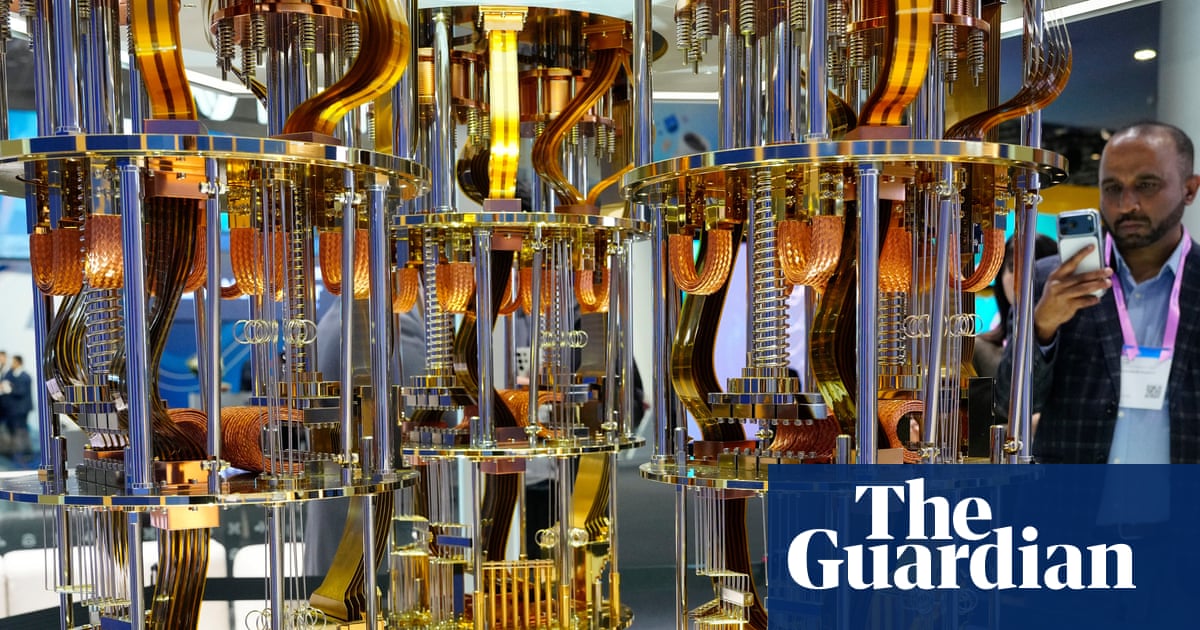
£1bn funding pledge for quantum computer design
Why It Matters
Boosts UK's quantum ecosystem, potentially accelerating AI-adjacent compute advancements. Signals government priority on strategic tech retention versus global competition.
What To Do Next
Check UKRI quantum funding calls for collaborative research grants.
Key Points
- •£1bn funding pledge for quantum computer design
- •Prevent talent loss to rivals like US in AI race
- •Targets startups, engineers, researchers for retention
- •Supports scientists, public sector, and businesses
🧠 Deep Insight
Background and context from public sources — not the original article. 6 sources cited.
🔑 Enhanced Key Takeaways
- •The UK's £1 billion quantum commitment is part of a broader £38.6 billion four-year R&D settlement (FY 2026–27 through FY 2029–30), with quantum technologies explicitly allocated £1.013 billion across the spending review period[1][4].
- •The UK government has announced a separate £670 million investment specifically for quantum computing, including a 10-year funding settlement for the National Quantum Computing Centre (NQCC), enabling long-term capability-building and positioning the UK to develop quantum computers capable of outperforming conventional supercomputers by 2035[3].
- •The funding strategy emphasizes a full-stack portfolio approach across multiple computing platforms (superconducting systems, ion traps, photonics, emerging platforms) with targeted deployment in high-value sectors including healthcare, transport, defense, and infrastructure, rather than focusing on a single quantum architecture[2].
- •The UK is leveraging a joined-up investment model designed to unlock £3 of private investment for every £1 of government investment through partnerships with the British Business Bank, National Wealth Fund, and National Security Strategic Investment Fund, addressing both talent retention and commercialization pathways[2][4].
- •The National Quantum Computing Centre operates a testbed program housing seven different computing platforms under one roof, allowing the government to evaluate multiple architectures and support industrial users exploring early applications—a distinctive capability differentiating the UK's approach[2].
📊 Competitor Analysis▸ Show
| Aspect | UK | US | China |
|---|---|---|---|
| Primary Funding Mechanism | Multi-year government settlement + private leverage (3:1 ratio) | Fragmented across NIST, NSF, DoD, private VCs | State-directed industrial policy |
| Timeline Horizon | 10-year NQCC settlement; 4-year UKRI cycle | Ongoing but variable by administration | Long-term state commitment |
| Platform Diversity | 7+ platforms in single testbed (NQCC) | Multiple competing private platforms | Centralized state platforms |
| Talent Retention Focus | Explicit emphasis on retaining researchers and startups | Market-driven competition | State-directed talent programs |
| Key Differentiator | Full-stack approach + sovereign capability | Private sector innovation leadership | Scale and resource concentration |
🛠️ Technical Deep Dive
- •National Quantum Computing Centre (NQCC) Testbed Architecture: Houses seven different computing platforms under one roof, enabling comparative evaluation of multiple quantum computing architectures (superconducting, ion trap, photonic, and emerging systems) rather than betting on a single technology[2].
- •Full-Stack Portfolio Approach: Funding covers superconducting systems, ion traps, photonics, emerging platforms, software, algorithms, applications, and research integrating quantum with high-performance computing (HPC) and artificial intelligence (AI)[2].
- •Sector-Specific Deployment Strategy: Targets rapid demonstration of quantum value in healthcare, transport, defense, and infrastructure sectors to catalyze private investment and accelerate long-term adoption[2].
- •Integration with Classical Computing: Explicit research focus on integrating quantum systems with HPC and AI infrastructure, indicating a hybrid approach rather than standalone quantum systems[2].
🔮 Future ImplicationsAI analysis grounded in cited sources
⏳ Timeline
📎 Sources (6)
Factual claims are grounded in the sources below. Forward-looking analysis is AI-generated interpretation.
- thequantuminsider.com — Ukri Maps 38 6 Billion Rd Budget Commits 1 Billion to Quantum
- quantumworldcongress.com — United Kingdom Unveils Next Phase of Quantum Strategy with 500m Mission Funding and New Ukus Tech Partnership
- nqcc.ac.uk — Uks Industrial Strategy 2025 Published
- techuk.org — Ukri Announces Over 1 Billion for Quantum Technologies in Budget Allocations for the Spending Review Period
- trade.gov — UK Quantum Technology Investment 2025 2026
- hiverlab.com — UK Government Commits Over 500m Quantum Computing
Weekly AI Recap
Read this week's curated digest of top AI events →
👉Related Updates
AI-curated news aggregator. All content rights belong to original publishers.
Original source: The Guardian Technology ↗
This is a summary, not the original. Read the source, or get the weekly briefing.
Weekly AI briefing
One email a week. Unsubscribe anytime.