Ubtech humanoid robot sales reach 13,000 units
Understand the commercial viability of humanoid robots in the current market despite design backlash.
30-Second TL;DR
What Changed
13,000 units ordered despite 'silicone doll' criticism
Why It Matters
The sales volume suggests that functional utility and the 'humanoid' form factor are driving enterprise adoption despite aesthetic concerns.
What To Do Next
Analyze the market positioning of high-end humanoid robots to identify gaps in current embodied AI service applications.
Key Points
- •13,000 units ordered despite 'silicone doll' criticism
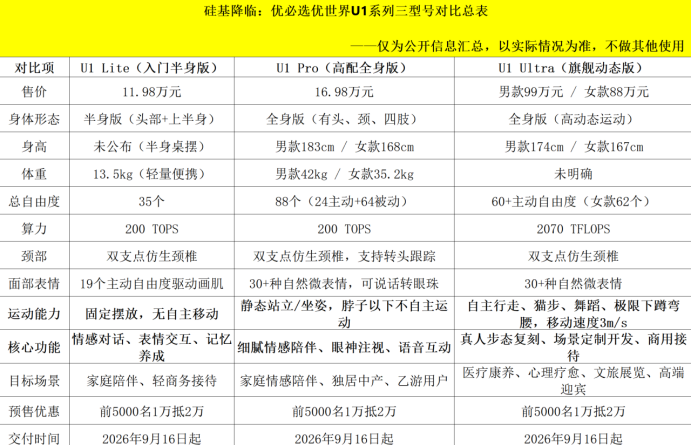
- •Priced at 990,000 RMB
- •Reflects strong market demand for humanoid robotics
Deep Insight
AI-generated analysis for this event — not the original article.
Enhanced Key Takeaways
- •The 13,000 unit figure refers to cumulative orders and strategic partnerships, including significant adoption within the automotive manufacturing sector for assembly line tasks.
- •Ubtech's humanoid platform, often identified as the Walker S series, utilizes a proprietary large model (Embodied AI) trained on industrial manufacturing data rather than general-purpose conversational data.
- •The 'silicone doll' criticism stems from the robot's aesthetic design choices intended to mimic human-like skin textures for safer human-robot interaction (HRI) in collaborative environments.
- •The 990,000 RMB price point is positioned as a B2B industrial solution, with Ubtech offering customized integration services for factory automation rather than a consumer-grade retail model.
- •Ubtech has established strategic collaborations with major Chinese EV manufacturers, such as NIO and BYD, to pilot these robots in real-world production environments.
Competitor Analysis
- Ubtech (Walker S)
- Industrial/Manufacturing
- Tesla (Optimus)
- General Purpose/Labor
- Figure AI (Figure 02)
- General Purpose/Labor
- Ubtech (Walker S)
- ~990,000 RMB
- Tesla (Optimus)
- Estimated <$20,000 (Target)
- Figure AI (Figure 02)
- Not Publicly Disclosed
- Ubtech (Walker S)
- Factory floor integration
- Tesla (Optimus)
- Humanoid dexterity/AI training
- Figure AI (Figure 02)
- Neural network-based reasoning
| Feature | Ubtech (Walker S) | Tesla (Optimus) | Figure AI (Figure 02) |
|---|---|---|---|
| Primary Focus | Industrial/Manufacturing | General Purpose/Labor | General Purpose/Labor |
| Pricing | ~990,000 RMB | Estimated <$20,000 (Target) | Not Publicly Disclosed |
| Key Benchmark | Factory floor integration | Humanoid dexterity/AI training | Neural network-based reasoning |
Technical Deep Dive
- Actuators: Employs high-torque, high-precision servo actuators developed in-house to handle industrial payloads.
- Vision System: Utilizes multi-modal sensor fusion combining LiDAR, depth cameras, and visual-tactile sensors for spatial awareness.
- AI Architecture: Integrated with a domain-specific Large Embodied Model (LEM) that translates natural language instructions into complex motor control sequences.
- Degrees of Freedom: Features 41 high-performance joints to mimic human range of motion for assembly tasks.
- Safety: Includes real-time collision detection and force-feedback loops to ensure safe operation alongside human workers.
Future ImplicationsAI analysis grounded in cited sources
Timeline
- 2018-01Ubtech unveils the first generation Walker humanoid robot at CES.
- 2021-07Launch of Walker X, featuring improved mobility and AI interaction capabilities.
- 2023-12Ubtech Robotics completes its IPO on the Hong Kong Stock Exchange.
- 2024-02Ubtech announces strategic partnership with NIO to test Walker S in EV manufacturing.
- 2025-05Ubtech reports significant expansion of industrial deployment orders for the Walker S series.
Weekly AI Recap
Read this week's curated digest of top AI events →
Related Updates
AI-curated news aggregator. All content rights belong to original publishers.
Original source: 钛媒体 ↗
This is a summary, not the original. Read the source, or get the weekly briefing.
The weekly digest
One email a week. Unsubscribe anytime.