Uber Starts ID. Buzz Robotaxi Tests in LA
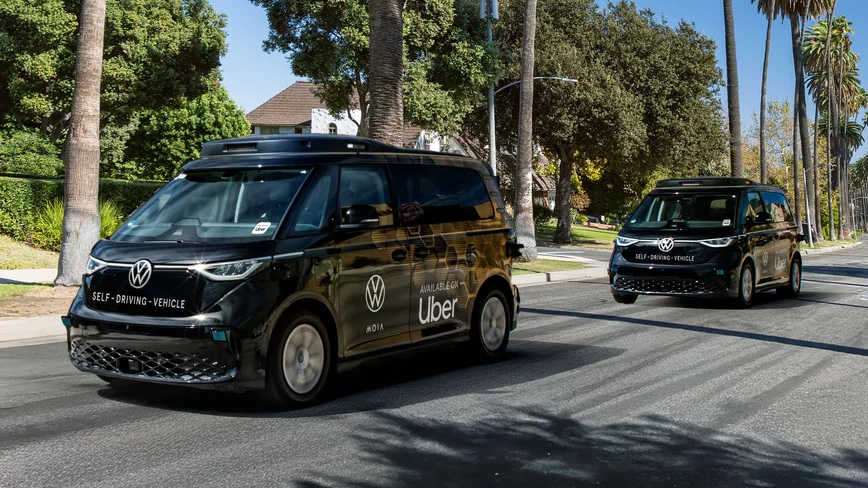
💡Uber robotaxi test advances AV timelines; key for mobility AI integrations
⚡ 30-Second TL;DR
What Changed
On-road testing in LA with safety drivers; public launch nearing
Why It Matters
Accelerates robotaxi deployment, pressuring competitors like Waymo. Signals maturing AV partnerships for scalable fleets, relevant for AI devs in mobility.
What To Do Next
Explore Uber AV API for integrating MOIA-powered robotaxi fleets into logistics platforms.
Key Points
- •On-road testing in LA with safety drivers; public launch nearing
- •Uses MOIA America self-driving tech; driverless by late 2026
- •ID. Buzz EV: 234-mile range, seats 7, sliding doors
- •Uber's AV partners include Waymo, Avride; future: Rivian, Zoox
🧠 Deep Insight
AI-generated analysis for this event — not the original article.
🔑 Enhanced Key Takeaways
- •The testing program utilizes a specialized sensor suite integrated into the ID. Buzz, featuring a combination of LiDAR, radar, and high-resolution cameras to achieve 360-degree perception, specifically optimized for dense urban environments like Los Angeles.
- •Volkswagen's MOIA America subsidiary is leveraging data gathered from its extensive pilot programs in Hamburg, Germany, to refine the autonomous driving stack for US-specific traffic laws and infrastructure challenges.
- •Uber's integration strategy involves a custom API layer that allows the ID. Buzz fleet to interface directly with the Uber app, enabling seamless ride-hailing, vehicle tracking, and automated payment processing without requiring a separate interface.
📊 Competitor Analysis▸ Show
| Feature | Uber/VW (ID. Buzz) | Waymo (Jaguar I-PACE) | Zoox (Purpose-Built) |
|---|---|---|---|
| Vehicle Type | Retro-styled Minivan | SUV | Carriage-style Pod |
| Seating Capacity | Up to 7 | 4 | 4 |
| Operational Status | Testing (Safety Driver) | Commercial (Driverless) | Commercial (Driverless) |
| Primary Market | US Urban Centers | US Major Metros | US Urban Centers |
🛠️ Technical Deep Dive
- •Vehicle Platform: MEB (Modular Electric Drive Matrix) architecture.
- •Sensor Suite: Multi-modal sensor fusion including long-range LiDAR, short-range radar, and 360-degree camera arrays.
- •Compute Architecture: Centralized high-performance computing unit capable of processing multi-gigabit sensor data streams in real-time.
- •Redundancy: Dual-redundant steering and braking systems to ensure safe fallback maneuvers in the event of primary system failure.
- •Connectivity: 5G-enabled V2X (Vehicle-to-Everything) communication for real-time traffic signal and infrastructure data exchange.
🔮 Future ImplicationsAI analysis grounded in cited sources
⏳ Timeline
Weekly AI Recap
Read this week's curated digest of top AI events →
👉Related Updates

AI-curated news aggregator. All content rights belong to original publishers.
Original source: Engadget ↗
This is a summary, not the original. Read the source, or get the weekly briefing.
The weekly digest
One email a week. Unsubscribe anytime.