Turn .NET Code into Living Architecture Docs
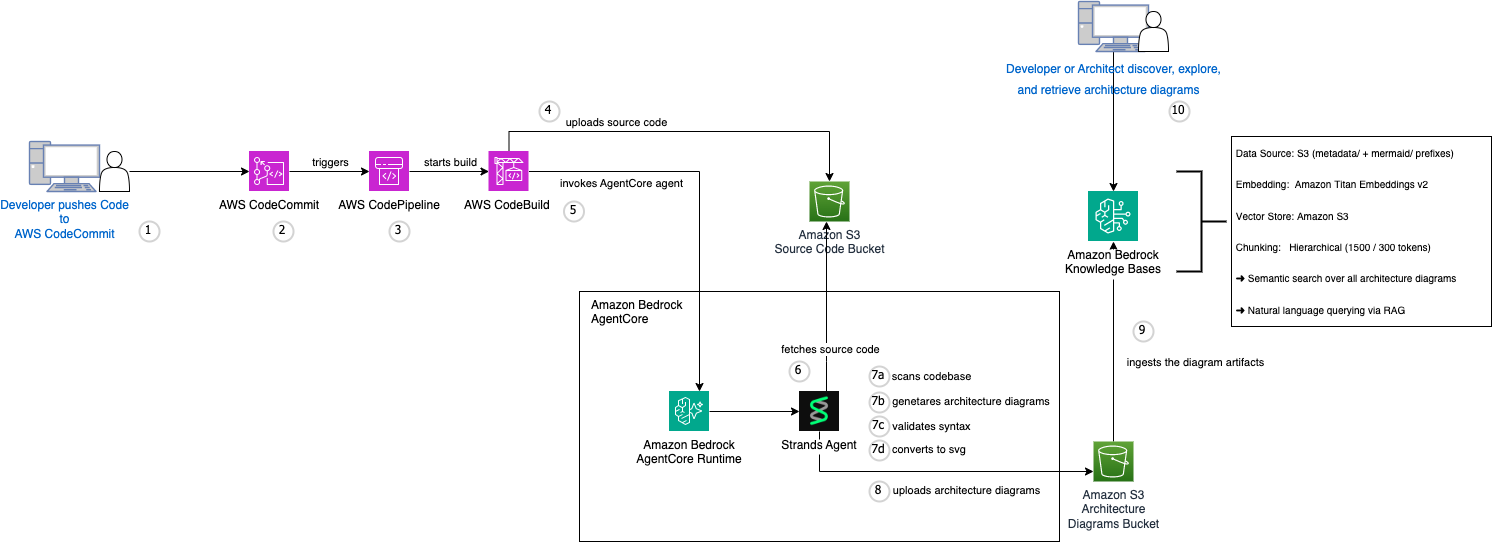
💡See how AgentCore turns legacy code analysis into searchable, continuously updated architecture documentation.
⚡ 30-Second TL;DR
What Changed
Analyzes .NET codebases to infer system architecture
Why It Matters
Automated documentation can reduce the cost of keeping architecture knowledge current, especially in large or frequently changing codebases. Searchable, code-derived documentation may also shorten onboarding and improve impact analysis for engineering teams.
What To Do Next
Create a CodePipeline proof of concept that sends a representative .NET service to Bedrock AgentCore and indexes its generated architecture documentation.
Key Points
- •Analyzes .NET codebases to infer system architecture
- •Generates architecture diagrams automatically
- •Maintains searchable documentation through Knowledge Bases and AWS CodePipeline
🧠 Deep Insight
Background and context from public sources — not the original article. 13 sources cited.
🔑 Enhanced Key Takeaways
- •Living architecture documentation utilizes machine-readable formats like YAML or Markdown co-located with the codebase to ensure AI agents maintain real-time, accurate context.
- •The industry is shifting toward 'spec-anchored' documentation, where architectural records evolve in tandem with software rather than relying on static, manual specifications.
- •Model Context Protocol (MCP) servers are increasingly used to bridge the gap between AI agents and diagramming tools, enabling direct interaction with architectural visuals.
- •Architecture Decision Records (ADRs) are now treated as first-class outputs, incorporating 'revisit triggers' to maintain design integrity during automated development cycles.
- •The 'architecture.md' standard has emerged as a project-agnostic template to provide AI coding agents with essential stack and data flow context, reducing the need for repetitive codebase scanning.
📊 Competitor Analysis▸ Show
| Feature | AWS Bedrock AgentCore | Boomi Scribe | Diagram-as-Code (Python/MCP) |
|---|---|---|---|
| Primary Focus | Enterprise Architecture Synthesis | Integration Workflow Docs | Visual Diagram Generation |
| Pricing | Consumption-based (Bedrock) | Subscription/Tiered | Open Source/Free |
| Benchmarks | High (Large-scale codebases) | Medium (Integration focus) | Low (Manual integration req) |
🛠️ Technical Deep Dive
- Implementation relies on a three-stage feedback loop: continuous monitoring of telemetry and commits, graph-based synthesis of architectural knowledge, and proactive agentic decision-making.
- Utilizes Model Context Protocol (MCP) to allow AI agents to query and update documentation structures dynamically.
- Architecture diagrams are generated via Diagram-as-Code (DaC) libraries, ensuring visuals are stored in version control and updated alongside source code.
- Knowledge Bases are structured to ingest ADRs and code-co-located metadata to serve as a 'unified architectural brain' for LLM inference.
🔮 Future ImplicationsAI analysis grounded in cited sources
⏳ Timeline
📎 Sources (13)
Factual claims are grounded in the sources below. Forward-looking analysis is AI-generated interpretation.
Weekly AI Recap
Read this week's curated digest of top AI events →
👉Related Updates
AI-curated news aggregator. All content rights belong to original publishers.
Original source: AWS Machine Learning Blog ↗
This is a summary, not the original. Read the source, or get the weekly briefing.
Weekly AI briefing
One email a week. Unsubscribe anytime.