Turn Giant AI PRs into Reviewable Stacks
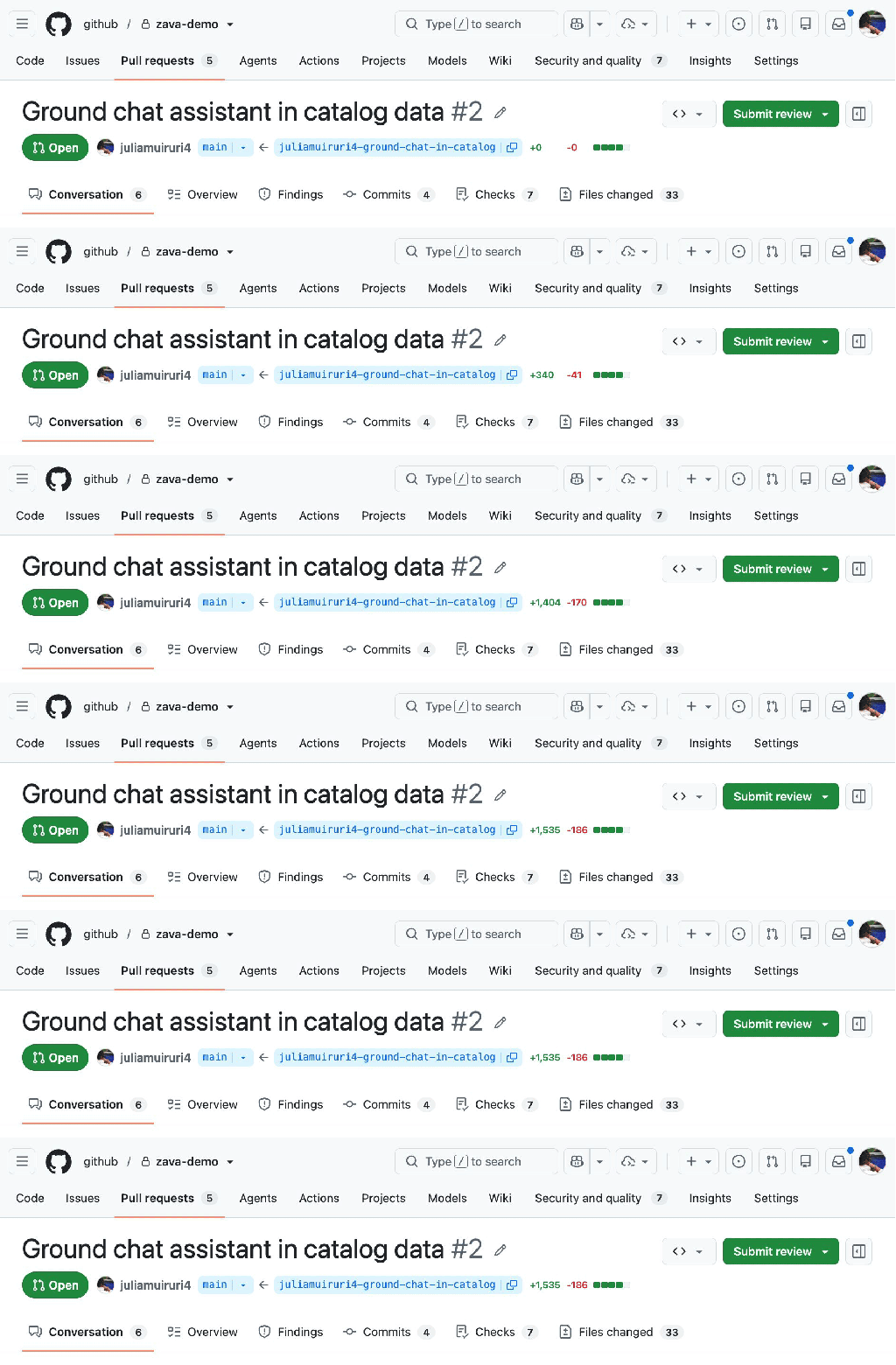
Learn how to make AI-generated code changes smaller, ordered, and easier to review.
30-Second TL;DR
What Changed
Large AI-generated pull requests can be decomposed into smaller reviewable changes.
Why It Matters
This can reduce review friction when coding agents generate broad, multi-file changes. Teams may be able to preserve agent productivity while giving human reviewers smaller, more understandable units of work.
What To Do Next
試用 GitHub stacked pull requests,要求你的 coding agent 將下一個大型變更拆成依序提交的多個小型 pull request。
Key Points
- •Large AI-generated pull requests can be decomposed into smaller reviewable changes.
- •The changes should be organized into a clean, ordered stack of pull requests.
- •GitHub stacked pull requests provide the workflow for managing this decomposition.
Deep Insight
AI-generated analysis for this event — not the original article.
Enhanced Key Takeaways
- •Stacked pull requests rely on git-branch-based dependency tracking, where each PR in the stack targets the head of the previous PR rather than the main branch.
- •GitHub's implementation leverages the 'gh' CLI tool and specific metadata headers to maintain the relationship between stacked PRs, preventing merge conflicts during sequential integration.
- •This workflow addresses the 'context window bottleneck' where AI agents often generate monolithic code changes that exceed human cognitive capacity for review.
- •The approach integrates with CI/CD pipelines by allowing automated tests to run on individual PRs in the stack, ensuring that breaking changes are caught early in the dependency chain.
- •Adopting stacked PRs reduces the 'merge hell' phenomenon by enabling incremental code reviews, which statistically increases the likelihood of finding bugs compared to reviewing large, singular PRs.
Competitor Analysis
- GitHub Stacked PRs
- Native CLI/Platform Integration
- Graphite
- Dedicated Stacked PR Platform
- Aviator
- Enterprise Merge Queue & Stacking
- GitHub Stacked PRs
- Included in GitHub Pro/Enterprise
- Graphite
- Freemium (Free for individuals)
- Aviator
- Enterprise-focused/Custom
- GitHub Stacked PRs
- Optimized for GitHub ecosystem
- Graphite
- High velocity/CLI-first workflow
- Aviator
- Focus on merge throughput/safety
| Feature | GitHub Stacked PRs | Graphite | Aviator |
|---|---|---|---|
| Core Focus | Native CLI/Platform Integration | Dedicated Stacked PR Platform | Enterprise Merge Queue & Stacking |
| Pricing | Included in GitHub Pro/Enterprise | Freemium (Free for individuals) | Enterprise-focused/Custom |
| Benchmarks | Optimized for GitHub ecosystem | High velocity/CLI-first workflow | Focus on merge throughput/safety |
Technical Deep Dive
- Uses git-based dependency tracking where PRs are linked via parent-child relationships in the repository metadata.
- Relies on the GitHub CLI (gh) to automate the creation of branches and the subsequent opening of PRs targeting the previous branch in the stack.
- Implements a rebase-on-merge strategy to ensure that when a base PR is merged, the dependent PRs are automatically updated to point to the new base.
- Utilizes automated dependency graph resolution to prevent circular references within the stack.
- Supports partial CI execution, allowing developers to trigger tests only on the modified PR in the stack rather than the entire chain.
Future ImplicationsAI analysis grounded in cited sources
Timeline
- 2022-06GitHub introduces the 'gh' CLI tool enhancements for better PR management.
- 2024-03GitHub expands support for AI-assisted coding workflows via GitHub Copilot Workspace.
- 2025-11GitHub integrates advanced dependency tracking for stacked pull requests in public beta.
- 2026-05GitHub officially rolls out the stacked PR workflow for AI agents to all Enterprise users.
Weekly AI Recap
Read this week's curated digest of top AI events →
AI-curated news aggregator. All content rights belong to original publishers.
Original source: GitHub Blog ↗
This is a summary, not the original. Read the source, or get the weekly briefing.
The weekly digest
One email a week. Unsubscribe anytime.