Tsinghua's GUICrafter Trains AI Agents at 0.1% Data Cost
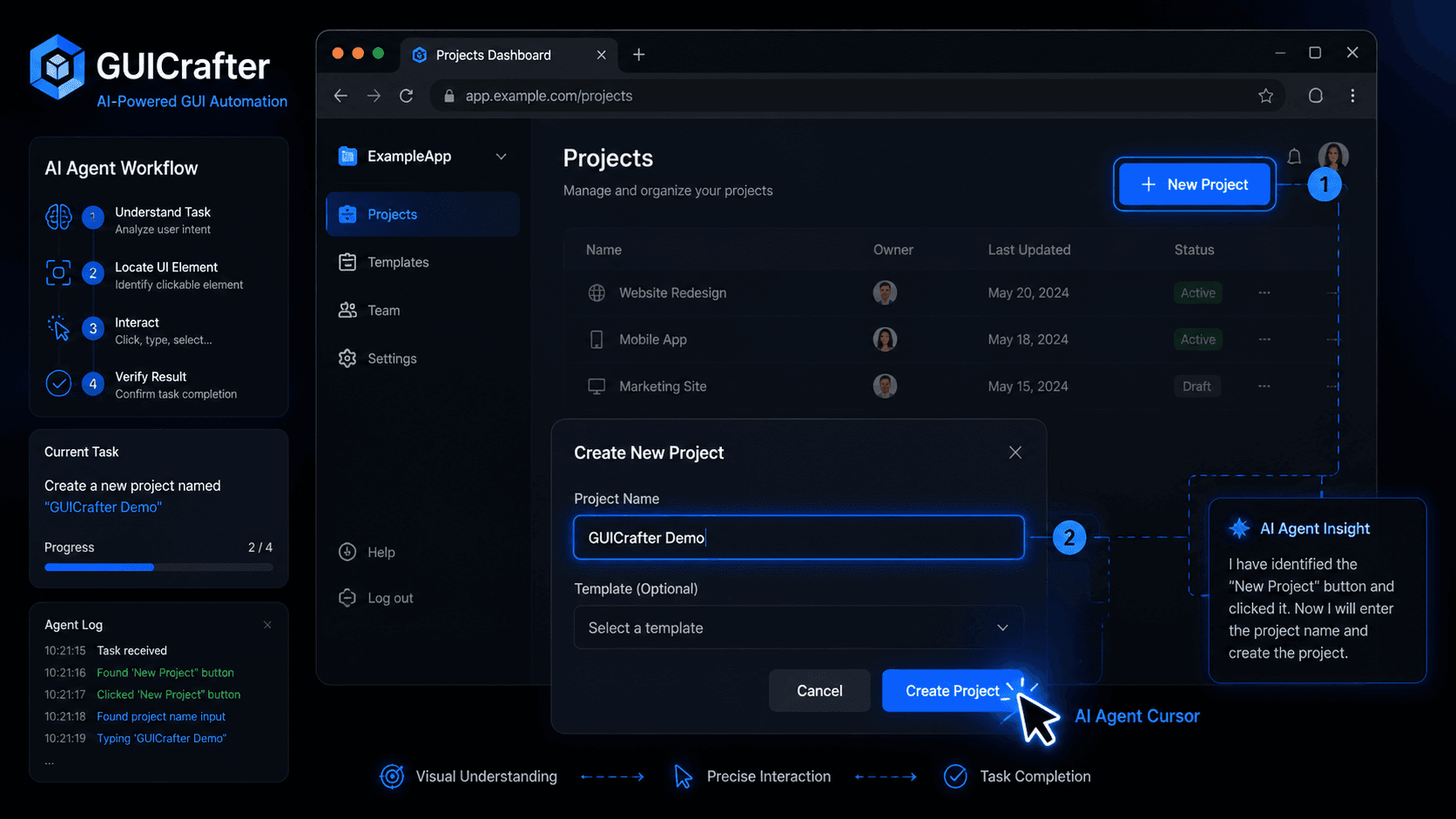
A breakthrough in training GUI agents with 99.9% less data cost using web screenshots.
30-Second TL;DR
What Changed
Utilizes massive, zero-cost web screenshots for training
Why It Matters
This research significantly lowers the barrier to entry for training specialized computer control agents, potentially democratizing autonomous GUI interaction.
What To Do Next
Review the GUICrafter methodology to see if your agent training pipeline can be optimized using synthetic or web-scraped screenshot data.
Key Points
- •Utilizes massive, zero-cost web screenshots for training
- •Achieves competitive performance against top-tier GUI agents
- •Reduces training data requirements by 99.9% compared to traditional methods
Deep Insight
AI-generated analysis for this event — not the original article.
Enhanced Key Takeaways
- •GUICrafter addresses the 'data scarcity' bottleneck in GUI agent training by synthesizing high-quality, instruction-following trajectories from static web screenshots without human annotation.
- •The framework employs a two-stage pipeline: first, it generates diverse GUI interaction tasks using a large language model (LLM), and second, it utilizes a vision-language model (VLM) to predict valid action sequences.
- •By leveraging the vast, unlabelled web as a training corpus, the method bypasses the need for expensive, manually recorded human-computer interaction (HCI) datasets.
- •The research team integrated a 'GUI-aware' objective function that specifically optimizes for element localization and semantic understanding within complex, non-standardized web interfaces.
- •GUICrafter demonstrates significant cross-domain generalization, maintaining high success rates even when deployed on websites or applications not seen during the synthetic training phase.
Competitor Analysis
- GUICrafter
- Synthetic (0.1% cost)
- AppAgent (Tencent)
- Human Demonstrations
- ScreenAgent (Google)
- Human/Synthetic Mix
- GUICrafter
- High (Web-scale)
- AppAgent (Tencent)
- Low (Manual effort)
- ScreenAgent (Google)
- Medium
- GUICrafter
- Data Efficiency
- AppAgent (Tencent)
- Generalist Navigation
- ScreenAgent (Google)
- Multimodal Reasoning
| Feature | GUICrafter | AppAgent (Tencent) | ScreenAgent (Google) |
|---|---|---|---|
| Training Data | Synthetic (0.1% cost) | Human Demonstrations | Human/Synthetic Mix |
| Scalability | High (Web-scale) | Low (Manual effort) | Medium |
| Primary Focus | Data Efficiency | Generalist Navigation | Multimodal Reasoning |
Technical Deep Dive
- Architecture: Utilizes a generative framework that treats GUI navigation as a sequence modeling problem, mapping visual inputs to discrete action tokens.
- Data Synthesis: Employs a 'Self-Correction' mechanism where the model validates its own generated trajectories against a set of predefined GUI constraints.
- Input Processing: Processes raw screenshots by extracting DOM-like structures or visual bounding boxes to reduce the search space for the agent.
- Optimization: Implements a lightweight fine-tuning approach (likely LoRA or similar PEFT) on top of a pre-trained VLM backbone to adapt to GUI-specific tasks.
Future ImplicationsAI analysis grounded in cited sources
Timeline
- 2024-05Tencent releases AppAgent, establishing a baseline for multimodal GUI agents.
- 2025-11Tsinghua and Tencent researchers publish the initial preprint for GUICrafter.
- 2026-03GUICrafter is presented at a major AI conference, highlighting the 99.9% data reduction milestone.
Weekly AI Recap
Read this week's curated digest of top AI events →
Related Updates



AI-curated news aggregator. All content rights belong to original publishers.
Original source: Pandaily ↗
This is a summary, not the original. Read the source, or get the weekly briefing.
The weekly digest
One email a week. Unsubscribe anytime.