Tsinghua Robot Demonstrates Real-time Physical Reasoning

💡See how Physical AGI is moving from theory to unscripted, real-world human-robot collaboration.
⚡ 30-Second TL;DR
What Changed
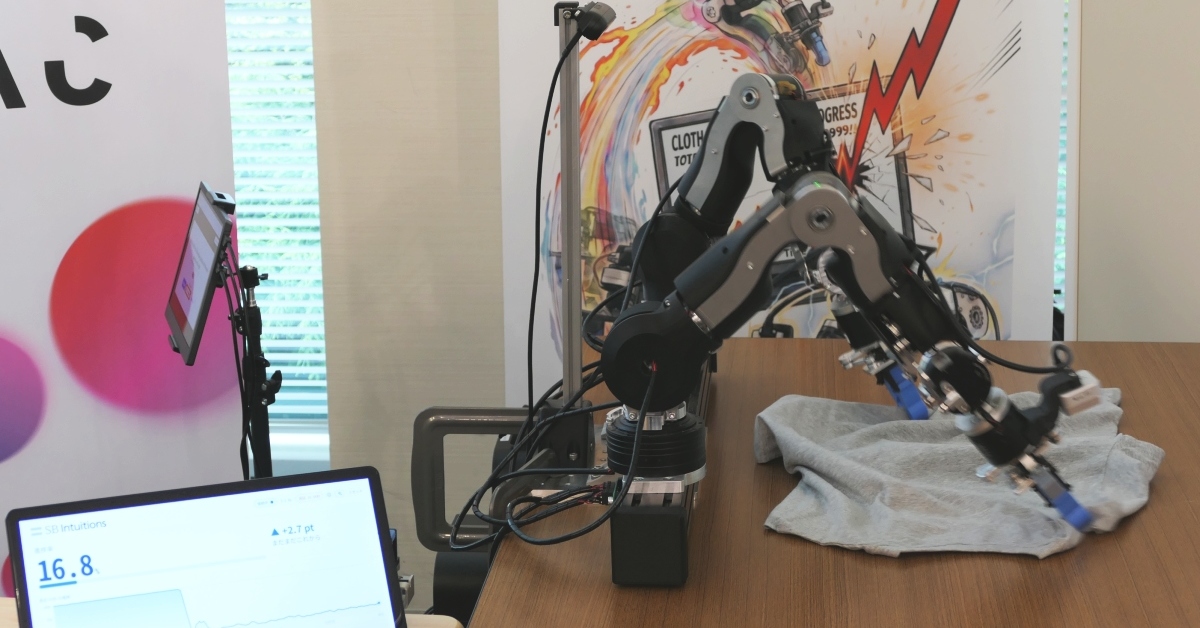
Robot successfully commanded humans to complete complex physical tasks in real-time.
Why It Matters
This demonstration marks a significant step toward Physical AGI, where robots move beyond pre-programmed motions to understand and manipulate the physical world through human-like reasoning.
What To Do Next
Study the integration of LLMs with robotic control stacks to improve how your agents handle unscripted, real-world physical tasks.
Key Points
- •Robot successfully commanded humans to complete complex physical tasks in real-time.
- •Demonstration operated without pre-written scripts, proving high-level reasoning.
- •Successfully handled improvised, random tasks proposed by live audience members.
- •Focuses on bridging the gap between cognitive paradigms and physical world interaction.
🧠 Deep Insight
AI-generated analysis for this event — not the original article.
🔑 Enhanced Key Takeaways
- •The research originates from the Tsinghua University Institute for AI Industry Research (AIR), led by Professor Ya-Qin Zhang.
- •The system utilizes a 'Physical World Model' that integrates Large Multimodal Models (LMMs) with real-time spatial-temporal reasoning capabilities.
- •The robot employs a hierarchical control architecture that separates high-level task planning from low-level motor execution to ensure safety during human-robot collaboration.
- •The demonstration specifically highlighted the robot's ability to perform 'zero-shot' physical reasoning, meaning it did not require fine-tuning on the specific balance scale task prior to the live event.
- •The underlying framework incorporates a feedback loop that allows the robot to adjust its verbal instructions based on the human's observed progress or errors in real-time.
📊 Competitor Analysis▸ Show
| Feature | Tsinghua Physical Reasoning Robot | Figure AI (Figure 02) | Tesla Optimus (Gen 2) |
|---|---|---|---|
| Primary Focus | Human-Robot Collaboration/Instruction | General Purpose Labor | Manufacturing/Repetitive Tasks |
| Reasoning Type | Real-time Physical/Cognitive | End-to-End Neural | Task-Specific/Teleoperation |
| Human Interaction | High (Commanding/Guiding) | Moderate (Assisting) | Low (Autonomous Execution) |
🛠️ Technical Deep Dive
- Architecture: Employs a Vision-Language-Action (VLA) model backbone adapted for physical world grounding.
- Reasoning Engine: Uses a Chain-of-Thought (CoT) process optimized for physical constraints, allowing the model to simulate the outcome of actions before issuing commands.
- Perception: Utilizes multi-modal sensor fusion (RGB-D cameras and tactile feedback) to map the physical state of the environment into a latent space.
- Latency: The system achieves sub-200ms latency for perception-to-instruction cycles, which is critical for natural human interaction.
🔮 Future ImplicationsAI analysis grounded in cited sources
⏳ Timeline
Weekly AI Recap
Read this week's curated digest of top AI events →
👉Related Updates
AI-curated news aggregator. All content rights belong to original publishers.
Original source: 量子位 ↗
This is a summary, not the original. Read the source, or get the weekly briefing.
The weekly digest
One email a week. Unsubscribe anytime.