True Anomaly Raises $650M for Orbital Defense
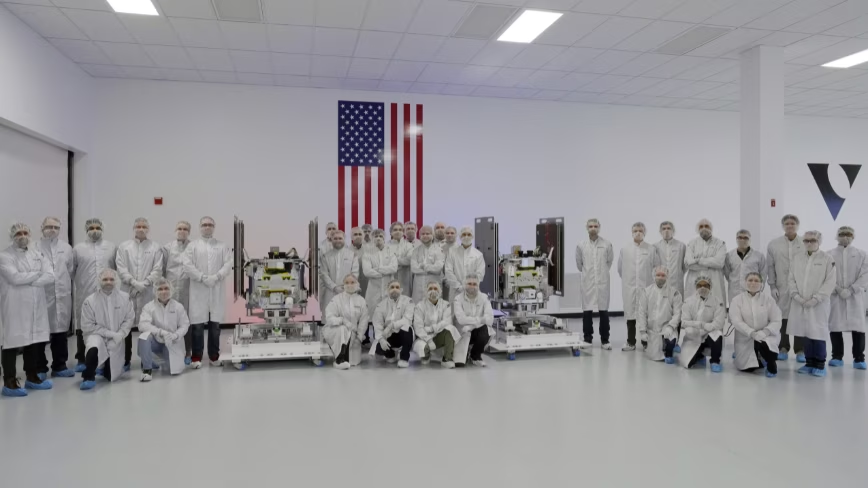
💡$650M fuels AI autonomous vehicles for orbital defense—key for space AI devs
⚡ 30-Second TL;DR
What Changed
Raised $650M in latest round, total funding >$1B
Why It Matters
Boosts AI-driven autonomy in space defense, potentially shifting national security strategies toward orbital capabilities. Attracts talent and partnerships in embodied AI for harsh environments.
What To Do Next
Explore True Anomaly's job listings for AI autonomy roles in space defense.
Key Points
- •Raised $650M in latest round, total funding >$1B
- •Only space startup exclusively focused on orbital defense
- •Jackal vehicles enable autonomous maneuvering for inspection and missile interception
🧠 Deep Insight
AI-generated analysis for this event — not the original article.
🔑 Enhanced Key Takeaways
- •The $650 million funding round was led by a consortium of defense-focused venture capital firms and strategic partners, signaling a shift toward private-sector involvement in space-based national security infrastructure.
- •True Anomaly has secured multiple contracts with the U.S. Space Force for 'tactical responsiveness,' specifically focusing on the ability to rapidly deploy assets to counter adversarial maneuvers in contested orbital environments.
- •The company's 'Golden Dome' platform utilizes a proprietary AI-driven command-and-control architecture designed to integrate with existing Department of Defense space domain awareness (SDA) networks.
📊 Competitor Analysis▸ Show
| Feature | True Anomaly | Astroscale | Rocket Lab (Space Systems) |
|---|---|---|---|
| Primary Focus | Orbital Defense/Interception | Debris Removal/Servicing | Launch/Satellite Bus |
| Autonomous Maneuvering | High (Tactical/Offensive) | Moderate (Proximity Ops) | Low (Standard Ops) |
| Defense Integration | Native/Strategic | Commercial/Civil | Commercial/Defense |
| Pricing Model | Government Contract | Service-based | Hardware/Launch-based |
🛠️ Technical Deep Dive
- •Jackal Autonomous Orbital Vehicle (AOV): Designed as a modular, small-satellite platform capable of high-delta-V maneuvers for rapid intercept and inspection.
- •On-board Processing: Utilizes radiation-hardened edge computing to process sensor data in real-time, reducing latency for autonomous decision-making during proximity operations.
- •Sensor Suite: Equipped with multi-spectral optical sensors and LiDAR for high-fidelity characterization of non-cooperative targets.
- •Golden Dome Architecture: A software-defined mission control system that leverages machine learning to automate the detection, tracking, and threat assessment of orbital objects.
🔮 Future ImplicationsAI analysis grounded in cited sources
⏳ Timeline
Weekly AI Recap
Read this week's curated digest of top AI events →
👉Related Updates


AI-curated news aggregator. All content rights belong to original publishers.
Original source: The Next Web (TNW) ↗
This is a summary, not the original. Read the source, or get the weekly briefing.
The weekly digest
One email a week. Unsubscribe anytime.