Tritium Shortage Threatens Nuclear Fusion Commercialization
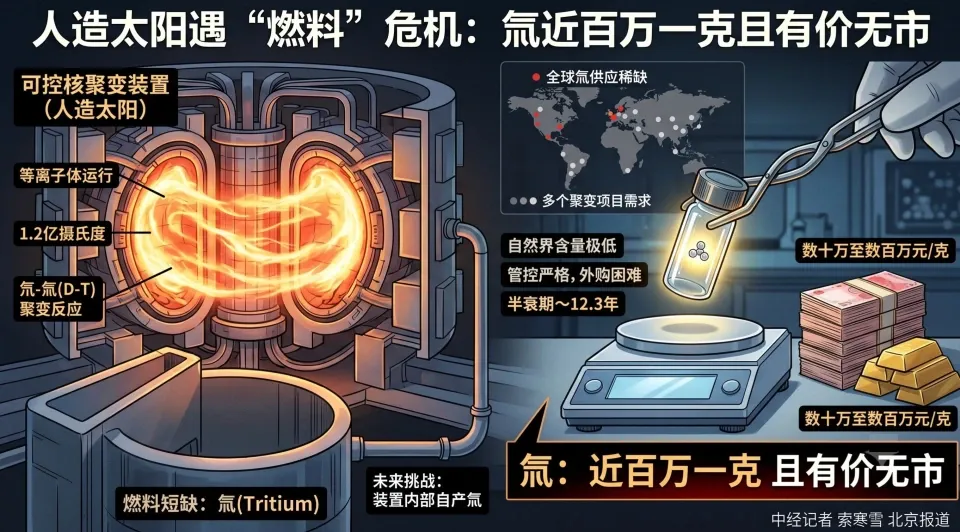
๐กUnderstand the critical supply chain bottleneck threatening the future of high-energy fusion power.
โก 30-Second TL;DR
What Changed
Global tritium inventory is currently limited to 20 kilograms.
Why It Matters
The high cost and limited availability of fuel could delay the transition from experimental fusion reactors to commercial power generation.
What To Do Next
Monitor advancements in alternative fuel cycles or breeding blanket technologies that reduce reliance on external tritium supplies.
Key Points
- โขGlobal tritium inventory is currently limited to 20 kilograms.
- โขMarket price for tritium has reached $40,000 per gram.
- โขFuel scarcity directly impacts the development timeline of the HL-3 tokamak.
๐ง Deep Insight
Web-grounded analysis with 24 cited sources.
๐ Enhanced Key Takeaways
- โขThe vast majority of the world's civilian tritium supply is a byproduct of Canadian Deuterium-Uranium (CANDU) heavy water fission reactors, which were first built in the 1970s.
- โขTritium is a radioactive isotope with a half-life of approximately 12.3 years, causing existing stockpiles to diminish by about 5% annually.
- โขA single 1-gigawatt (GW) commercial fusion reactor could require around 55 kilograms of tritium annually, significantly more than the current global civilian inventory.
- โขWhile fusion reactors are designed to breed their own tritium from lithium using breeding blankets, this technology is still in development and has not yet been demonstrated at a commercial scale or with a sufficient breeding ratio for self-sufficiency.
- โขA substantial portion of tritium produced in the United States is designated for military applications, further limiting its availability for civilian fusion research and commercialization efforts.
๐ ๏ธ Technical Deep Dive
- Deuterium-Tritium (D-T) Fusion Reaction: The D-T reaction, the primary focus for fusion energy, releases high-energy neutrons and helium atoms. These neutrons are crucial for the process of tritium breeding.
- Tritium Breeding Blankets: Future fusion reactors will rely on 'breeding blankets' lining the reactor vessel. These blankets contain lithium (specifically lithium-6) which absorbs the high-energy neutrons from the fusion reaction to produce new tritium fuel.
- Breeding Blanket Concepts: The International Thermonuclear Experimental Reactor (ITER) is testing various breeding blanket concepts, including water-cooled lithium-lead, water-cooled ceramic breeder, helium-cooled ceramic breeder, and helium-cooled ceramic pebbles.
- Tritium Fuel Cycle Challenges: Key challenges in the tritium fuel cycle include efficiently extracting tritium from breeding materials, ensuring material compatibility within the blanket under extreme conditions, preventing tritium leakage, and achieving a tritium breeding ratio (TBR) greater than 1.05 to 1.10 for self-sustainment.
- Tritium Properties: Tritium (Hydrogen-3) is a radioactive isotope of hydrogen with two neutrons. It decays by emitting a low-energy beta particle (5.7 keV) to become non-radioactive helium-3, with a half-life of 12.3 years.
- HL-3 Tokamak Performance: China's HL-3 tokamak has achieved significant plasma performance, including ion temperatures exceeding 100 million degrees Celsius (10 keV) and a fusion triple product surpassing 0.65 ร 10^20 keV s/m^3, demonstrating progress towards efficient D-T fusion conditions.
๐ฎ Future ImplicationsAI analysis grounded in cited sources
โณ Timeline
๐ Sources (24)
Factual claims are grounded in the sources below. Forward-looking analysis is AI-generated interpretation.
Weekly AI Recap
Read this week's curated digest of top AI events โ
๐Related Updates

Shanghai AI competition focuses on autonomous research and fusion
Lianchuang Electronic Suspends Trading Amid Control Change

vivo India forms joint venture with Dixon Technologies

Kunlun Tech Mureka V9.5 Enhances AI Music with Reflective Reasoning
AI-curated news aggregator. All content rights belong to original publishers.
Original source: Pandaily โ