Transparency Audit of Google's DiffusionGemma Model
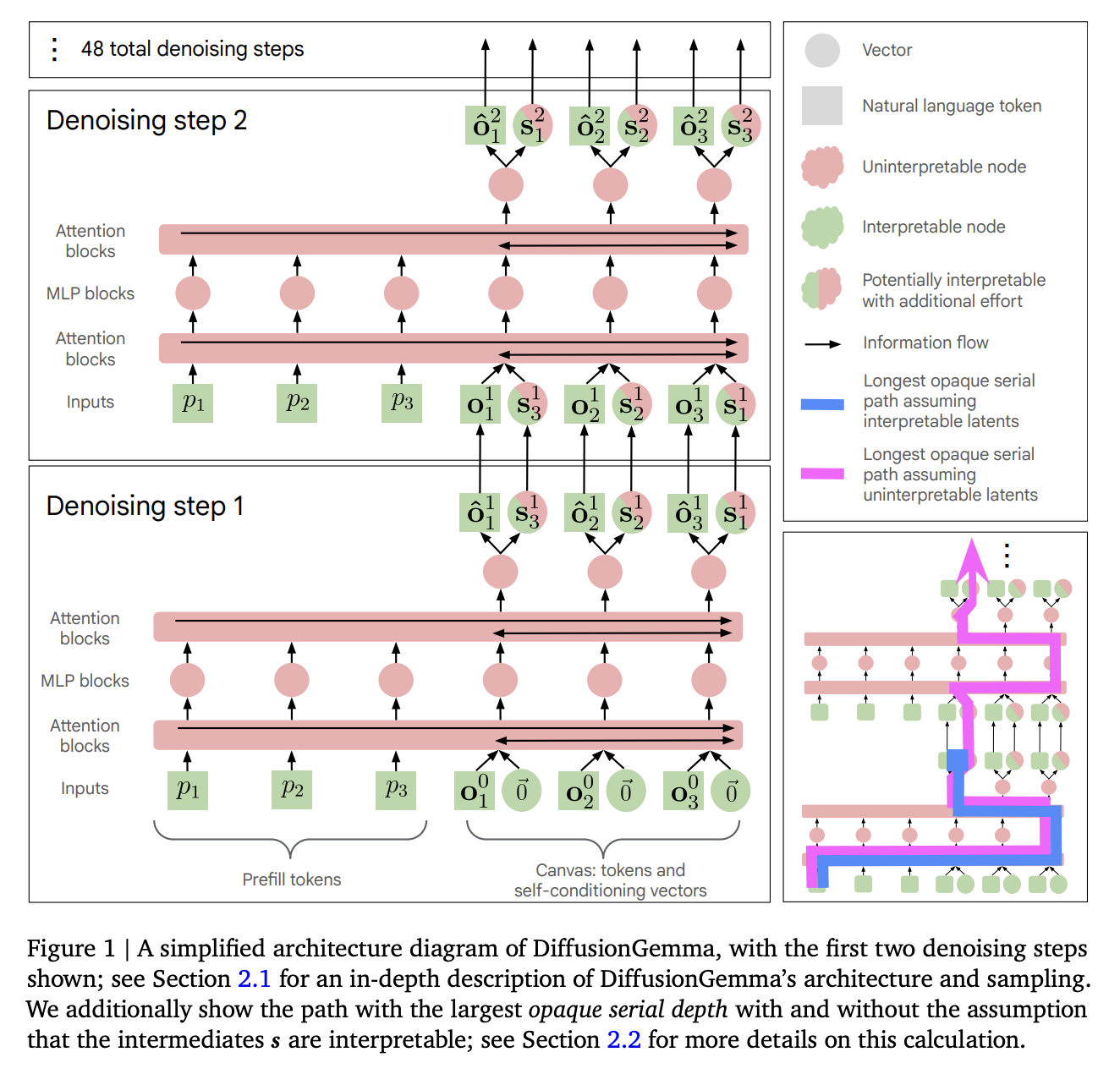
Learn why text diffusion models are harder to interpret than standard LLMs and how to audit their reasoning.
30-Second TL;DR
What Changed
DiffusionGemma achieves similar variable transparency to Gemma using logit lens techniques.
Why It Matters
This research highlights the difficulty of monitoring latent reasoning in non-autoregressive models, which could impact future safety protocols for advanced AI architectures.
What To Do Next
Review the 24 open problems listed in the paper to identify potential research directions for your own interpretability projects.
Key Points
- •DiffusionGemma achieves similar variable transparency to Gemma using logit lens techniques.
- •Algorithmic transparency is lower in diffusion models because they generate tokens in a single 'canvas' rather than sequentially.
- •The study identifies unique phenomena like non-chronological reasoning and token smearing in text diffusion.
- •Researchers provided 24 open problems to advance the field of interpretability in non-autoregressive architectures.
Deep Insight
AI-generated analysis for this event — not the original article.
Enhanced Key Takeaways
- •The study utilized mechanistic interpretability techniques, specifically Sparse Autoencoders (SAEs), to map internal activations to human-interpretable concepts within the diffusion process.
- •DiffusionGemma operates by iteratively refining a sequence of latent representations, which contrasts with the single-pass token prediction used in standard autoregressive Gemma models.
- •The research highlights that 'token smearing' occurs because diffusion models distribute semantic information across the entire sequence simultaneously rather than localizing it to specific tokens.
- •The audit suggests that current interpretability tools designed for Transformers may require significant architectural adjustments to account for the iterative denoising steps inherent in diffusion-based text generation.
- •Google DeepMind's release of the 24 open problems aims to foster a standardized benchmark for evaluating 'faithfulness' in interpretability methods across non-autoregressive architectures.
Competitor Analysis
- DiffusionGemma
- Iterative Denoising
- Standard Autoregressive LLMs (e.g., GPT-4, Llama 3)
- Sequential Token Prediction
- Stable Diffusion (Text-based variants)
- Iterative Denoising
- DiffusionGemma
- High (via SAEs)
- Standard Autoregressive LLMs (e.g., GPT-4, Llama 3)
- High (Well-studied)
- Stable Diffusion (Text-based variants)
- Moderate (Complex latent space)
- DiffusionGemma
- Research/Transparency
- Standard Autoregressive LLMs (e.g., GPT-4, Llama 3)
- General Purpose/Chat
- Stable Diffusion (Text-based variants)
- Image/Text Generation
- DiffusionGemma
- Transparency-focused
- Standard Autoregressive LLMs (e.g., GPT-4, Llama 3)
- Performance-focused
- Stable Diffusion (Text-based variants)
- Quality-focused
| Feature | DiffusionGemma | Standard Autoregressive LLMs (e.g., GPT-4, Llama 3) | Stable Diffusion (Text-based variants) |
|---|---|---|---|
| Generation Process | Iterative Denoising | Sequential Token Prediction | Iterative Denoising |
| Interpretability | High (via SAEs) | High (Well-studied) | Moderate (Complex latent space) |
| Primary Use Case | Research/Transparency | General Purpose/Chat | Image/Text Generation |
| Benchmarks | Transparency-focused | Performance-focused | Quality-focused |
Technical Deep Dive
- Architecture: Based on the Gemma 2B backbone, adapted for diffusion-based text generation.
- Training Objective: Uses a discrete diffusion process where the model learns to predict the noise added to token embeddings.
- Latent Space: Operates on a continuous embedding space that is discretized during the final decoding phase.
- Interpretability Method: Employs Sparse Autoencoders (SAEs) trained on intermediate denoising steps to decompose activations into interpretable features.
- Reasoning Mechanism: Utilizes 'intermediate-context reasoning' where the model refines the entire sequence context across multiple denoising iterations.
Future ImplicationsAI analysis grounded in cited sources
Timeline
- 2024-02Google releases the initial Gemma open-model family.
- 2024-05Google DeepMind introduces DiffusionGemma as a research-focused text diffusion model.
- 2025-03Researchers commence the transparency audit focusing on mechanistic interpretability of diffusion architectures.
- 2026-06Publication of the Transparency Audit of Google's DiffusionGemma Model on the AI Alignment Forum.
Weekly AI Recap
Read this week's curated digest of top AI events →
AI-curated news aggregator. All content rights belong to original publishers.
Original source: AI Alignment Forum ↗
This is a summary, not the original. Read the source, or get the weekly briefing.
The weekly digest
One email a week. Unsubscribe anytime.