Training Data Becomes AI's New Bottleneck
💡Data scarcity, copyright risk, and synthetic alternatives may redefine who controls AI model economics.
⚡ 30-Second TL;DR
What Changed
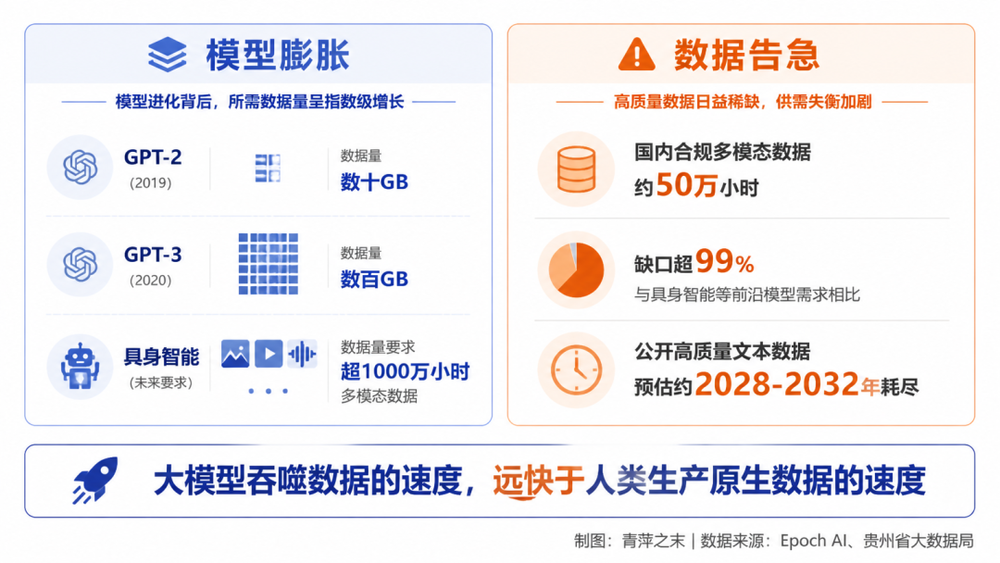
High-quality public text may face significant shortages from the late 2020s to the early 2030s.
Why It Matters
AI companies may increasingly compete not only for GPUs but also for exclusive, clean, and legally authorized datasets. Content companies could capture more value, although ownership fragmentation and weak data-processing capabilities mean that merely holding copyrights will not guarantee pricing power.
What To Do Next
Audit your training and RAG datasets separately, document provenance and licenses for every source, and test a filtered synthetic-data mix before expanding paid-content procurement.
Key Points
- •High-quality public text may face significant shortages from the late 2020s to the early 2030s.
- •Embodied AI may require at least 10 million hours of multimodal data, while reported compliant domestic physical-interaction data is only about 500,000 hours.
- •AI-generated training data can contribute to model collapse when reused without filtering, deduplication, and human-data mixing.
- •Copyright publishers are becoming potential AI data suppliers, but ownership rights, token attribution, cleaning, labeling, and compliance remain major barriers.
- •Synthetic data, MoE architectures, curriculum learning, RAG, and continuous learning offer alternatives to consuming ever more original human data.
🧠 Deep Insight
AI-generated analysis for this event.
🔑 Enhanced Key Takeaways
- •The 'Data Wall' phenomenon is driving a shift toward 'Data-Centric AI,' where researchers prioritize data quality and curation over sheer volume to mitigate the diminishing returns of scaling laws.
- •Major AI labs are increasingly utilizing 'Data Flywheels' where models are used to automatically label, clean, and filter raw data, reducing the reliance on expensive human-in-the-loop annotation.
- •The emergence of 'Data Markets' and licensing deals between AI companies and media conglomerates (e.g., Reddit, News Corp) has established a precedent for valuing training data based on token-level utility rather than flat fees.
- •Research into 'Neural Data Compression' suggests that models may eventually be able to learn more efficiently from smaller, highly compressed datasets, potentially alleviating the demand for massive raw data ingestion.
- •Privacy-preserving techniques such as Differential Privacy and Federated Learning are being integrated into training pipelines to allow the use of sensitive, non-public data without violating regulatory compliance.
🛠️ Technical Deep Dive
- Synthetic Data Augmentation: Techniques like Rejection Sampling and Self-Correction are used to filter out low-quality synthetic outputs before they are fed back into training loops to prevent model collapse.
- Mixture of Experts (MoE): By activating only a subset of parameters per token, MoE architectures reduce the computational cost of training, allowing models to achieve high performance with less data density.
- Curriculum Learning: Models are trained on progressively more complex data subsets, which has been shown to improve convergence rates and data efficiency compared to random sampling.
- Retrieval-Augmented Generation (RAG): By offloading knowledge to external, updatable databases, RAG reduces the need for models to 'memorize' vast amounts of data during pre-training.
🔮 Future ImplicationsAI analysis grounded in cited sources
⏳ Timeline
Weekly AI Recap
Read this week's curated digest of top AI events →
👉Related Updates



AI-curated news aggregator. All content rights belong to original publishers.
Original source: 虎嗅 ↗