Token Prices Give Way to Task Economics
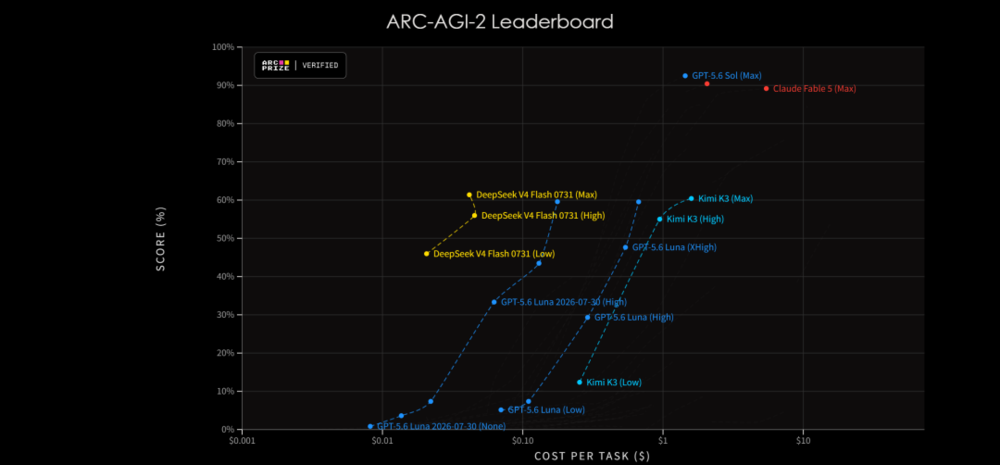
💡Model prices are diverging—learn why task cost, compute scarcity, and user scale now matter more than tokens.
⚡ 30-Second TL;DR
What Changed
DeepSeek has announced a potentially large API price increase but has not yet disclosed the exact adjustment.
Why It Matters
For AI builders, raw token price is becoming a less reliable proxy for application economics. Teams should evaluate models by cost per completed workflow, latency, reliability, and capacity availability rather than by token pricing alone.
What To Do Next
Benchmark your production workflow across DeepSeek API, GPT-5.6-Luna-0730, and Kimi-K3 using cost per successful task, not cost per million tokens.
Key Points
- •DeepSeek has announced a potentially large API price increase but has not yet disclosed the exact adjustment.
- •Kimi-K3 reportedly costs $1.59 per ARC-AGI-2 task, compared with $0.18 for GPT-5.6-Luna-0730 at similar benchmark performance.
- •DeepSeek-V4-Flash-0731 is cited at $0.042 per task, leaving room for a substantial price increase while remaining cheaper than competing models.
- •Higher prices may be used to allocate scarce inference capacity toward users with stronger willingness to pay and higher-value workloads.
- •OpenAI emphasizes user scale and platform reach, while Anthropic focuses on high-value professional tasks.
🧠 Deep Insight
AI-generated analysis for this event.
🔑 Enhanced Key Takeaways
- •The shift toward task-based pricing is driven by the 'Inference Bottleneck,' where high-demand models like DeepSeek-V4 are experiencing GPU cluster saturation, forcing providers to prioritize high-margin enterprise traffic over low-margin consumer API usage.
- •Chinese AI providers are increasingly adopting 'Dynamic Capacity Allocation' (DCA) algorithms, which adjust API costs in real-time based on current network congestion and the specific computational complexity of the user's prompt.
- •Industry data suggests that the cost-per-task metric is becoming the primary KPI for enterprise procurement departments, effectively replacing 'tokens-per-dollar' as the standard for evaluating LLM ROI.
- •DeepSeek's pricing strategy is influenced by the 'Compute-to-Revenue' ratio, a new financial metric used by Chinese AI labs to ensure that inference costs do not exceed 30% of the revenue generated by a specific model deployment.
- •OpenAI and Anthropic are countering the task-economics trend by bundling inference with proprietary 'Agentic Frameworks,' effectively hiding the underlying compute costs within subscription-based platform fees.
📊 Competitor Analysis▸ Show
| Feature | DeepSeek-V4-Flash | GPT-5.6-Luna | Kimi-K3 | Anthropic-Opus-X |
|---|---|---|---|---|
| Pricing Model | Task-Based (Dynamic) | Token-Based (Fixed) | Task-Based (Fixed) | Subscription/Task Hybrid |
| ARC-AGI-2 Cost | $0.042 | $0.18 | $1.59 | $0.22 |
| Primary Focus | Throughput/Efficiency | Ecosystem/Scale | High-Value Reasoning | Professional Workflow |
🛠️ Technical Deep Dive
- DeepSeek-V4 utilizes a Mixture-of-Experts (MoE) architecture with dynamic routing that optimizes for task-specific latency rather than raw token throughput.
- The task-based pricing engine integrates with the model's inference scheduler to calculate the 'Compute-Intensity Score' (CIS) of a prompt before execution.
- Inference capacity is managed via a tiered priority queue where high-value tasks are routed to H100/B200 clusters, while low-priority tasks are offloaded to older, more efficient hardware.
🔮 Future ImplicationsAI analysis grounded in cited sources
⏳ Timeline
Weekly AI Recap
Read this week's curated digest of top AI events →
👉Related Updates


AI-curated news aggregator. All content rights belong to original publishers.
Original source: 虎嗅 ↗