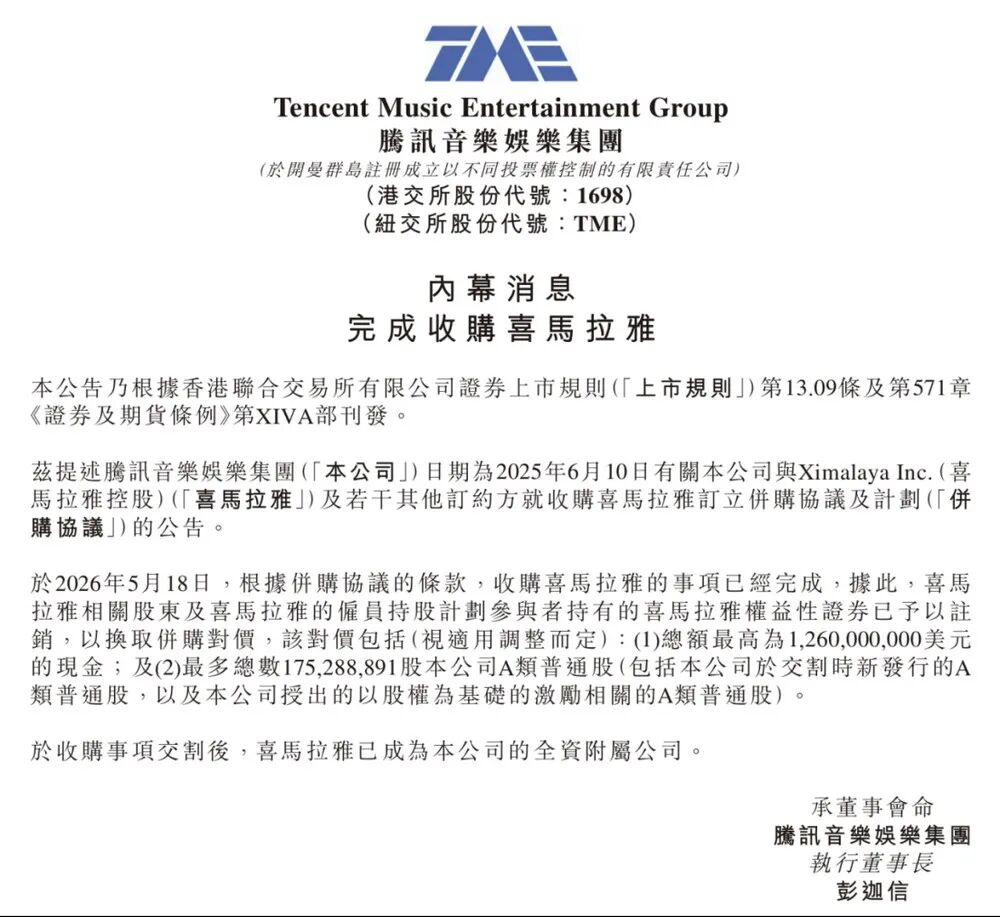
TME acquires Ximalaya for 18.6 billion RMB
💡Major M&A in the Chinese audio tech sector; impacts content accessibility and market competition for AI audio models.
⚡ 30-Second TL;DR
What Changed
TME paid 1.26 billion USD in cash and 175 million Class A shares for Ximalaya.
Why It Matters
This consolidation marks the end of the independent growth phase for China's largest audio platform and signals a shift toward integrated audio ecosystems under TME.
What To Do Next
Monitor TME's API and platform integration strategies to see if audio content becomes more accessible for cross-platform AI training.
Key Points
- •TME paid 1.26 billion USD in cash and 175 million Class A shares for Ximalaya.
- •Regulatory approval was granted with five specific conditions, including non-exclusive licensing and fair pricing.
- •The acquisition aims to fill TME's gap in long-form audio, podcasts, and in-car audio ecosystems.
🧠 Deep Insight
Web-grounded analysis with 13 cited sources.
🔑 Enhanced Key Takeaways
- •The acquisition was valued at approximately USD 2.9 billion in total, comprising USD 1.26 billion in cash and TME Class A ordinary shares, a figure higher than earlier reports of USD 2.4 billion.
- •China's State Administration for Market Regulation (SAMR) granted conditional approval on May 12, 2026, after a nearly year-long review, specifically prohibiting new exclusive licensing agreements for online audio content and mandating the termination of existing ones.
- •Ximalaya, despite being a market leader with 40-50% share in China's online audio playback market in 2024, had a history of financial losses and made multiple unsuccessful attempts to go public between 2021 and 2024 before this acquisition.
- •The regulatory conditions also explicitly bar the combined entity from bundling audio or music streaming services for carmakers and from restricting Ximalaya's content creators from distributing their works on other platforms.
📊 Competitor Analysis▸ Show
| Platform | Primary Content Focus | Content Generation Model | Key Monetization |
|---|---|---|---|
| Ximalaya (now TME subsidiary) | Long-form audio (audiobooks, podcasts, radio) | Professionally generated, authorized content (70% of China's audiobook copyrights) | Subscriptions, advertising, livestreaming |
| QingTing FM | Online radio, podcasts | Professional podcasting, international content | Subscriptions, advertising |
| Lizhi FM | Podcasts | User-generated content | User-generated content monetization |
| Fanqie Changting (ByteDance) | Audio versions of text content (novels) | Converts text to audio | Free-to-listen (ad-supported) |
| NetEase Cloud Music | Music streaming, some audio content | Licensed music, some audio content | Subscriptions, digital sales, advertising |
🔮 Future ImplicationsAI analysis grounded in cited sources
⏳ Timeline
📎 Sources (13)
Factual claims are grounded in the sources below. Forward-looking analysis is AI-generated interpretation.
Weekly AI Recap
Read this week's curated digest of top AI events →
👉Related Updates


AI-curated news aggregator. All content rights belong to original publishers.
Original source: 虎嗅 ↗