Thunderbird Bets on AI Display Glasses
💡Thunderbird leads AR shipments, but Meta's AI glasses reveal where the market—and developer opportunity—is moving.
⚡ 30-Second TL;DR
What Changed
Thunderbird iO AI Glasses weigh 34 grams and launched at a limited-time price of 2,349 yuan, or 1,996.7 yuan with a subsidy.
Why It Matters
The launch signals that smart-glasses competition is moving from display hardware toward AI assistance, ecosystem integration, and natural-language interaction. Thunderbird may gain differentiation from its optical expertise, but its path to sustainable profits remains uncertain because of low pricing, heavy fundraising, and dependence on partners.
What To Do Next
Benchmark iO's display-based workflow against camera-and-audio devices such as Ray-Ban Meta, focusing on latency, translation accuracy, battery life, and SDK access before building on the platform.
Key Points
- •Thunderbird iO AI Glasses weigh 34 grams and launched at a limited-time price of 2,349 yuan, or 1,996.7 yuan with a subsidy.
- •The glasses omit cameras and speakers while adding binocular monochrome display, AI memory, translation, and teleprompting.
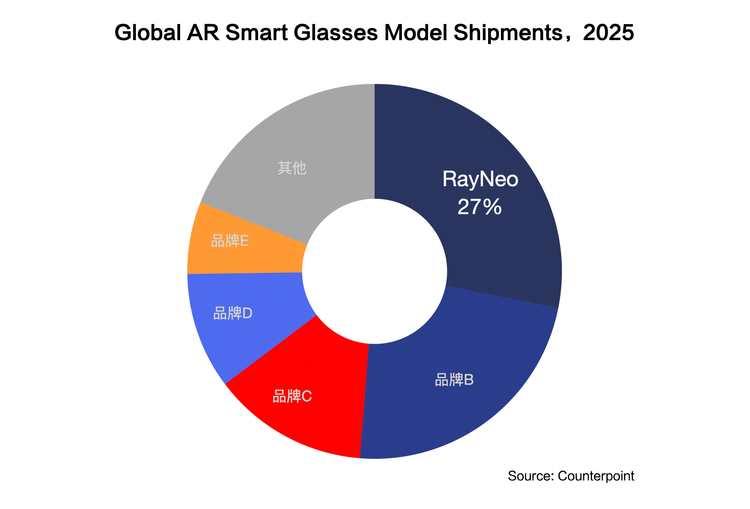
- •Thunderbird held 27% of global AR glasses shipments in 2025, but the total AR market was only about 1.06 million units.
- •Global AI glasses shipments reached 8.7 million units in 2025, with Meta accounting for 85.2% of the market.
- •Thunderbird's strategy relies on optical-display expertise, while external partners provide much of its large-model and ecosystem functionality.
🧠 Deep Insight
Background and context from public sources — not the original article. 12 sources cited.
🔑 Enhanced Key Takeaways
- •RayNeo secured the largest Series C funding round in China's AI+AR sector in 2025, backed by major telecom operators China Mobile and China Unicom.
- •The company's product roadmap classifies devices into three distinct tiers: non-display AI glasses, audio/video-focused AR glasses, and integrated AI+AR glasses like the X3 Pro.
- •RayNeo maintains a competitive edge as the only AR firm with fully in-house optical R&D and mass-production capabilities, specifically for binocular full-color MicroLED displays.
- •Industry data indicates that high return rates for smart glasses (47%–53%) are primarily driven by excessive weight and poor battery life, which the iO series aims to mitigate.
- •The iO glasses utilize a multi-model AI strategy, allowing users to toggle between various LLMs including Gemini, ChatGPT, Claude, and DeepSeek via a companion app.
📊 Competitor Analysis▸ Show
| Feature | RayNeo iO | Meta Ray-Ban (Gen 2) | Xiaomi Mijia Smart Glasses |
|---|---|---|---|
| Display | Binocular Monochrome | None | Binocular Monochrome |
| Camera | No | Yes | Yes |
| Weight | 34g | ~49g | ~51g |
| Pricing | ~2,349 CNY | ~$299 USD | ~2,699 CNY |
🛠️ Technical Deep Dive
- Architecture: Utilizes a dual-chip design to separate low-power standby tasks from high-performance AI reasoning to optimize battery longevity.
- Display: Employs binocular monochrome green display technology optimized for productivity and teleprompting.
- Integration: Relies on a companion smartphone application to bridge the glasses with external cloud-based LLMs.
- Manufacturing: Leverages in-house optical engine production to maintain cost control and supply chain stability.
🔮 Future ImplicationsAI analysis grounded in cited sources
⏳ Timeline
📎 Sources (12)
Factual claims are grounded in the sources below. Forward-looking analysis is AI-generated interpretation.
Weekly AI Recap
Read this week's curated digest of top AI events →
👉Related Updates

AI-curated news aggregator. All content rights belong to original publishers.
Original source: 虎嗅 ↗
This is a summary, not the original. Read the source, or get the weekly briefing.
Weekly AI briefing
One email a week. Unsubscribe anytime.