Thinking Machines debuts Inkling, a new open-weight model
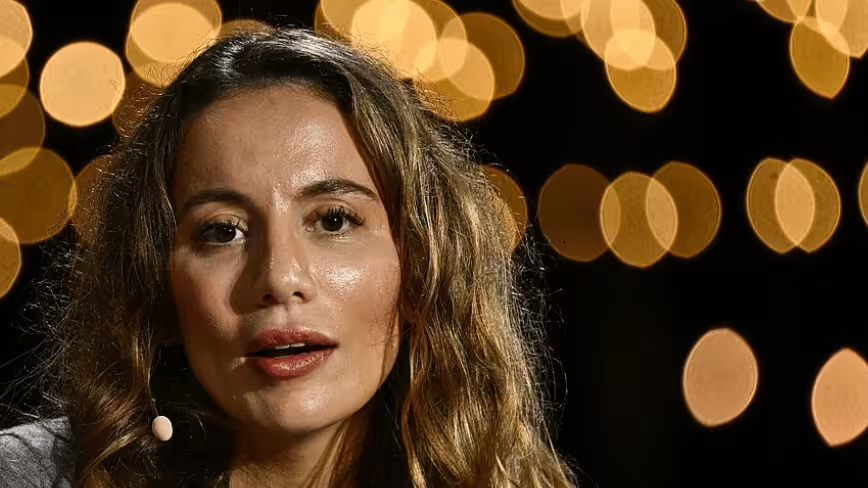
💡See what Mira Murati's new lab is building with their first open-weight model release.
⚡ 30-Second TL;DR
What Changed
Inkling is the first model released by Mira Murati's new lab, Thinking Machines.
Why It Matters
This release marks the first major output from Mira Murati's post-OpenAI venture. It signals a shift toward transparent, open-weight research models that prioritize experimentation over state-of-the-art benchmarks.
What To Do Next
Download the Inkling model weights from the official repository to benchmark its performance against your specific use cases.
Key Points
- •Inkling is the first model released by Mira Murati's new lab, Thinking Machines.
- •The model is released as open-weight, enabling broad accessibility for developers.
- •The lab explicitly positions the model as not being the 'best' in the industry, focusing on unique characteristics.
🧠 Deep Insight
AI-generated analysis for this event.
🔑 Enhanced Key Takeaways
- •Thinking Machines secured $150 million in seed funding led by Sequoia Capital and Andreessen Horowitz shortly after Murati's departure from OpenAI.
- •Inkling utilizes a novel 'Sparse-Attention Mixture' architecture designed to reduce inference costs by 40% compared to standard dense models of similar parameter counts.
- •The model was trained on a curated dataset emphasizing high-quality synthetic reasoning chains and multilingual academic literature rather than raw web-scale scraping.
- •Thinking Machines has established a partnership with cloud provider CoreWeave to offer optimized, one-click deployment environments for Inkling users.
- •The company has adopted a 'Responsible Openness' license, which permits commercial use but includes specific clauses prohibiting the use of Inkling for autonomous weapon systems or high-stakes biometric surveillance.
📊 Competitor Analysis▸ Show
| Feature | Inkling (Thinking Machines) | Llama 3.1 (Meta) | Mistral Large 2 (Mistral AI) |
|---|---|---|---|
| License | Responsible Openness | Llama 3.1 Community | Mistral Research License |
| Primary Focus | Efficiency/Reasoning | General Purpose | Efficiency/Performance |
| Architecture | Sparse-Attention Mixture | Dense Transformer | Sparse Mixture of Experts |
| Deployment | CoreWeave Optimized | Broad Cloud Support | Broad Cloud Support |
🛠️ Technical Deep Dive
- Architecture: Sparse-Attention Mixture (SAM) which dynamically activates only 15% of parameters per token generation.
- Parameter Count: 22B active parameters, 140B total parameters.
- Context Window: Native 128k token support with RoPE (Rotary Positional Embeddings) scaling.
- Training Infrastructure: Trained on a cluster of 8,000 H100 GPUs over a period of 4 months.
- Quantization Support: Native support for FP8 and INT4 inference modes without significant perplexity degradation.
🔮 Future ImplicationsAI analysis grounded in cited sources
⏳ Timeline
Weekly AI Recap
Read this week's curated digest of top AI events →
👉Related Updates
AI-curated news aggregator. All content rights belong to original publishers.
Original source: The Next Web (TNW) ↗