The Three Chokepoints in Semiconductor Manufacturing
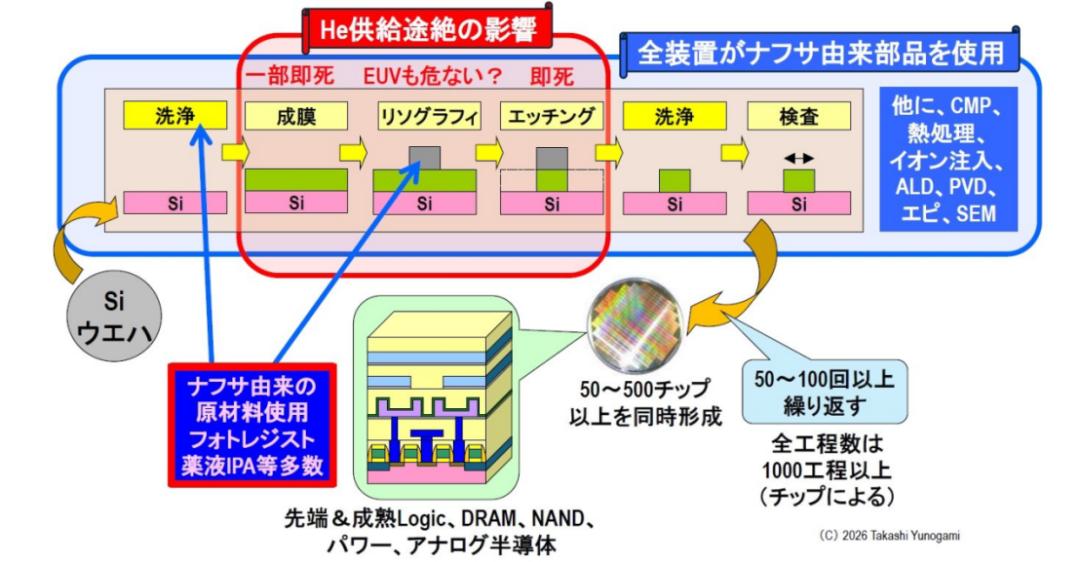
AI-chip capacity depends on obscure materials; this article identifies three supply-chain chokepoints worth tracking.
30-Second TL;DR
What Changed
Helium is treated as a critical industrial gas dependency for semiconductor manufacturing.
Why It Matters
Material shortages or price volatility could increase the cost and lead time of AI-chip production. AI infrastructure builders should treat semiconductor inputs as operational risks, not merely procurement details.
What To Do Next
Add helium, naphtha-derived chemicals, and photoresist to your AI-hardware supply-risk register and assign alternate-source owners.
Key Points
- •Helium is treated as a critical industrial gas dependency for semiconductor manufacturing.
- •Naphtha connects semiconductor production to upstream petrochemical supply chains.
- •Photoresist availability directly affects lithography-related manufacturing processes.
- •The article evaluates supply-chain vulnerabilities rather than announcing a specific product launch.
Deep Insight
AI-generated analysis for this event — not the original article.
Enhanced Key Takeaways
- •Helium supply is increasingly constrained by geopolitical instability in major producing nations like Qatar and Russia, forcing semiconductor firms to invest in helium recovery and recycling systems to mitigate price volatility.
- •Naphtha's role in semiconductor manufacturing is primarily as a feedstock for producing high-purity solvents and precursors used in wafer cleaning and etching, linking the industry's cost structure directly to global crude oil price fluctuations.
- •Photoresist supply chains are highly concentrated, with Japanese firms like JSR Corporation, Tokyo Ohka Kogyo, and Shin-Etsu Chemical controlling over 80% of the global market for advanced EUV and ArF photoresists.
- •The industry is shifting toward 'circular supply chains' for specialty gases, where manufacturers are increasingly co-locating gas purification plants directly at mega-fab sites to reduce logistics-related contamination risks.
- •Advanced lithography processes require photoresists with extreme purity levels (parts-per-trillion), making the supply chain vulnerable to even minor disruptions in the production of specialized photo-acid generators (PAGs).
Technical Deep Dive
- Helium usage: Primarily utilized as a cooling agent in cryogenics and as a purge gas for high-temperature processes to prevent oxidation and ensure thermal uniformity during wafer processing.
- Naphtha derivatives: Used in the synthesis of photoresist polymers and as a carrier solvent for chemical mechanical planarization (CMP) slurries.
- Photoresist composition: Consists of a polymer resin, a photo-acid generator (PAG), and a solvent; advanced EUV resists require specific molecular weight distributions to achieve sub-7nm resolution.
- Contamination sensitivity: Semiconductor-grade materials require metallic impurity levels below 10 parts per trillion (ppt) to prevent yield-killing defects on advanced nodes.
Future ImplicationsAI analysis grounded in cited sources
Timeline
- 2019-07Japan imposes export restrictions on photoresists to South Korea, highlighting the fragility of the global supply chain.
- 2022-02Global helium shortages intensify due to the shutdown of major processing plants, impacting semiconductor manufacturing lead times.
- 2023-09Major semiconductor manufacturers begin formalizing long-term supply agreements for photoresist precursors to avoid market volatility.
- 2025-04Industry-wide adoption of advanced helium recycling technology reaches record levels in new 2nm-class fab construction projects.
Weekly AI Recap
Read this week's curated digest of top AI events →
AI-curated news aggregator. All content rights belong to original publishers.
Original source: 钛媒体 ↗
This is a summary, not the original. Read the source, or get the weekly briefing.
The weekly digest
One email a week. Unsubscribe anytime.