The Technical Reality of AI Agent Skills
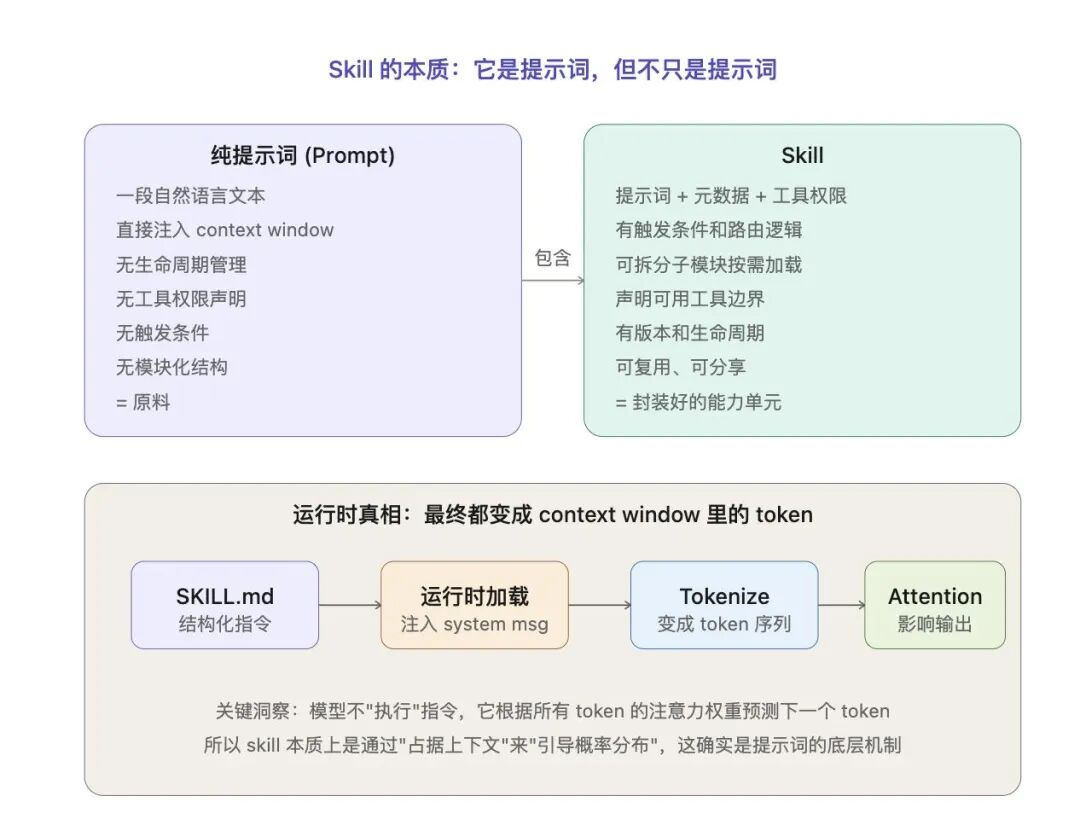
💡Learn why most AI 'Skills' are just glorified prompts and how to build actual agentic infrastructure.
⚡ 30-Second TL;DR
What Changed
Skills function as 'gravity fields' in the attention mechanism, influencing token probability distributions.
Why It Matters
Understanding that Skills are essentially managed prompts allows developers to build more robust agentic workflows. It shifts the focus from 'writing long prompts' to 'architecting efficient, modular, and permission-aware agent systems'.
What To Do Next
Audit your existing agent prompts; replace vague qualitative instructions with specific, verifiable data structures to increase information density.
Key Points
- •Skills function as 'gravity fields' in the attention mechanism, influencing token probability distributions.
- •Excessive prompt length in Skills wastes context window space and dilutes the model's focus.
- •The true value of a Skill lies in its external metadata, such as trigger routing, tool permissions, and modular loading.
- •Effective Skills prioritize information density over verbose instructions to optimize model performance.
🧠 Deep Insight
Web-grounded analysis with 31 cited sources.
🔑 Enhanced Key Takeaways
- •AI agent skills are fundamentally implemented through 'function calling' or 'tool use,' where the Large Language Model (LLM) generates a structured output (e.g., JSON) that an external application then executes, rather than the LLM performing the action itself.
- •Effective skill management employs 'dynamic context management' and 'progressive loading,' meaning that only essential metadata is loaded initially, while detailed instructions and resources are pulled into the context window on-demand when a skill is triggered, optimizing token usage and focus.
- •The portability and reusability of AI agent skills are enhanced by standardized formats, such as the SKILL.md file, which defines trigger conditions, workflows, and supporting resources, allowing skills to be shared and utilized across various AI platforms and tools.
- •The evolution of AI agents increasingly involves multi-agent systems, where specialized agents collaborate and coordinate using these skills, often orchestrated by frameworks that manage state, communication, and task delegation.
- •Beyond prompt engineering, developing production-ready AI agents with robust skills necessitates a broader 'agent engineering' discipline, encompassing expertise in system design, retrieval engineering (RAG), reliability, security, and observability to ensure real-world viability.
📊 Competitor Analysis▸ Show
AI Agent Orchestration Frameworks and Platforms
| Feature/Platform | LangChain/LangGraph | Microsoft AutoGen | CrewAI | Semantic Kernel | OpenAI Agents SDK | Google ADK |
|---|---|---|---|---|---|---|
| Orchestration Pattern | Graph-based, stateful workflows | Conversational, multi-agent collaboration | Role-based team automation | Enterprise integration, plugin-based | OpenAI-centric, custom GPTs, function calling | Hierarchical, multi-agent orchestration |
| Language Support | Python, JS | Python, C# | Python | C#, Python, Java | Python, JS (via OpenAI API) | Python, TS |
| Multi-Agent Support | Strong | Strong | Strong | Adequate | Strong (via Swarm) | Strong |
| Memory/State Management | Explicit state management, checkpointing | Dynamic conversation state | Built-in memory (ChromaDB + SQLite), external backends | Integrates with external memory | Context management | Session management |
| Tool Integration | Modular, reusable tools, API chaining | Supports various tools | Role-specific tools | Plugins for external services | Function calling, code interpreter | Action groups, knowledge bases |
| Best For | Highly customized, complex agent systems with precise control | Complex workflows requiring multiple specialized agents to collaborate | Teams needing multi-agent capabilities with intuitive role-based structure | Enterprise organizations integrating AI agents into existing software ecosystems | Users already in the OpenAI stack, rapid development | Gemini-powered apps, native interoperability |
| Open Source | Yes | Yes | Yes | Yes | No (SDK is, underlying models/features are proprietary) | No (ADK is, underlying models/features are proprietary) |
| Key Differentiator | Graph-based control for stateful, cyclic workflows | Dynamic conversational orchestration | Intuitive role-based approach for team-based systems | Strong enterprise integration, plugin model | Tight integration with OpenAI models and ecosystem | Multi-agent orchestration for Gemini-powered applications |
🛠️ Technical Deep Dive
- Function Calling Mechanism: When an LLM utilizes a 'skill' or 'tool,' it typically involves a process where the LLM analyzes user input, identifies the need for an external action, and then generates a structured output (often JSON) containing the function name and its required arguments. The LLM itself does not execute this function; instead, an external application or runtime environment receives this structured output, deserializes it, and then executes the actual function or API call.
- Model Training for Tool Use: LLMs are fine-tuned on datasets that include extensive code examples and modified text corpuses to effectively detect when a function needs to be called and to accurately format the necessary arguments. This training enables them to understand function definitions and the expected outputs of tools.
- Context Management and Progressive Loading: To optimize the limited context window, advanced skill systems employ progressive loading. This means that only minimal metadata about available skills is initially presented to the LLM. When a specific task requires a skill, its full instructions and supporting resources are dynamically loaded into the context, reducing token waste and maintaining focus.
- Orchestration Patterns: AI agent frameworks utilize various architectural patterns for managing skills and agent interactions:
- Graph-based: Frameworks like LangGraph define agents and their interactions as nodes and edges in a graph, allowing for explicit state management and cyclic workflows.
- Conversational: AutoGen models agent collaboration as dynamic message exchanges, where agents delegate tasks and reach consensus through structured dialogue.
- Role-based: CrewAI assigns specific roles, goals, and expertise to agents, enabling predictable and maintainable behavior in team-based systems.
- Interoperability Protocols: Emerging standards like the Model Context Protocol (MCP) and Agent Communication Protocol (ACP) aim to standardize how AI applications connect to external tools and how agents communicate with each other, facilitating dynamic capability discovery and reducing vendor lock-in.
- Skill Definition Format: Skills are often defined in human-readable, structured formats, such as markdown files (e.g., SKILL.md), which include trigger conditions, step-by-step workflows, supporting resources (scripts, templates), and constraints.
🔮 Future ImplicationsAI analysis grounded in cited sources
⏳ Timeline
📎 Sources (31)
Factual claims are grounded in the sources below. Forward-looking analysis is AI-generated interpretation.
- martinfowler.com
- apideck.com
- promptingguide.ai
- anthropic.com
- manus.im
- dev.to
- skill-desktop.com
- kdnuggets.com
- medium.com
- kdnuggets.com
- monday.com
- intuz.com
- medium.com
- medium.com
- gleecus.com
- youtube.com
- olostep.com
- langchain.com
- redis.io
- ninjalabo.ai
- langfuse.com
- medium.com
- amazon.com
- medium.com
- gostoa.dev
- zilliz.com
- substack.com
- coderabbit.ai
- kore.ai
- ibm.com
- galileo.ai
Weekly AI Recap
Read this week's curated digest of top AI events →
👉Related Updates


AI-curated news aggregator. All content rights belong to original publishers.
Original source: 虎嗅 ↗