The rise of LLM Routers: Optimizing AI inference costs
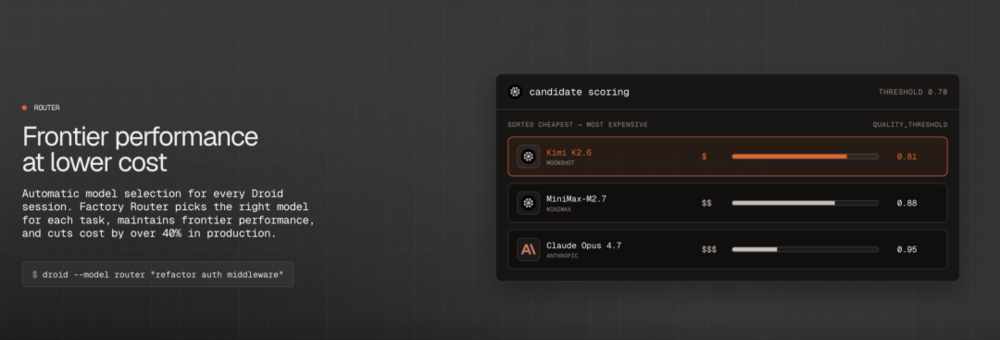
💡Learn how to slash AI inference costs by 25%+ using intelligent model routing and orchestration.
⚡ 30-Second TL;DR
What Changed
LLM Routers act as a critical middleware layer to balance performance and cost by selecting models based on task complexity.
Why It Matters
The shift toward model routing indicates that LLMs are becoming commoditized, moving value from the model layer to the orchestration and infrastructure layer.
What To Do Next
Evaluate LiteLLM or Factory Router to implement cost-aware model switching in your production AI pipeline.
Key Points
- •LLM Routers act as a critical middleware layer to balance performance and cost by selecting models based on task complexity.
- •New routers like Inworld Router incorporate acoustic signals (emotion, hesitation) to decide model routing.
- •Infrastructure-focused routers like LiteLLM are becoming standard gateways for enterprise API management and cost control.
- •Multi-model orchestration projects like Sakana Fugu aim to leverage collective intelligence, though they introduce complexity and latency.
🧠 Deep Insight
AI-generated analysis for this event — not the original article.
🔑 Enhanced Key Takeaways
- •LLM routers are increasingly adopting 'semantic routing' techniques, which use lightweight embedding models (like BGE or E5) to classify incoming prompts by intent before dispatching them to specialized models.
- •The emergence of 'Router-as-a-Service' platforms now includes automated A/B testing capabilities, allowing enterprises to dynamically shift traffic based on real-time latency and error rate monitoring.
- •Advanced routers are integrating 'fallback chains' that automatically retry requests with more powerful models if a smaller, cheaper model fails to meet predefined confidence thresholds or output quality constraints.
- •Data privacy and compliance are driving the development of 'local-first' routers that can route sensitive PII-heavy queries to on-premise models while offloading general tasks to cloud-based APIs.
- •Recent benchmarks indicate that effective routing can reduce total inference expenditure by 40-60% for high-volume applications without statistically significant degradation in task completion quality.
📊 Competitor Analysis▸ Show
| Feature | LiteLLM | RouteLLM | OpenRouter | Inworld Router |
|---|---|---|---|---|
| Primary Focus | API Standardization | Algorithmic Routing | Model Aggregation | Contextual/Acoustic |
| Pricing | Open Source/Managed | Open Source | Usage-based | Proprietary/Integrated |
| Benchmarks | N/A (Gateway) | High (Rank-based) | N/A (Marketplace) | N/A (Specialized) |
🛠️ Technical Deep Dive
- Semantic Routing Architecture: Utilizes a two-stage pipeline where an initial classifier (often a distilled BERT or TinyLlama) maps the prompt to a vector space to determine the optimal model endpoint.
- Confidence Scoring: Implements log-probability analysis of the initial token generation to trigger automatic fallbacks if the model's internal uncertainty exceeds a set threshold.
- Latency Optimization: Employs asynchronous request handling and connection pooling to ensure the routing overhead remains below 10-20ms per request.
- Dynamic Load Balancing: Uses weighted round-robin algorithms combined with real-time health checks to distribute traffic across multiple providers (e.g., OpenAI, Anthropic, Mistral) to mitigate regional outages.
🔮 Future ImplicationsAI analysis grounded in cited sources
⏳ Timeline
Weekly AI Recap
Read this week's curated digest of top AI events →
👉Related Updates



AI-curated news aggregator. All content rights belong to original publishers.
Original source: 虎嗅 ↗
This is a summary, not the original. Read the source, or get the weekly briefing.
The weekly digest
One email a week. Unsubscribe anytime.