The Real Carbon Cost of AI Data Centres
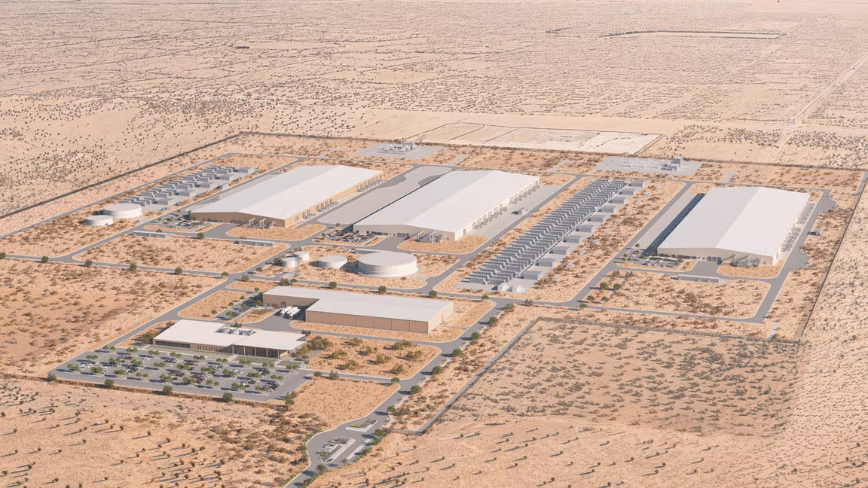
💡See why the viral 24-million-cars claim about AI data-centre emissions may be misleading.
⚡ 30-Second TL;DR
What Changed
A Cornell study estimates the potential emissions from planned US data centres.
Why It Matters
If the projections are directionally accurate, power availability and carbon intensity will become important constraints for AI infrastructure planning. Practitioners should distinguish between estimated operational emissions, grid mix, and broader lifecycle impacts before using the statistic for strategy or communications.
What To Do Next
Recalculate your AI workload’s emissions using regional grid-carbon intensity, expected utilization, and data-centre PUE instead of relying on car-equivalent headlines.
Key Points
- •A Cornell study estimates the potential emissions from planned US data centres.
- •The headline comparison equates the emissions to those of 24 million cars.
- •TNW cautions that the figure has been rounded and may oversimplify the underlying analysis.
🧠 Deep Insight
AI-generated analysis for this event.
🔑 Enhanced Key Takeaways
- •The Cornell study specifically highlights that the surge in data center energy demand is driven by the transition from traditional CPU-based computing to power-intensive GPU-based AI training and inference.
- •Grid decarbonization rates are currently failing to keep pace with the rapid deployment of hyperscale data centers, creating a 'carbon lock-in' effect where new facilities rely on fossil-fuel-heavy baseload power.
- •The 24 million car equivalent figure is derived from projected capacity additions of approximately 35-40 gigawatts (GW) of new data center load in the United States by 2030.
- •Industry analysts note that the Cornell study assumes a 'business-as-usual' scenario for energy procurement, often overlooking corporate Power Purchase Agreements (PPAs) that prioritize renewable energy credits.
- •Regional grid operators, such as PJM Interconnection, have reported that data center load growth is the primary factor forcing the delay of coal plant retirements to maintain grid reliability.
🛠️ Technical Deep Dive
- AI data center power density is increasing from 5-10 kW per rack to 50-100+ kW per rack due to high-performance computing (HPC) requirements.
- Liquid cooling technologies are being implemented to manage the thermal output of high-TDP (Thermal Design Power) GPUs, which significantly alters the Power Usage Effectiveness (PUE) metrics.
- The carbon intensity of AI workloads is heavily dependent on the 'carbon intensity of marginal generation,' which fluctuates based on the time of day and the specific energy mix of the local grid.
- Scope 3 emissions, specifically those embedded in the manufacturing of semiconductors and server hardware, often exceed the operational carbon footprint of the data centers themselves.
🔮 Future ImplicationsAI analysis grounded in cited sources
⏳ Timeline
Weekly AI Recap
Read this week's curated digest of top AI events →
👉Related Updates


AI-curated news aggregator. All content rights belong to original publishers.
Original source: The Next Web (TNW) ↗