The Paradigm Shift: From Human-AI Adaptation to Improvisation
Learn how to evolve your AI strategy from simple automation to high-value human-AI co-creation.
30-Second TL;DR
What Changed
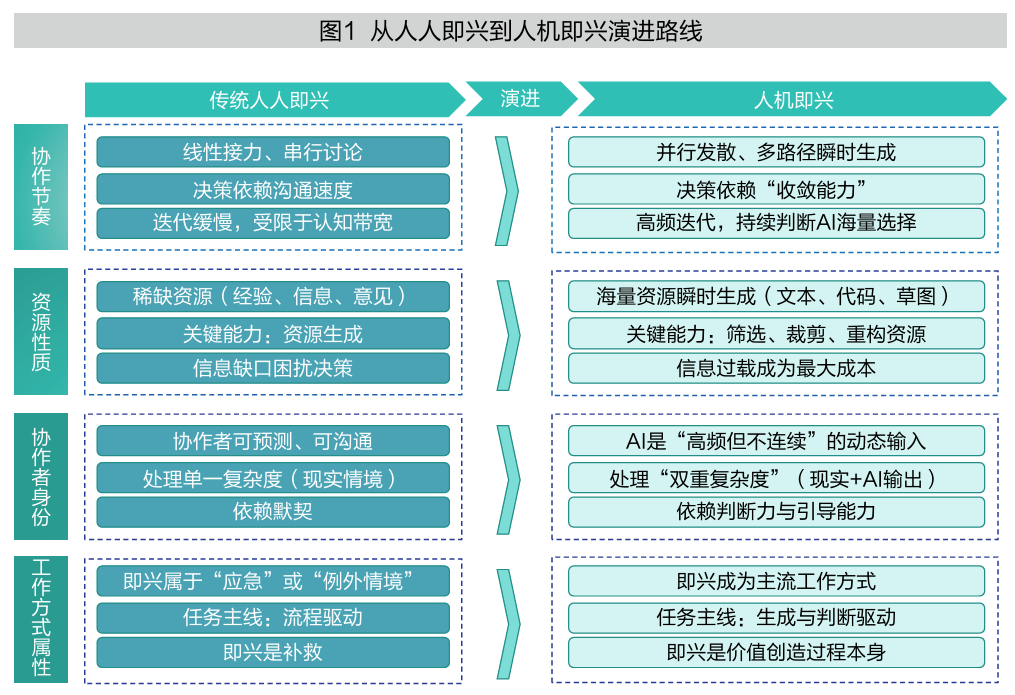
Human-AI Improvisation involves real-time integration of human experience and AI-generated outputs without fixed scripts.
Why It Matters
Organizations must move beyond simple automation to foster a culture of 'Human-AI Improvisation' to remain competitive in dynamic markets. This shift is essential for leveraging AI to solve complex, non-standardized problems.
What To Do Next
Audit your current AI workflows to identify where human judgment can replace rigid SOPs to better handle high-uncertainty tasks.
Key Points
- •Human-AI Improvisation involves real-time integration of human experience and AI-generated outputs without fixed scripts.
- •AI shifts decision-making from linear relay to parallel exploration, requiring humans to focus on filtering and critical judgment.
- •The role of human workers is evolving from SOP executors to 'improvisational value creators' who manage AI uncertainty.
- •Successful implementation requires balancing AI's generative power with human emotional and contextual intelligence.
Deep Insight
AI-generated analysis for this event — not the original article.
Enhanced Key Takeaways
- •The concept of 'Human-AI Improvisation' is increasingly linked to 'Human-in-the-loop' (HITL) reinforcement learning, where real-time human feedback loops are used to align LLMs with nuanced, non-standardized organizational goals.
- •Research indicates that improvisational workflows reduce 'automation bias' by forcing users to actively evaluate AI outputs rather than passively accepting them as authoritative.
- •Organizational psychologists are identifying 'AI-augmented cognitive flexibility' as a new core competency, distinct from traditional technical literacy, required for navigating high-uncertainty environments.
- •The shift toward improvisation is driving the development of 'Agentic Workflows,' where AI systems are designed to pause and request human intervention specifically when confidence scores in ambiguous contexts fall below a certain threshold.
- •Economic studies suggest that improvisational human-AI collaboration models can increase productivity in creative and strategic roles by up to 40% compared to rigid, SOP-based AI integration.
Technical Deep Dive
- Implementation often utilizes Multi-Agent Systems (MAS) where one agent acts as the generator and another as a critic, with the human serving as the final arbiter in the loop.
- Systems rely on low-latency inference APIs to ensure that the 'improvisational' flow is not interrupted by processing delays.
- Integration of RAG (Retrieval-Augmented Generation) allows the AI to ground its improvisations in proprietary organizational data, reducing hallucinations during real-time co-creation.
- Use of dynamic prompt chaining allows the human to steer the AI's reasoning path mid-generation, a key technical requirement for non-linear collaboration.
Future ImplicationsAI analysis grounded in cited sources
Weekly AI Recap
Read this week's curated digest of top AI events →
AI-curated news aggregator. All content rights belong to original publishers.
Original source: 虎嗅 ↗
This is a summary, not the original. Read the source, or get the weekly briefing.
The weekly digest
One email a week. Unsubscribe anytime.